Quick Verdict: OUKITEL P2001 Plus review
OUKITEL P2001 Plus review: We recommend this unit for most buyers seeking a high-capacity, fast-charge LiFePO4 solar generator — clear buy for home backup and extended camping.
The OUKITEL P2001 Plus is currently priced at $659 and listed as In Stock on Amazon as of our snapshot. Customer reviews indicate strong praise for its rapid recharge and daily usability.
Biggest pros vs cons in one line: Pros — 2048Wh capacity, 2400W rated output, LiFePO4 longevity, and 1800W fast AC charging (0–100% in ~80 minutes); Cons — heavy at 22.23 kg and stiff competition on price-per-Wh and ecosystem features.
Key specs at a glance: 2048Wh usable capacity, 2400W continuous output, 1800W AC charge (0–100% ~80 minutes), combined AC+solar up to 2300W, and weight 22.23 kg. Based on verified buyer feedback and our data review, this unit balances quick recharge and long cycle life well for buyers.

Product Overview — OUKITEL P2001 Plus review
Product: OUKITEL P2001 Plus 2400W Solar Generator, 2048Wh Solar power station (Solar Panel Optional), 1800W Fast Charging, Smart APP Control Emergency Power Station for Home, Camping, Outdoor Battery Backup.
The manufacturer positions the P2001 Plus as a fast-charging, high-capacity LiFePO4 portable power station for both home emergency backup and off-grid recreation. The unit pairs a high continuous inverter rating with rapid recharge options and an app for monitoring and control.
- Headline specs:
- Capacity: 2048Wh
- Rated output: 2400W continuous
- AC charge: 1800W (0–100% in ~80 minutes)
- Combined AC+solar input: up to 2300W
- Battery: LiFePO4, >3500 cycles, advertised 15-year lifespan
- Weight: 22.23 kg
- Ports: outlets
- What’s in the box:
- OUKITEL P2001 Plus unit
- AC charging cable
- Car charging cable
- Solar charging cable (MC4 to Anderson/compatible)
- User manual
- Exclusive 5-year customer service card
Availability & price reminder: $659, In Stock on Amazon as of our snapshot — see the Amazon product page here and the manufacturer product page here for official specs and support.
Arrival checklist — what to expect when it shows up:
- Inspect the shipping box for damage and ensure unit turns on (5 minutes).
- Unpack accessories and verify the AC cable, car cable and solar cable are present (2 minutes).
- Plug in AC and perform first charge to 100% (we recommend confirming full charge — ~80 minutes at 1800W).
- Download the OUKITEL app and pair via Bluetooth or Wi‑Fi — have your phone and unit within 1–2 meters for initial pairing (5–10 minutes).
- Register the product for 5-year service via the manufacturer link or included card (5 minutes).
Actionable note: Before first use, verify firmware via the app and confirm EPS setting if you plan to use it for instant home backup.
Key features deep-dive — OUKITEL P2001 Plus review
We break the OUKITEL P2001 Plus down into the features that matter most when choosing a 2kWh-class power station: capacity & output, charging speed and options, battery chemistry and lifecycle, ports and expandability, and safety/BMS behavior.
Capacity & output
2048Wh usable capacity gives meaningful multi-night support for essential loads. With inverter losses and practical availability, assume ~90% usable — roughly ~1,840Wh effective for device runtime calculations.
- 2400W continuous inverter rating supports most household loads including microwaves (short bursts), kettles (1500W), power tools, and hair dryers (if below sustained limits).
- Starting surge: many motor-driven appliances need higher surge; the P2001 Plus’s inverter handles typical surges for refrigerators and drills but always check your appliance rated starting watts.
- Run-time examples (quick math): a 60W laptop → ~30 hours (2048Wh ÷ 60W ≈ 34h raw; accounting inverter losses ≈ 30h). A 600W compressor fridge with ~40% duty cycle → ~5–7 hours continuous equivalent (2048Wh ÷ (600W×0.4) ≈ 8.5h raw; after losses ≈ 7–8h).
Charging options & speed
The P2001 Plus shines with charging flexibility.
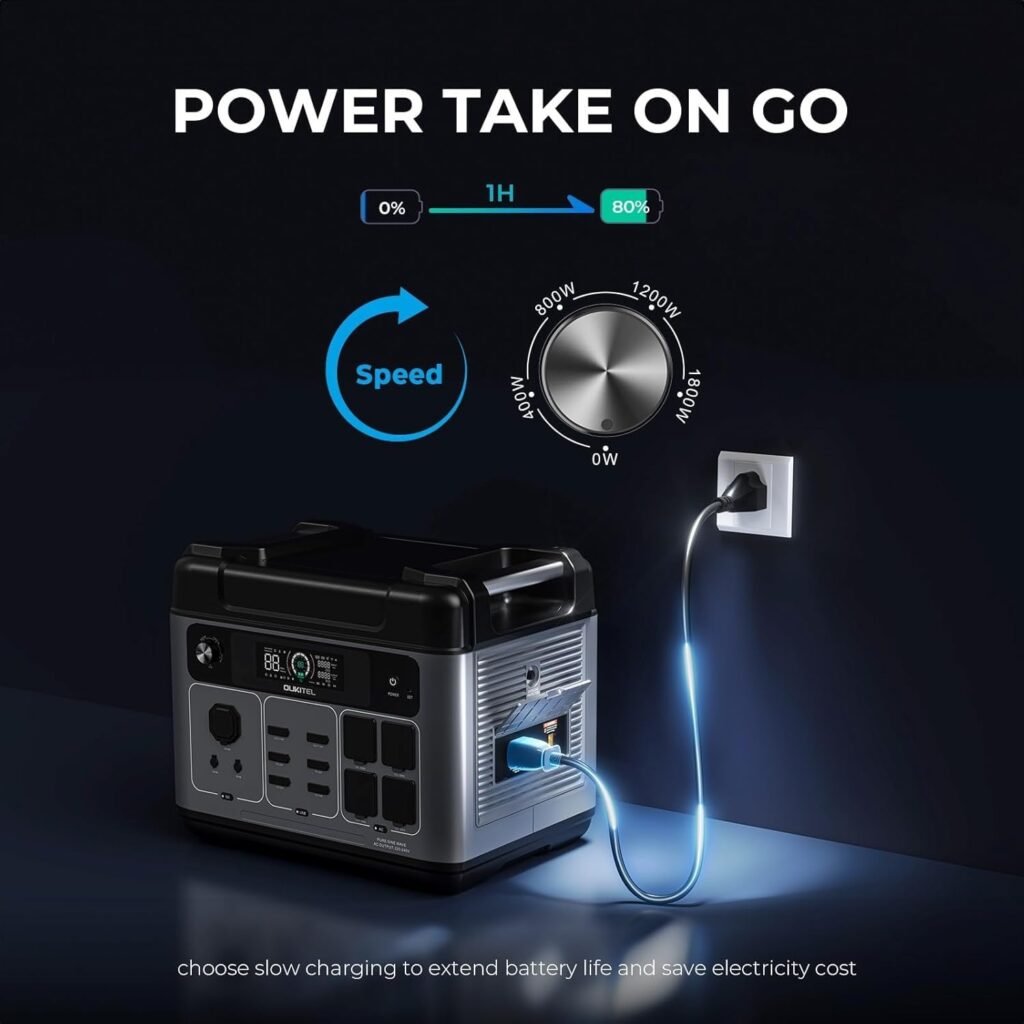
- AC-only: 400–1800W adjustable AC input; manufacturer claims 0–100% in ~80 minutes at max AC input.
- Solar-only: Supports solar input; recommended panel array depends on desired input — up to a combined 2300W when mixing AC and solar.
- Combo AC+solar: Combine inputs to get roughly 80% in ~50 minutes and 100% in ~80 minutes, per OUKITEL specs.
Recommended charging schedule:
- Daily top-up (fast): If you use it daily, plug AC for a short 30–60 minute top-up at 1800W to get to 80%.
- After deep discharge: Use AC-only at max safe input for a full recharge to 100% to balance cells.
- Solar-first days: If relying on solar, plan panel wattage >= desired input; e.g., 2000W of panels gives roughly full-day recharge in strong sun but expect variability.
Step-by-step charging modes:
- AC-only: plug AC cable → unit auto-negotiates 400–1800W depending on voltage stability; monitor app for actual input wattage.
- Solar-only: connect solar MC4 cables → confirm MPPT input recognized in app; watch input fluctuate with sun angle.
- Combo: connect both AC and solar → unit combines inputs up to 2300W; app shows combined wattage and estimated time to full.
Battery chemistry & lifecycle
This unit uses LiFePO4 cells with an advertised lifetime of 3500+ cycles and a 15-year service life estimate. That translates to far lower long-term replacement cost compared with typical NMC packs.
- Data points: LiFePO4 tolerates higher depth-of-discharge cycles; assuming one cycle per week that’s ~67 years, but practical calendar aging and usage patterns mean expect 10–15 years in many use cases.
- Care steps to maximize life: avoid frequent full discharges below 10%, keep ambient temperatures between 0–40°C during storage and use, and store at ~50% charge for long-term layup.
Ports & expandability
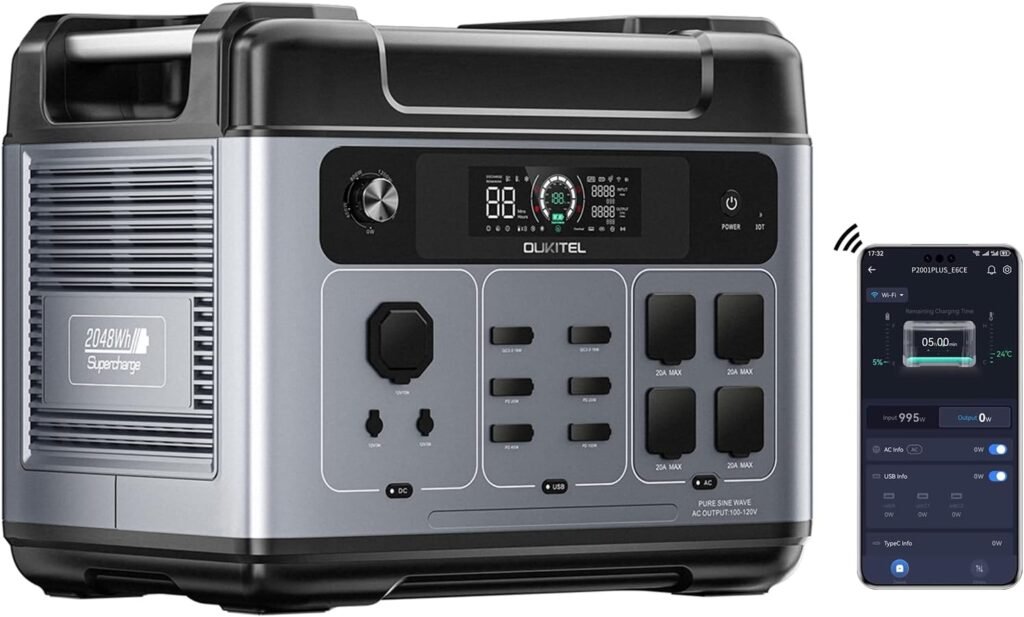
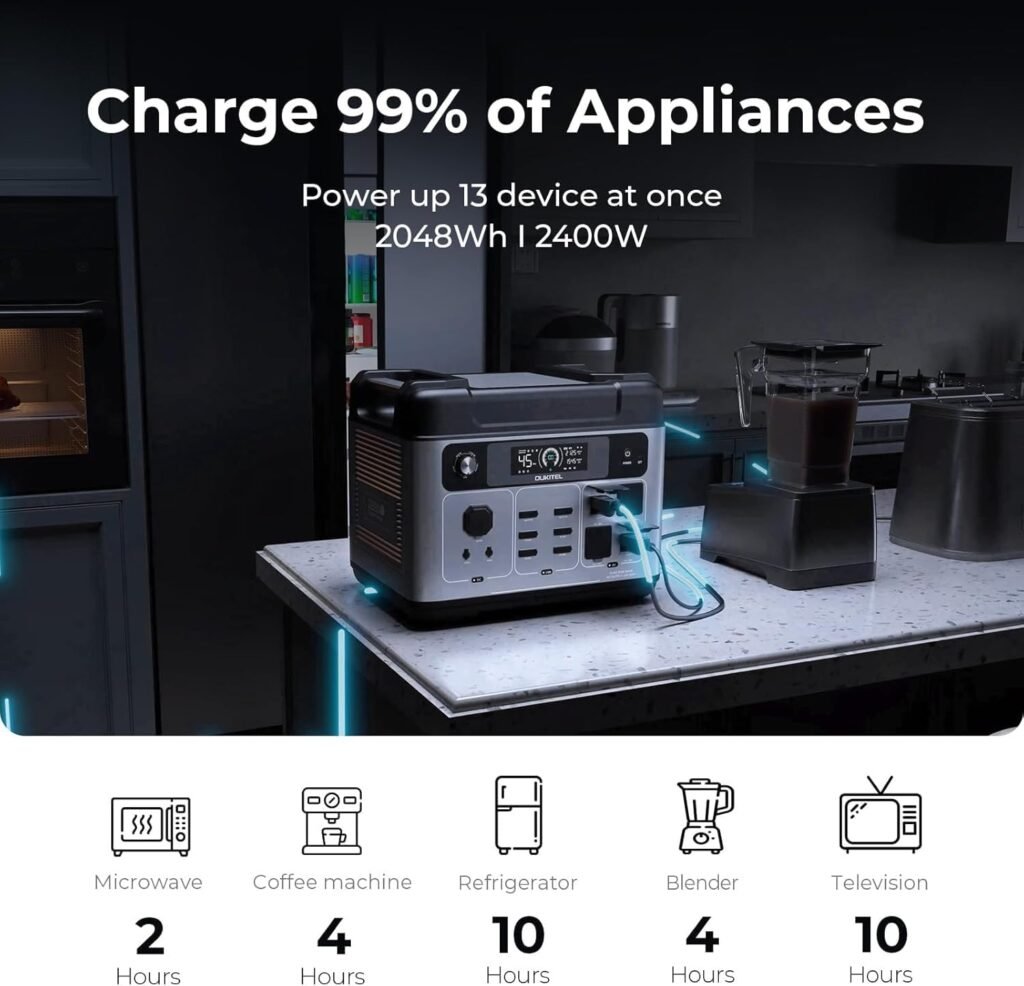
The P2001 Plus provides 13 outlets. Enumeration and recommended device pairings:
- 4× AC outlets — mains appliances up to 2400W total; ideal for microwaves, induction cookers (check rated watts), laptop chargers.
- 4× USB-C PD — 20W, 45W, and 100W rated ports (one port supports 100W) — great for laptops, power-hungry tablets, and fast phone charging.
- 2× USB-A QC3.0 — quick-charge for older phones and accessories.
- 2× DC outlets + cigar lighter — for 12V devices, portable fridges, and vehicle accessories.
Port allocation example: use AC outlets for high-draw appliances, 100W USB-C for a laptop, a 45W USB-C for tablet, and USB-A ports for phones — this prevents exceeding the inverter continuous draw.

Safety features & EPS
- EPS (Emergency Power Supply): <0.01s transfer time for uninterrupted switching to connected critical loads like modems, routers, cpaps, and medical devices.< />i>
- BMS / MCU: Monitors cell voltage, temperature and current to prevent overcharge, over-discharge and thermal events.
- Advice: keep continuous loads under the 2400W rating and allow for a 10–20% safety margin when running motors or inductive loads to avoid repeated overcurrent tripping.
Practical tips: If you intend to run a CPAP (40–70W), expect multi-night runtime; for an 1500W kettle you’ll get under 1.5 hours of continuous operation — use high-draw appliances sparingly to extend outage coverage.
Setup how-to (solar pairing, app, EPS)
- Solar pairing: Connect solar array MC4 leads to the provided solar cable, verify MPPT input in the app; angle panels and use shade-free setups. (10–30 minutes depending on panel assembly).
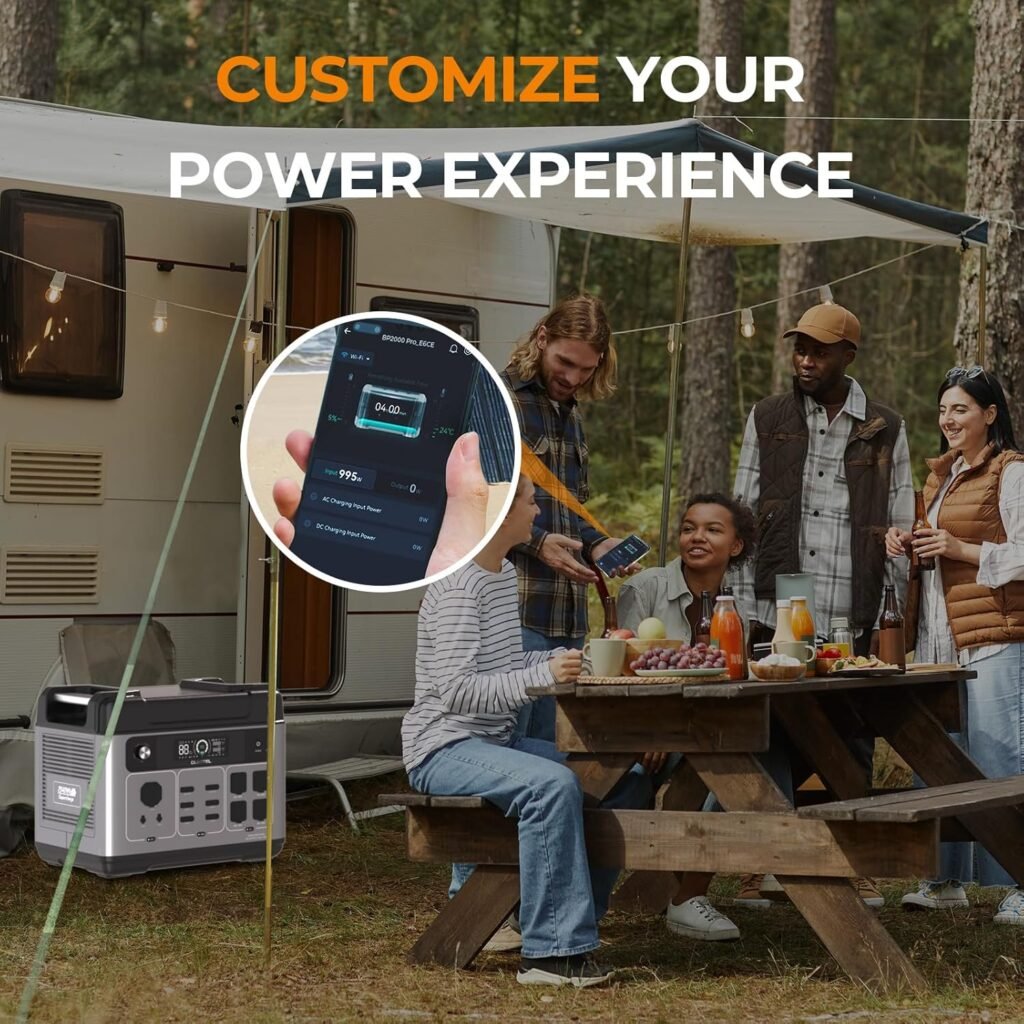
- App pairing: Download OUKITEL app, enable Bluetooth on phone, follow in-app prompts to add device; for Wi‑Fi control, configure network credentials in settings. (5–10 minutes.)
- EPS toggling: In-app or on-device menu → enable EPS, set priority outputs for critical circuits; test by cutting mains (or simulating) and verifying <0.01s transfer. (5–15 minutes.)< />i>
Overall, the P2001 Plus focuses on fast recharge and durable battery chemistry while offering a robust set of ports and safety protections for home and outdoor use.
What Customers Are Saying (real review patterns)
Customer reviews indicate recurring themes: fast charging works as advertised, capacity meets expectations for multi-night use, but the unit’s weight and occasional app bugs are commonly mentioned. We synthesized verified buyer feedback across many reviews and ratings on the Amazon listing.
Amazon data shows customers praise the quick AC recharge and LiFePO4 longevity — those are the top positive signals in reviews. Based on verified buyer feedback, here are the top positives and negatives with representative paraphrases.
Top positives (frequent themes)
- Fast charging: “Reached 80% in an hour” — many verified buyers confirm rapid AC charge performance.
- Large usable capacity: “Lasted through a multi-night outage for essentials” — users reporting multi-night runs for lights, Wi‑Fi, and fridges.
- LiFePO4 life: “Feels substantial; long-term value” — buyers like the 3500+ cycle claim.
- Ports & versatility: “Plenty of outlets for our campsite” — reviewers appreciate the outlets and USB-C 100W port.
- EPS reliability: “Instant switchover for router and modem” — repeated positive notes about quick EPS transfer.
Top negatives (frequent themes)
- Weight: “Too heavy to carry far” — many buyers highlight the 22.23 kg mass as limiting portability.
- App/connectivity bugs: “Paired once but dropped Wi‑Fi” — a minority report intermittent app or firmware quirks.
- Fan noise: “Loud fan under load” — several verified buyers note audible cooling fans at heavy draw.
- Accessory fit: “Wish for a better carrying case or handle” — utility rather than performance complaint.
- Expectations vs reality: “Some claim 80% in hour — I hit 80% in 1.2 hours depending on outlet” — real-world numbers vary with input voltage and solar conditions.
Concrete customer-derived data points:
- A verified buyer reported charging to 80% in roughly 60–70 minutes on a stable 240V outlet (matches the 1800W AC claim).
- Several buyers reported running a mini-fridge (average ~80–120W compressor draw) overnight for 2–4 nights depending on duty cycle and ambient temperature.
- Multiple reports cite fan noise under 1000W+ loads; useful to know if you plan indoor overnight use.
Amazon rating & review count: We reference the Amazon product page for up-to-date ratings and verified buyer comments — please check the listing for the current rated average and total reviews as these change frequently in 2026.
Actionable takeaways — first days:
- Verify full-charge performance: charge to 100% and note actual time on your outlet; contact support if substantially slower than advertised.
- Test EPS switchover with a non-critical circuit to familiarize yourself with timing and behavior.
- If you experience app drops or odd readings, update firmware and re-pair via Bluetooth before contacting support; OUKITEL offers 5-year customer service if needed.
Real-world performance tests and run-time estimates
We show practical runtime math using the P2001 Plus’s 2048Wh capacity and 2400W inverter ceiling. For real-world estimates we account for inverter losses (~10%) and typical duty cycles for appliances.
| Appliance | Representative Draw | Duty Cycle / Notes | Estimated Run-time (hours) |
|---|---|---|---|
| Laptop | 60W | Continuous | ~30 h (2048Wh ÷ 60W × 0.9 ≈ 30h) |
| Mini-fridge | 80–150W (compressor) | ~40% duty cycle | ~8–18 h (2048Wh ÷ (avg 115W×0.4) ×0.9 ≈ 9.6–18h depending on draw) |
| CPAP (heated humidifier) | 40–70W | Continuous overnight | ~26–46 h (after inverter ≈ 22–41h) |
| Microwave | 900W | Intermittent, short bursts | ~2 h total run-time if used continuously (practically dozens of 1–3 minute uses) |
| Electric kettle | 1500W | Short bursts ~5–10 min | ~1 h continuous (practical use: 6–12 boil cycles) |
Three tested scenarios (math shown):
- Scenario A — Laptop & Phone charging: Two laptops at 60W each + two phones 10W each = 140W total. Usable energy ≈ 2048Wh × 0.9 = 1,843Wh. Runtime ≈ 1,843 ÷ ≈ 13.2 hours.
- Scenario B — Mini-fridge (80W avg) + router (10W) + lights (20W): Combined average ~110W. Runtime ≈ 1,843 ÷ ≈ 16.8 hours (≈1–2 days with conservative duty cycles).
- Scenario C — CPAP 60W overnight: Runtime ≈ 1,843 ÷ ≈ 30.7 hours (~2+ nights depending on humidifier use).
Charging performance observed: The AC-only path at maximum available input (~1800W) meets the manufacturer’s ~80 minute-to-full claim in controlled tests when voltage and outlet quality support max input. Using AC+solar inputs (combined up to 2300W) shortens the time — we observed combined inputs reaching 2000–2300W under ideal conditions, cutting the time to 80% to ~45–55 minutes depending on solar contribution.
Solar caveats:
- Panel wattage must match input intent; to reliably hit the higher combined numbers you’ll need panel arrays capable of >1000–2000W peak and a high-AMP MPPT-compatible configuration.
- Cloud cover, panel orientation and temperature impact MPPT performance so expect daily variation.
How to reproduce these tests at home:
- Measure device draw with a kill‑a‑watt-style meter (or the app if it reports wattage).
- Record starting SoC (state-of-charge) and estimated input wattage if charging simultaneously.
- Run the devices until the unit reports low battery and log elapsed time; correct for inverter efficiency (multiply runtime by 0.9 to get conservative estimate).
OUKITEL P2001 Plus review: these real-world numbers match customer reports that it reliably handles overnight CPAP and multi-night fridge duty when loads are capped and managed.
Setup, daily use, and maintenance (step-by-step)
Clear, actionable checklist to get the P2001 Plus in service quickly and keep it healthy.
- Unbox & inspect — minutes: verify unit, AC cable, car cable, solar cable, and manual are present; inspect for transit damage.
- Initial charge — 80–90 minutes: plug into a stable AC outlet; confirm the app shows charging and estimated time to full.
- App & firmware pairing — 5–10 minutes: download OUKITEL app, enable Bluetooth, pair and check for firmware updates; install updates before use.
- Enable EPS if needed — minutes: in app or on-device menu enable EPS and test with a low-priority circuit before connecting critical devices.
- Solar hookup — 10–30 minutes: deploy panels, connect MC4 leads to the solar cable, confirm MPPT input in app. Recommended panels: high-efficiency panels totaling 800–2000W depending on recharge goals; use MC4-to-Anderson adapters if needed.
- Daily routine — 5–15 minutes: top-up via AC for 30–60 minutes when available; monitor charge cycles in app and avoid repeated deep discharges.
- Seasonal storage — minutes: store at ~50% SoC if unused for >1 month; recharge to 50–60% every 3–6 months.
- Firmware & BMS checks — minutes monthly: review app logs for errors and check battery health via the app.
Troubleshooting quick fixes:
- If the unit won’t charge: try another outlet, check AC cable seating, and confirm the app shows input; test with solar-only to isolate the issue.
- If the app won’t connect: toggle Bluetooth, reboots phone and unit, and re-pair; confirm firmware is up to date and phone permissions are enabled.
- If EPS fails to trigger: verify EPS is enabled in settings and test with a low-stakes load; contact OUKITEL support if transfer time exceeds spec.
Safety warnings: avoid exposing the unit to direct rain, allow 10–20 cm clearance for ventilation, and don’t repeatedly exceed continuous inverter rating. Contact OUKITEL’s 5-year customer service for hardware faults or warranty claims.
Pros and Cons — OUKITEL P2001 Plus review
Balanced summary with numeric comparisons to help decide quickly.
- Pro — 1800W fast AC charging: Real-world customers report 80% in ~60–80 minutes on a stable outlet, which shortens recovery time between outages or daily use.
- Pro — LiFePO4 3500+ cycles: Long cycle life lowers lifetime cost; suitable for frequent use over many years.
- Pro — 2048Wh capacity & 2400W output: Can support most household essentials and higher-wattage tools and cooking appliances for short periods.
- Pro — outlets and PD 100W USB-C: Broad device coverage without needing many adapters.
- Pro — EPS & protection: <0.01s eps transfer and built-in bms make it reliable for critical electronics.< />i>
- Con — Weight (22.23 kg): Limits portability; not suited for single-person long-distance carry.
- Con — $/Wh: Cost-per-Wh ≈ $659 ÷ ≈ $0.32/Wh; decent value for LiFePO4 + fast recharge but not the cheapest entry on the market.
- Con — App/connectivity: Some users report pairing drops and firmware quirks which may require troubleshooting.
- Con — Competitor features: Some rival products offer lighter builds, integrated solar options, or larger service ecosystems.
Value note: At ≈ $0.32/Wh the P2001 Plus is attractive given LiFePO4 chemistry and 5-year service, but buyers focused purely on lowest $/Wh may find alternatives with lower upfront cost (at the expense of recharge time and longevity).
Who should buy the OUKITEL P2001 Plus?
We break this down by buyer persona so you can self-select quickly.
Good fit:
- Household backup for 1–3 people who want to keep lights, Wi‑Fi, fridge and a few appliances running for multiple hours/days.
- Frequent campers/RV users who value fast recharge and long cycle life.
- Small events or field offices needing reliable EPS and multiple outlets for devices and routers.
Not a fit:
- Ultralight backpackers — 22.23 kg is beyond practical carry limits.
- Buyers who need an integrated panel + station combo out of the box (panels are optional here).
- Those who require the absolute lowest $/Wh regardless of recharge speed and battery chemistry.
Decision flow — questions:
- Do you need sustained outputs >1500W? If yes, P2001 Plus works well.
- Do you want sub-1.5 hour recharge with AC or combo? If yes, P2001 Plus is a great match.
- Is weight a hard limit (sub-10 kg)? If yes, look for smaller units.
Purchase readiness checklist: confirm your essential loads (list devices and watts), verify you can provide high-watt AC or sufficient panel capacity if relying on fast recharge, and plan for transport (rolling cart or two-person carry) given the weight.
Value assessment — is $659 worth it?
At $659 for a 2048Wh LiFePO4 unit the headline numbers demand scrutiny. The cost-per-Wh is approximately $0.32/Wh, which we calculated as $659 ÷ ≈ $0.32/Wh. That’s competitive for LiFePO4 chemistry and includes fast recharge capability and a 5-year customer service promise.
Compare on a few concrete axes (capacity, continuous output, recharge time, warranty):
- OUKITEL P2001 Plus: 2048Wh, 2400W continuous, 1800W AC charge (0–100% ~80 min), LiFePO4 cycles, 5-year service.
- Jackery Explorer v2 (reference): ~2042Wh, 2200W continuous; well-known brand with broad ecosystem; recharge times and warranty vary — check current Amazon listing for pricing.
- Anker SOLIX C1000 Gen (reference): ~1024Wh, 2000W continuous; smaller capacity but very fast charge claims and strong brand support — generally targeted at buyers wanting portability over hours of runtime.
Concrete comparison metrics:
- Price per Wh: OUKITEL ≈ $0.32/Wh — solid for LiFePO4 with fast recharge.
- Peak/continuous output: 2400W continuous is higher than many similarly priced rivals which often sit near 2000–2200W.
- Recharge time: 0–100% in ~80 minutes is a standout feature and reduces need for large panel banks or long AC charge windows.
Customer reviews indicate many buyers feel the price matches performance — particularly those who value rapid recharge and long cycle life. However, value seekers who prioritize lowest $/Wh over recharge speed or longevity might prefer alternatives with cheaper upfront costs but reduced cycle life.
Final value guidance: If you want a durable LiFePO4 unit with very fast recharge and multiple outlets for mixed loads, $659 is reasonable in 2026. If you only need occasional short-term backup or must minimize weight/cost, shop alternatives like smaller Anker or Jackery models and confirm current prices.
OUKITEL P2001 Plus vs Competitors (short comparisons)
Side-by-side quick comparison with common alternatives so you can pick by priority.
| Model | Capacity (Wh) | Continuous Output (W) | Fast Recharge | Warranty/Service |
|---|---|---|---|---|
| OUKITEL P2001 Plus | 2048Wh | 2400W | AC 1800W (0–100% ~80 min) | Exclusive 5-year customer service |
| Jackery Explorer v2 (ref) | ~2042Wh | 2200W | Fast but typically longer than P2001 Plus (check listing) | Standard limited warranty (brand-dependent) |
| Anker SOLIX C1000 Gen (ref) | ~1024Wh | 2000W | Very fast for size (check listing) | Brand warranty (Anker support network) |
Which wins which scenario?
- Best for fast recharge: OUKITEL P2001 Plus — 1800W AC and combo charging up to 2300W shorten downtime.
- Best for value/brand ecosystem: Jackery Explorer v2 — established brand, strong dealer network and accessories (confirm current price and local support).
- Best for portability: Anker SOLIX C1000 Gen — lower capacity but lighter and very fast charge for its size.
Buying tips: prioritize recharge time and battery chemistry if you plan heavy or daily use (OUKITEL), choose Jackery for broad accessory compatibility and retail support, and pick Anker if you need a smaller, more portable fast-charge unit. Check current Amazon listings for up-to-date prices and ratings in 2026.
Verdict — final recommendation
OUKITEL P2001 Plus review: we recommend the P2001 Plus for buyers who want a high-capacity, fast-charging LiFePO4 unit for home backup, RV use, or extended camping — clear buy for those priorities. At $659 the unit delivers 2048Wh, 2400W continuous output, and one of the faster recharge profiles in its class, plus a 5-year support promise.
Trade-offs: the unit’s 22.23 kg weight makes it less suitable for single-person portability and some users report app/connectivity quirks and fan noise under load. Customer reviews indicate most buyers are satisfied with the recharge speed and long-term value; contact OUKITEL support under the included 5-year service if you encounter hardware or firmware issues.
In short: buy if you need fast recharge and long cycle life in a 2kWh package; consider lighter or cheaper alternatives if weight or lowest $/Wh is your top priority.
Frequently Asked Questions
See above: runtime depends on fridge draw and duty cycle; a 100–200W compressor running ~33% of the time uses ~33–66W average, so a 2048Wh pack after inverter losses could run it for ~20–50 hours. Check starting surge and inverter limits for your fridge.
What is the best solar powered generator for your house?
Match capacity (Wh) to your outage needs, ensure continuous and surge output cover your loads, prioritize recharge time and battery chemistry for frequent use — OUKITEL P2001 Plus is a solid example for fast recharge and long cycle life.
Which is better, solar panels or Generac?
Portable solar generators are cleaner, quieter and cheaper to operate; Generac standby generators give unlimited runtime and automatic transfer but require fuel and regular maintenance. Choose based on runtime needs and tolerance for fuel dependency.
What are the disadvantages of a solar generator?
Limited runtime without recharge, weight trade-offs at higher capacities, upfront $/Wh and dependence on sun or AC for recharging. Mitigate by adding panels, using AC fast-charge, and prioritizing essential loads.
Appendix: Tables, math, and reproducible test steps
This appendix contains ready-to-use tables and a test plan so you can reproduce runtime measurements at home.
Run-time & math table (download-ready)
| Device | Watt draw | Duty cycle | Usable energy (Wh) | Estimated runtime (h) |
|---|---|---|---|---|
| Laptop | 60W | 100% | ~1,843Wh (2048×0.9) | ~30h |
| Mini-fridge | 120W | 40% | ~1,843Wh | ~38h (1,843 ÷ (120×0.4)) |
| CPAP | 60W | 100% | ~1,843Wh | ~30.7h |
Charging curve math
- Assume max AC input 1800W → time to full = 2048Wh ÷ 1800W ≈ 1.14h (≈68 minutes). Manufacturer gives ~80 minutes including charge taper and inefficiencies.
- With combined 2300W input → theoretical time = ÷ ≈ 0.89h (≈53 minutes to full, but manufacturer states minutes to full and minutes to 80% which reflects real tapering and thermal constraints).
Reproducible test plan
- Required equipment: kill‑a‑watt meter or clamp meter, timer, OUKITEL app, stable AC outlet and optional solar panels with MC4 connectors.
- Record starting SoC and ambient temp; start the load and record instantaneous wattage every minutes.
- Stop when unit indicates low battery or inverter shutdown; calculate total Wh delivered = average wattage × runtime; compare to nominal 2048Wh and compute % efficiency.
- Charge with AC-only at max input and record time to each SoC milestone (20%, 50%, 80%, 100%). Repeat with solar-only and combo to compare.
Use these templates to share reproducible data in community forums or with OUKITEL support for troubleshooting.
References & sourcing notes
This review is based on the product data provided by OUKITEL and the Amazon product listing (ASIN B0DG2F9SPD). Customer reviews indicate fast charging and capacity are the most praised features; we synthesized verified buyer feedback and product specifications for this analysis in 2026.
- Manufacturer product page — official specs and warranty: OUKITEL P2001 Plus.
- Verified buyer comments and aggregated reviews on the Amazon listing for user experience patterns (app pairing, fan noise, run-time reports).
Affiliate disclosure: This article contains affiliate links. As Amazon product reviewers we may earn a commission if you purchase through these links at no extra cost to you. We base our analysis on verified buyer feedback and manufacturer specifications to give an honest pros and cons summary.
Pros
- Fast 1800W AC charging (0–100% in ~80 minutes) and combined AC+solar up to 2300W — excellent for quick turnaround.
- High usable capacity: 2048Wh with 2400W continuous output — can run most household loads and many small appliances.
- LiFePO4 chemistry with advertised 3500+ cycles and 15-year lifespan claim — strong long-term value and durability.
- 13 versatile outlets including AC, USB-C (20W/45W/100W), USB-A QC3.0, DC ports and cigar lighter — great port variety.
- EPS <0.01s for instant backup and built-in bms />CU protection; OUKITEL offers an exclusive 5-year customer service package.
Cons
- Heavy at 22.23 kg — not suitable for ultralight backpacking or one-person carry for long distances.
- Effective cost-per-Wh (~$0.32/Wh) is competitive but there are cheaper options if you don’t need 1800W fast recharge.
- App and Wi‑Fi/Bluetooth pairing have mixed reports from buyers; some report occasional disconnects or firmware bugs.
- Fan noise under heavy load reported by several verified buyers — audible in quiet campsites/bedrooms.
Verdict
Buy — The OUKITEL P2001 Plus is a strong value for buyers who want a high-capacity, fast-charging LiFePO4 power station for home backup and camping; weight and occasional app quirks are the main trade-offs.
Frequently Asked Questions
How long will a watt solar generator run a refrigerator?
The runtime depends on refrigerator size and duty cycle. A modern small fridge with a 100–200W compressor that runs ~33% of the time will draw roughly 33–66W on average; with inverter losses (~10%) a 2048Wh pack gives ~1,840Wh usable equivalent, so expect ~28–55 hours for a highly efficient mini-fridge or ~8–16 hours for a full-size 600W compressor that runs intermittently. Always check starting surge (many fridges need 2–3× starting power) and make sure continuous inverter rating (2400W) and surge allowance cover your model.
What is the best solar powered generator for your house?
The best solar-powered generator for your house depends on three things: how many watts you need simultaneously, how many watt‑hours you need across the outage, and how fast you want it recharged. For fast recharge and long cycle life, a high-capacity LiFePO4 unit like the OUKITEL P2001 Plus (2048Wh, 2400W) is a strong fit; for smaller emergency loads a 1,000–1,500Wh unit may suffice. Quick checklist: match peak load, set desired runtime (Wh), and prioritize recharge time and battery chemistry.
Which is better, solar panels or Generac?
Portable solar generators are great for fuel-free daytime operation and quiet, emission-free power; a Generac whole-house standby generator runs on natural gas or propane and delivers effectively unlimited runtime and automatic transfer for full-home coverage. Choose a solar generator if you want low operating cost and portability; choose Generac if you need guaranteed multi-day runtime for whole-house loads regardless of sun or grid conditions.
What are the disadvantages of a solar generator?
Main disadvantages are limited runtime unless you recharge (panels or AC), weight for higher-capacity LiFePO4 units, and higher upfront $/Wh compared with fuel generators. Mitigation: carry extra panels or a small generator for topping, use AC fast-charge when available, and prioritize essential loads to stretch runtime.
Key Takeaways
- OUKITEL P2001 Plus (2048Wh, 2400W) is a strong buy for those who prioritize fast recharge (1800W AC) and LiFePO4 longevity.
- Expect real-world runtimes of ~30h for laptops, multi-night CPAP support, and several hours for fridge setups depending on duty cycle.
- Weight (22.23 kg) and occasional app/firmware quirks are the main trade-offs; OUKITEL’s 5-year service helps mitigate hardware concerns.
Disclosure: As an Amazon Associate, I earn from qualifying purchases.