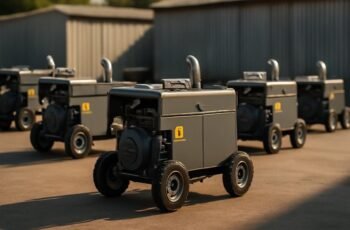
Imagine a neighborhood blackout where our home runs on a 12,500-watt tri-fuel setup, starting reliably with the push of a button. We’ll walk you through seven portable natural gas options that combine durability, safe features like CO sensors, and transfer-switch readiness to keep essential loads powered. We’ll weigh runtimes, startup options, and EPA compliance, then point out practical maintenance and warranty angles so you know what to expect when the lights go out. There’s more to consider before you decide.
Key Takeaways
- Tri-fuel capability (gas, propane, natural gas) gives flexibility to beat outages using your existing fuel lines or cylinders.
- Generators with CO safety/shutdown and AVR help protect home electronics during natural gas outages.
- Look for models with transfer-switch readiness to ensure code-compliant, seamless power transfer.
- Compare runtimes on natural gas; larger displacement engines typically offer longer run times under moderate loads.
- Prioritize models with remote or push-button start and solid warranty for reliable, accessible outage use.
Champion Power 12,500-Watt Electric Start Tri-Fuel Generator
If you want a versatile backup that covers all fuel options with one unit, the Champion Power 12,500-Watt Electric Start Tri-Fuel Generator is our top pick. We’ll spell out why it stands out. This tri-fuel model runs on natural gas, propane, or gasoline, with hoses included for immediate use. Gasoline delivers 12,500 starting watts and 10,000 running watts; propane offers 11,250/9,000; natural gas provides 10,000/8,000. Electric start with a 500cc Champion engine simplifies startup, while Intelligauge tracks voltage, frequency, and run times. CO Shield adds safety, and a 3-year warranty plus free lifetime support back up our confidence.
Best For: Those seeking a versatile, all-in-one backup power solution that runs on natural gas, propane, or gasoline with electric start and smart monitoring.
Pros:
- Tri-fuel capability provides fuel flexibility and easier fueling during outages
- Electric start with included battery simplifies startup and operation
- Built-in CO Shield safety, Intelligauge monitoring, and solid warranty support
Cons:
- Higher upfront cost compared to singles-fuel units
- Heavier and less portable due to tri-fuel design and power output
- Requires space for hoses and hookup setup even out of the box
Westinghouse 14500W Tri-Fuel Portable Generator with Remote Start
The Westinghouse 14500W Tri-Fuel Portable Generator with Remote Start stands out for bigger homes needing flexible fuel options and convenient startup. We can run it on gasoline, propane, or natural gas, delivering 14,500 peak watts on gas and 11,500 running watts, or 13,500/10,500 on propane, and 12,000/9,500 on natural gas. Its heavy‑duty 550cc OHV engine with cast iron sleeve powers up to 19 hours on a full tank or 7 hours on a 20 lb. propane tank. Low THD protects sensitive electronics, and factory testing plus a 3‑year warranty add confidence. Remote start and transfer switch readiness simplify use and service.
Best For: homeowners needing a flexible, high-capacity tri-fuel generator with remote start and transfer switch readiness for reliable, versatile power during outages.
Pros:
- Tri-fuel flexibility (gasoline, propane, natural gas) for fuel availability and convenience
- High peak/running wattage with low THD for powering multiple appliances and sensitive electronics
- Remote start plus transfer switch readiness simplifies operation and backup power setup
Cons:
- Heavy unit with a large fuel tank, potentially less portable for frequent moving
- Higher upfront cost compared to smaller portable generators
- 3-year warranty covers parts/labor, but service availability may vary by region
Westinghouse 12500W Dual Fuel Portable Generator
This Westinghouse 12500W Dual Fuel Portable Generator is ideal for families needing reliability and flexibility during outages, with a 12500 peak watts on gasoline and 11200 peak watts on propane. We power essentials with 9500 running watts gasoline and 8500 running watts propane, plus a remote start via key fob and both electric and recoil options. It runs up to 12 hours on a 6.6-gallon tank, and you’ll monitor fuel with a gauge. Dual-fuel means versatility, and the generator includes two 120V outlets, a 120/240V outlet, and a transfer switch-ready connection for safe, easy backup power. EPA compliant, with safety features and a 3-year warranty.
Best For: families seeking reliable, flexible backup power with dual-fuel capability and remote start for easier outages.
Pros:
- Dual-fuel flexibility (gasoline or propane) for extended runtimes and versatile fuel options
- High peak and running wattage with multiple outlets (including 50A RV/6V parallel-ready transfer switch compatibility)
- Remote start with key fob plus electric/recoil start for convenient startup
Cons:
- Heavier unit with a large 457cc engine may be less portable for some users
- Fuel consumption and weight could be higher with maximum load
- May include residual odor from factory testing or oil/fuel prior to initial use
Generac 12,500W Tri-Fuel Portable Generator with COsense
Our Generac 12,500W tri-fuel generator stands out with COsense, an automatic CO detector that shuts down the unit if danger is detected. We want to highlight its core specs: 12,500 starting watts, 9,500 running watts, 500cc OHV engine, and 7.5-gallon tank delivering up to 9.5 hours at 50% load on gasoline. It runs on gasoline, propane, or natural gas, and uses an electric push-start with a rechargeable battery. COsense enhances safety with automatic shutdown, while a low-oil shutdown and hour meter aid maintenance. Its heavy-duty frame, weathered outlets, and portability suits home backup, job sites, or camping scenarios. Includes battery, charger, hoses, and tools.
Best For: Homeowners and contractors needing versatile, tri-fuel backup power with automatic CO safety and rugged portability.
Pros:
- Tri-fuel flexibility (gasoline, propane, natural gas) for fuel choice and outage resilience
- COsense automatic CO detection with shutdown for safer operation
- Push-button electric start with long runtime and durable, portable build
Cons:
- Heavier unit may be less convenient to move for some users
- 7.5-gallon tank, while long-lasting, still requires refueling planning for extended outages
- Higher upfront cost compared to single-fuel portable generators
DuroStar DS13000MXT 13,000-Watt Tri-Fuel Portable Generator
Peak reliability starts with tri-fuel versatility: the DuroStar DS13000MXT can run on gasoline, propane, or natural gas, making it a flexible whole-home backup option when blackouts strike. We point to its 13,000-watt peak and 10,500-watt running output, powering essential circuits with a 50 Amp transfer switch-ready system. Its 500cc OHV engine, 8.3-gallon tank, and up to 13 hours runtime keep you powered longer between fuelings. The CO Alert shuts down if fumes are detected, and remote electric start adds convenience. Built for portability with wheels and a handle, it’s designed for storm-ready home backup.
Best For: Emergency power users who need a tri-fuel generator capable of backing up an entire home during outages with transfer-switch readiness and remote electric start.
Pros:
- Tri-fuel versatility (gasoline, propane, natural gas) for flexible fuel availability
- High power output (up to 13,000 peak / 10,500 running watts) with 50 Amp transfer switch-ready capability
- CO Alert automatic shutdown for added safety and remote start convenience
Cons:
- Heavy and sizeable unit may be cumbersome to move without wheels and handle kit
- Longer runtime depends on load; efficiency varies with fuel choice
- Requires setup (fuel lines/regulators for propane/natural gas) and potential professional installation for transfer switch integration
WEN 4,750W Dual Fuel Portable Generator with Wheel Kit
Need reliable dual-fuel power fast? We’ve got the WEN 4,750-Watt Dual Fuel Portable Generator with Wheel Kit (DF475T). It runs on gasoline or propane, delivering 4750 surge/3800 running on gas and 4350 surge/3500 running on propane, with 240V output selectable for transfer switches. The 224cc OHV engine starts electrically via a key, and the unit includes a wheel kit for easier movement. It powers lights, TV, fridge, sump pump, and tools, featuring two 120V GFCI outlets, a 240V L14-30R, and a 12V outlet. Tank up to 4 gallons, up to 11 hours at half load. Durable, CARB compliant, backed by warranty.
Best For: Homeowners and small contractors needing reliable dual-fuel (gas or propane) backup power with transfer-switch readiness and portable mobility.
Pros:
- Dual-fuel capability (gasoline or propane) for flexibility and longer-term fuel options
- 240V output with a dedicated L14-30R and 120V GFCI outlets for essential appliances and transfer-switch use
- Electric start with wheel kit for easy startup and portability, plus CARB-compliant, rugged build
Cons:
- Heavier unit (approximately 105.8 pounds) which may require setup assistance
- Lower running watts on propane (3500) compared to gasoline (3800) which affects load planning
- Shorter runtime on propane and need for LPG hose connection with setup considerations
Westinghouse Tri-Fuel Portable Generator with Remote Start
The Westinghouse Tri-Fuel Portable Generator with Remote Start stands out for its true three-fuel flexibility, including natural gas, so you can run on whichever fuel is most available during a blackout. We highlight its 28,000 peak / 20,000 running watts (gasoline), 25,200 peak / 18,000 running (propane), and 22,400 peak / 16,000 running (natural gas). With a heavy-duty 999 cc V-Twin OHV, it powers many circuits for up to 15 hours on a full tank. It includes remote start, electric push-button start, interlock-ready transfer, multiple outlets, and a robust 3-year warranty with support. It’s built for reliability and transfer readiness.
Best For: Homeowners needing flexible, multi-fuel backup power with remote-start convenience and transfer-readiness for whole-home or high-demand loads.
Pros:
- Tri-fuel capability (gasoline, propane, natural gas) offers versatile fuel options during outages.
- Remote start, electric push-button start, and interlock-ready transfer enhance convenience and prep for automatic transfer switches.
- High power output (up to 28,000 peak / 20,000 running watts gasoline) with multiple outlets and built-in AVR and CO sensor for safer, job-site or home-use power.
Cons:
- Very heavy (~557 lb), making relocation challenging without assistance.
- Large footprint (38″ L x 35″ W x 40.4″ H) and significant fuel/maintenance needs.
- Higher upfront cost and complex setup might be overkill for smaller blackout needs.
Factors to Consider When Choosing Portable Natural Gas Generators for Home
We’ll walk you through key factors like fuel options, output needs, and transfer requirements so you can pick the right portable natural gas generator for your home. We’ll also cover run time, safety and compliance, and easy start mechanisms to fit your use case. By keeping these considerations in mind, we can compare models efficiently and avoid buying the wrong setup.
Fuel Options Overview
When choosing portable natural gas generators for home use, it’s helpful to understand how fuel options affect performance and suitability. Tri-fuel units give us flexibility to run on natural gas, propane, or gasoline, which matters during outages. Natural gas typically delivers lower starting and running watts than gasoline, reducing peak power availability compared to other fuels. Propane and natural gas use can influence runtime and fuel efficiency, often resulting in different run times per tank or line pressure. A built-in CO safety/off switch is important when using natural gas to help mitigate carbon monoxide risks in enclosed spaces. Fuel delivery hardware—hoses, regulators, and connections—for natural gas must be compatible with the generator and ready to use out of the box.
Output And Transfer Needs
If you’re sizing a portable natural gas generator, matching output to your home’s needs and ensuring smooth transfer are top priorities. We look at output specs, noting peak watts for starting surges and running watts for continuous load. Natural gas typically yields lower starting and running watts than gasoline, so you’ll want to size for your essential circuit needs and any anticipated startup spikes. Transfer-switch readiness matters for seamless switching during outages; some models are transfer switch ready, others need an interlock kit. Fuel flexibility matters too, with CO safety features and low-oil shutdown protecting reliability when natural gas is used as a backup. Remember, a clear plan for expected loads helps prevent overloads and equipment stress in a real outage.
Run Time Considerations
Run time is a key factor after sizing, since natural gas will affect how long you can run critical loads between refuels or pressure checks. We see runtimes on natural gas vary by model, with typical durations around 8 to 15 hours at half to 50% load, depending on tank size and engine displacement. Larger displacement engines and higher fuel flow generally yield longer run times, all else equal. Some units publish specific figures, like around 8,000 running watts with a defined runtime under a given fuel supply. Fuel source setup—gas line connection versus portable cylinders—can influence continuous run time due to fuel pressure and delivery efficiency. Headroom in runtime data ties to load level, with about 50% load typically delivering longer runtimes than higher loads.
Safety And Compliance
In portable natural gas generators, safety and compliance aren’t optional—they’re essential. We look for CO sensors with auto shutoff (COshield/COsense) to detect dangerous carbon monoxide levels, especially if anyone uses the unit in semi-enclosed spaces. Multi-fuel capability can affect local fuel-supply and venting rules, so we confirm the unit is listed for natural gas operation if used as a primary backup. Transfer switch readiness or compatibility matters for safe, code-compliant connection to home circuits during outages. Low-oil shutdown and automatic voltage regulation protect both the generator and our home electronics. EPA certification and proper clearance and ventilation guidelines are nonnegotiable when placing and venting a residential natural gas generator.
Start Mechanisms
Starting your portable natural gas generator means weighing how you’ll power it up when the lights go out. We look for electric start with a rechargeable battery and a push-button ignition, so startup is quick without manual pulling. Remote electric start from a distance adds convenience during outages, a real plus when you’re busy with other tasks. Some models include CO Shield or COsense safety systems that automatically shut down if carbon monoxide is detected, which can affect how you start and run the unit. Transfer-switch readiness and interlock or direct hardwired connections shape how the start mechanism links to your home’s electrical system. Dual- or tri-fuel designs pair electric start with fuel controls for fast switching without changing the starting procedure.
Maintenance Essentials
Maintenance essentials are essential for reliable performance when you’re relying on portable natural gas generators at home. We recommend regular engine oil changes per the manufacturer to prevent wear and ensure reliable starts, especially on natural gas. Monitor fuel levels and maintain the natural gas supply inlet, making sure hoses are secure and free of leaks to sustain uninterrupted operation. Perform periodic CO sensor and automatic shutoff inspections (CO Shield/COSense) to keep safety features functional. Verify that tri-fuel or dual-fuel configurations are correctly set for natural gas and test transfer-switch readiness to ensure seamless power transfer during outages. Keep an up-to-date maintenance log with run-time hours from the Intelligauge or hour meter, recording oil changes, spark plug checks, and filter replacements.
Warranty And Support
When choosing portable natural gas generators for home use, warranty and support matter as much as performance and safety. Most models offer a 3-year limited warranty, with some including nationwide service networks for coverage and support. Warranty coverage typically applies to both parts and labor, ensuring repair or replacement of defective components within the term. Some generators provide bundled lifetime technical support from dedicated experts, extending assistance beyond the warranty period. In-box accessories (oil, hoses, battery, remote start) are usually considered part of the product package and may be required for proper warranty activation. Warranty terms often specify conditions related to maintenance, fuel type, and correct usage to keep coverage valid.
Frequently Asked Questions
How Safe Is Natural Gas Use During Power Outages?
We’re careful: natural gas is generally safe during outages when systems are properly installed and vented, but we stay vigilant about carbon monoxide risks, shutoffs, and professional inspection before use so you stay protected and informed.
Can Portable Gas Gensets Power Whole Home Reliably?
We can power a whole home reliably with portable gas gensets, but only with proper sizing, transfer switches, and fuel management. We’ll plan, install, and test, ensuring continuous electricity while prioritizing safety and Code compliance for you.
Do Tri-Fuel Gensets Support Natural Gas Conversion Kits?
Yes, tri-fuel gensets can use natural gas conversion kits. Picture us adapting, like chameleons, to fit gas lines. We’ll verify kit compatibility, install safely, and test performance before relying on steady, clean power.
What Maintenance Boosts Longevity of Gas Generators?
We maintain gas generators by following a routine: change oil and filters regularly, inspect spark plugs, keep air filters clean, run at load periodically, check hoses and belts, monitor coolant levels, and schedule professional servicing before peak seasons.
Are There Emissions or Noise Limits for Residential Use?
Yes, there are emissions and noise limits for residential use. We comply with local noise ordinances and EPA-based emissions standards, aiming for quiet operation and cleaner exhaust so you can run essentials without disturbing neighbors.
Conclusion
We’ve explored strong portable natural gas options that keep essentials running when outages hit. Each model brings reliability, safety, and transfer-switch readiness to your home setup. Think of your generator like a sturdy lifeboat in a storm: it won’t stop at the first wave, but you’ll steer it smoothly through. Choose the wattage you need, confirm fuel compatibility, and prioritize safety features—CO sensors, AVR, and easy starting. Your blackout resilience starts with smart selection.