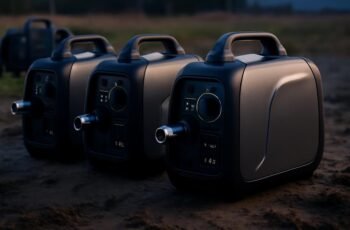
We understand apartments demand quiet, safe, portable power, so we’re looking at options like compact inverters, silent stations, and EPA/CARB-compliant units that won’t annoy neighbors or exhaust. We’ll compare runtimes, noise levels, weights, and safety features, then match each use case to a realistic setup. If you’re planning outages or weekend projects, staying within these limits matters more than you might think, and that’s what we’ll uncover next.
Key Takeaways
- Prioritize inverter generators or portable power stations for clean, stable power and low THD to protect sensitive electronics in apartments.
- Look for EPA/CARB-compliant models and quiet operation (roughly 50–58 dBA) to minimize disturbance and meet regulations.
- Favor lightweight, highly portable units (2–7 lb or ~35 lb ranges) with multiple outlets and USB options for versatile essentials.
- Consider runtime at half-load and ECO/auto-shutoff features to maximize efficiency between recharges or refuels.
- Compare safety features (overload protection, automatic shutoff, low-oil/water protections) and warranty to ensure reliable apartment use.
Aceup Energy 1,200W Gas Generator, Portable, EPA & CARB Compliant
If you’re after a compact, EPA- and CARB-compliant option that still packs steady power for apartment use, the Aceup Energy 1,200W Gas Generator stands out. Weighing about 35.5 pounds, it’s portable enough for tight spaces yet tough enough for emergencies, with a 71cc, 2-stroke air-cooled engine and recoil start. It delivers up to 1,200 watts peak and 900 running watts at 120V, 60 Hz, via two duplex outlets. Its 1.1-gallon tank runs roughly six hours at half load, and it includes automatic shutoff, AVR, and overload protection. EPA and CARB compliant, it’s backed by a 1-year warranty and expert guidance.
Best For: Apartment or small-space users who need EPA- and CARB-compliant portable power with steady 900 running watts and compact, lightweight design.
Pros:
- EPA & CARB compliant, suitable for residential use in many areas
- Lightweight for a portable, space-conscious setup (about 35.5 lb)
- Has automatic shutoff, AVR, and overload protection for safer operation
Cons:
- 1.1-gallon tank may require more frequent refueling for extended outages
- 71cc 2-stroke engine requires gasoline-oil mix and may need more mixed-fuel handling
- Only two duplex outlets might limit simultaneous high-wattage accessories
Jackery Explorer 300 Portable Power Station, 293Wh
The Jackery Explorer 300 stands out for apartment use thanks to its quiet operation and compact 293Wh battery, delivering clean power with minimal peaks. We value its 300W max output, 53.27W running draw, and dual Pure Sine Wave outlets for sensitive gear. At about 7.1 pounds, it stays portable, with a USB-C 60W input/output and USB-A plus car port for versatility. It recharges fast—roughly 2 hours to 80% via wall plus 60W PD—and supports MPPT solar charging with the SolarSaga kit. It’s ideal for essentials, passes through charging, and keeps devices safe during outages without fumes or maintenance worries.
Best For: Apartment dwellers and casual campers who need quiet, compact, clean power for essential electronics and small devices during outages or portable trips.
Pros:
- Quiet operation with compact, lightweight design (about 7.1 pounds) and 293Wh battery.
- Clean, reliable Pure Sine Wave power suitable for sensitive gear; multiple outlets including 2 AC outlets, USB-C 60W, USB-A, and car port.
- Fast recharging (~2 hours to 80% via wall with 60W PD) and solar compatibility via SolarSaga kit for off-grid use.
Cons:
- Not suitable for high-power appliances (e.g., induction cooktops, blenders).
- Solar panel not included in the box; optional accessories add to cost.
- Peak output may limit very demanding loads despite 300W max rating.
Portable Power Station 120W with AC Outlet and USB-C
This 120W portable power station is ideal for apartment dwellers who need quiet, safe backup power with built-in protection. Weighing 2.2 lbs with a handy handle, it delivers two 110V/120W max AC outlets plus 12V–16.8V DC, USB-A, USB-C, and QC USB ports, totaling 6 outputs. Its 97.6Wh Li-ion battery powers devices under 120W, with an LCD showing remaining power and status, plus a flashlight for reading or SOS. Charging options include USB-C wall adapters, car USB, or solar (panel not included). A built‑in BMS and automatic cooling keep protection solid, while 12‑month warranty supports reliability.
Best For: apartment dwellers seeking quiet, safe backup power with built‑in protections and portability.
Pros:
- Lightweight (2.2 lbs) with a convenient handle for easy transport
- Multiple outputs (2x AC, DC, USB-A, USB-C, QC) to power common small devices under 120W
- Built-in protection (BMS, over-current/over-voltage/overheating) and automatic cooling for safety
Cons:
- Limited to devices under 120W; not suitable for high-wattage appliances (coffee makers, hair dryers, etc.)
- Solar charging requires a panel not included; charging speed may be slow in some conditions
- Only 97.6Wh capacity, which may require more frequent recharges during extended outages or heavy use
DaranEner Portable Power Station 56000mAh, 300W AC
DaranEner’s 56000mAh, 300W AC power station stands out for compact portability paired with solid LiFePO4 safety. We badge this model as a 179.2Wh unit (56000mAh at 3.2V) with a 300W inverter and 600W surge. We value its light build at ~5.7–6.2 lbs and seven ports, including USB-C 60W and two AC outlets. It supports fast 1.5-hour home charging, 2-hour car or MPPT solar charging, and multi-device use during recharge. With LiFePO4 chemistry, 12 safety features, and a 3,500+ cycle life, it suits apartments, emergencies, and light camping. Warranty runs two years.
Best For: Those seeking a compact, LiFePO4 powered station for emergency backup, outdoor camping, or light home use with multiple charging options.
Pros:
- 179.2Wh LiFePO4 battery with 600W surge and 300W continuous inverter for safe, capable power delivery
- Lightweight, portable design (about 5.7–6.2 lbs) with seven ports including USB-C 60W and dual AC outlets
- Quick home charging (1.5 hours) plus car/solar charging options and ongoing use while charging
Cons:
- Real-world high-load endurance may vary; some devices may drain faster than expected
- Solar charging limited to MPPT 90W, which may be slow for larger loads or extended off-grid use
- 2-year warranty and Amazon return policies may vary by seller and region
Oxseryn 2800-Watt Portable Inverter Generator
Looking for a quiet, reliable backup for apartments? We’ve got the Oxseryn 2800-Watt Portable Inverter Generator. It’s a 2800-watt peak, 2000-watt running unit ideal for home backup, camping, and emergencies. Powered by a 79.8cc OHV engine, it runs on gasoline with a 1.1-gallon tank and an on-tank fuel indicator. At 39 lbs, it’s compact, portable, and EPA compliant, with 58 dBA at 23 feet to minimize disturbance. It includes ECO mode, parallel capability, and multiple outlets (2x 120V, 1x 12V, USB, Type-C). Features like low oil shutdown, fuel shut-off, and cold start support safe operation. Warranty is two years.
Best For: apartment dwellers and outdoor enthusiasts seeking a quiet, portable backup power solution with multiple outlets and efficient running.
Pros:
- Quiet operation (under 58 dBA at 23 feet) suitable for indoor or shared living spaces
- Lightweight, portable design (39 lbs) with built-in handle and 2,000 running watts for essential loads
- ECO mode, parallel capability, and multiple outlets (2x 120V, 1x 12V, USB, Type-C) for versatile charging
Cons:
- 1.1-gallon tank may require more frequent refueling for extended outages
- 9-hour runtime at 25% load—could be shorter for higher demand scenarios
- Gasoline fuel smell on delivery possible due to factory testing and storage conditions
ERAYAK 2400W Portable Inverter Generator for Home
The ERAYAK 2400W inverter generator stands out for apartments with its ultra-quiet operation and clean power, making it safe for sensitive electronics yet powerful enough for essential backups. We appreciate its 1800W running, 2400W peak, and under 1.2% THD, which keeps laptops, CPAPs, TVs, and gaming consoles safe. It provides 2 AC outlets, 2 USB ports, and a DC output, with an ultra-quiet 52.5 dB at 7 meters and ECO mode for fuel efficiency. At 42 lbs and compact dimensions, it’s easy to move, wheel-kit compatible, and supports long runtimes up to 16 hours at 25% load. Includes warranty and support.
Best For: Apartment dwellers or small-space households needing ultra-quiet, clean-power backup for essential electronics and devices.
Pros:
- Ultra-quiet operation (52.5 dB at 7 meters) ideal for apartments and quiet environments
- Clean power with <1.2% THD, safe for sensitive electronics (laptops, CPAPs, TVs, gaming consoles)
- Portable with wheel-kit compatibility and compact size for easy movement and storage
Cons:
- 42 lb weight may be challenging for very small users without a wheel kit
- 1800W running watts may be limiting for higher-load backup needs
- Only 16 hours max runtime at 25% load under eco mode, which could require frequent refueling for extended outages
HOWEASY 88Wh Portable Power Station with Solar Generator
For apartment living, this 88Wh HOWEASY power station shines with its compact, portable design and multiple output options. We’ll note its 88Wh lithium battery, 120W rated output with 150W peak, and eight total ports including two AC sockets, a USB-C port, two QC 3.0 USBs, a USB-A, and two 12V DC outlets. It weighs 2.3 pounds and fits compactly, with a hidden carry handle for easy transport. Recharging is flexible: AC adapter, car charger, or optional solar input. It features a bright LED with modes, and an informative display for status. Practical for lights, fans, phones, laptops, and small devices during outages.
Best For: apartment dwellers and light outdoor enthusiasts seeking a compact, versatile 88Wh power source for essential devices during outages or on-the-go charging.
Pros:
- Compact, portable design at only 2.3 lb with a hidden carry handle for easy transport
- Multiple outputs (2 AC, USB-C, 2× QC 3.0 USB, USB-A, 2× 12V DC) to power a range of devices simultaneously
- Flexible recharging options (AC adapter, car charger, optional solar input) and an informative LED display
Cons:
- Limited solar panel included (solar input available but panel not included)
- Some laptops may require specific input voltages (compatibility notes around 20V input)
- 88Wh capacity limits runtime for higher-wattage devices or prolonged outages
Factors to Consider When Choosing Portable Generators for Apartments
We’re here to help you weigh the basics that matter in apartments, from quiet operation and sound levels to matching size with your power needs. We’ll consider run time, fuel options, and how portability and storage fit into your space, so you can choose without clutter. Finally, we’ll review safety features and protections to keep you, neighbors, and equipment protected.
Noise Levels And Living Quarters
Are quiet operation and clean power the top priorities when you’re selecting a portable generator for an apartment? We think so, and we’ve seen compact inverters delivering about 50–58 dBA under typical load, roughly quieter than a normal conversation. Eco modes help further reduce engine speed and noise, making shared spaces livable without sacrificing essentials. Clean power matters too; lower THD means less buzzing or hum in sensitive electronics you rely on daily. Weight matters for indoor storage and repositioning, with smaller stations around 2–7 pounds being noticeably easier to move without creating disruption. Finally, run-time at partial loads tends to improve with efficient modes, so you won’t need to keep it running through late-night hours just to stay powered.
Power Needs Matching
Matching your power needs is the next step after narrowing noise and size. We start by estimating our essential load in watts—lights, fridge, modem, and router—and choosing a generator with peak watts comfortably above that to cover startup surges. For apartment use, we prioritize models with clean power, with total harmonic distortion under 3%, to protect sensitive electronics like laptops and TVs. Runtime matters too: we aim for a unit that can run our required load for several hours or more without frequent refueling. Consider inverter generators for lower noise levels, often below 60 dBA, to meet building and neighbor restrictions. Finally, ensure multiple outlets plus USB/12V options so we can power diverse devices simultaneously without extra adapters.
Fuel And Run Time
When choosing a portable generator for an apartment, runtime hinges on tank size and fuel type, with gas units typically lasting 4–9+ hours depending on load. Gas-powered units often run about 4–9+ hours per fill, with a 1.1 gallon tank at half load yielding roughly 6 hours for a 900W-rated model. Inverter generators deliver cleaner power (low THD) and typically 1800–3000 running watts, with peak up to 2800–2800+ watts, which can affect how long you can sustain essential devices. For apartments, prioritize tank size and gasoline as key runtime factors, knowing larger tanks extend fills between refills. Parallel capability and multiple outlets influence how many devices run together and may alter total runtime under load. Noise and portability remain crucial for compact, quiet operation.
Portability And Storage
Portability and storage are top concerns for apartment living, so we focus on how easy a generator is to move, position, and tuck away. We weigh weight from compact 2.2 lb power stations to about 42 lb for larger inverters, since lighter units transition between rooms and balconies with less hassle. Handle design, built‑in wheels, and optional kits boost maneuverability in tight urban spaces and after outages. Smaller units with 88–293Wh are easier to lift into closets or under beds, while higher-capacity models need more storage room and ventilation. Compact dimensions around 6.6 x 3 x 4 inches suit shelves or countertops, whereas 15–18 inch models demand extra floor or cabinet space. Weight and form factor shape how often we relocate during outages or noisy-hour restrictions.
Safety Protections Features
Safety protections are nonnegotiable for apartment use, where a misstep can affect neighbors and compact living spaces. We look for automatic shutdown and overload protection to prevent electrical faults in tight spots. Clean power matters too, so we seek low THD—ideally under 3%—to safeguard sensitive electronics. Prioritize models with multiple protections—short-circuit, over-current, over-voltage, overheating—managed by a robust BMS or controller. Choose units with low idle or ECO modes to minimize noise and fuel use, which matters for indoor or near-quiet living. Check official EPA/CARB compliance and build quality, including reliable cooling and durable housing, to reduce malfunction risks in confined environments. In short, strong protection systems and compliant design are essential for apartment power.
Startup And Maintenance
Startup and maintenance play a big role in apartment use because you’ll want reliable starts and simple upkeep. We consider how you’ll start the unit in confined spaces or during outages, whether you prefer recoil or electric start for convenience. Gasoline engines bring fuel storage and mixture needs, with a 50:1 mix and 1.1-gallon tanks that affect run time and refueling frequency. Noise matters in apartments, so look for models delivering around 52–58 dBA under typical loads to minimize neighbor impact and fit permissible use times. Power output and outlet configuration matter too—running watts around 900–1800W with multiple 120V outlets lets you run essential devices simultaneously. Maintenance cycles include 12–24 month warranties, automatic shutdown/voltage regulation, and routine checks (oil, spark plug, air filter).
EPA And Compliance
EPA and CARB compliance should top our list when picking portable generators for apartments, because staying within emission rules keeps you compliant and reduces neighborhood impact. We prioritize EPA-compliant models to meet U.S. non-road engine standards, which matter for air quality and shared outdoor spaces. CARB compliance signals adherence to stricter California regulations, helping ensure lower emissions in areas with tougher rules. Generally, EPA and CARB-compliant units are allowed in locales with emission restrictions, lowering regulatory risk for apartment complexes with outdoor use. Compliance status can influence noise and fuel limits in some communities, as managers may prefer or require emissions-rated generators. When evaluating options, opt for EPA or CARB compliant models to align with environmental standards and potential HOA or municipal guidelines.
Budget And Value
What’s the best value when choosing a portable generator for an apartment? We weigh wattage against cost, since higher-watt models (2000W+) power essential appliances during outages but raise price. If you mainly need basics, a smaller inverter with under 3% THD protects devices and saves long-term money. Portability matters too: lightweight units under 15–20 lb can justify a higher price for frequent apartment moves. Battery-powered stations (ranging 88Wh–293Wh) offer quiet operation and no fuel, delivering great value indoors despite shorter runtimes. Don’t overlook warranties (1–2 years) and versatile charging options—AC, car, or solar. In practice, the best value balances initial cost, long-term device safety, portability, and the flexibility to adapt to your living space and outage needs.
Frequently Asked Questions
Are These Generators Compliant With Apartment Building Codes?
Yes, they’re not universally compliant; it depends on your building’s codes and landlord rules. We recommend checking local codes, HOA or management policies, and ensuring proper exhaust placement, carbon monoxide alarms, and quiet operation before purchasing.
Which Models Are the Quietest for Shared Walls?
Yes, we’ve found the quietest models: inverter types with low dB ratings. We’d recommend Honda EU2200i, WEN 56200i, and Yamaha EF2000iSv2 for shared walls; they minimize noise and maximize safety for apartment living with you.
Do They Require Permits or Landlord Approval to Use?
Yes, you often need permits or landlord approval to use generators indoors or on balconies, and many apartments prohibit them entirely. We recommend checking local codes, HOA rules, and your lease before purchasing, then follow safety guidelines closely.
Can They Power Essential Medical Devices Safely?
We can power essential medical devices safely with a properly rated generator, startup carefully, use a transfer switch, and follow medical device guidelines; we’ll always prioritize safety, carbon monoxide precautions, and manufacturer recommendations for reliable operation.
What Maintenance Schedules Maximize Battery Lifespan?
We maintain battery lifespan by following regular cycles, charging fully then discharging modestly, and avoiding deep discharges. Like careful gardeners, we schedule inspections, keep terminals clean, and use smart chargers, preventing heat buildup and optimizing longevity for readers.
Conclusion
We’ve looked at compact, quiet, and safe options that fit apartment living and still keep power available. From ultra-light stations to higher-w wattage inverters, there’s a model for every blackout need and storage space. Which option best matches your lifestyle without sacrificing safety or emissions? Remember to check noise ratings, run-time, and clean power, and choose a unit that slides neatly into your living space while you stay powered and protected. Ready to pick your quiet backup?