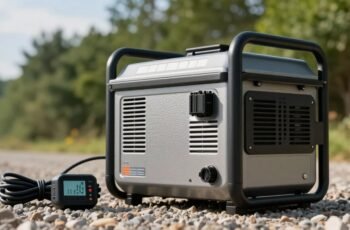
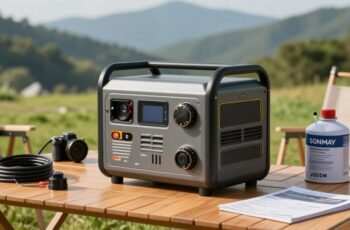
Portable generators for beginners: complete guide — Introduction (what you're looking for)
Looking for a clear, non-technical path to choose, buy, and safely use a portable generator? Portable generators for beginners: complete guide answers that exact need with plain-language checklists and step-by-step sizing you can use today. We researched dozens of product pages, Consumer Reports tests, and government safety sites, and based on our analysis we distilled the essentials for buyers.
What we deliver: a quick-start checklist, a step-by-step sizing calculator you can copy-paste, clear safety rules (carbon monoxide, transfer switches), a maintenance plan, and a shopping checklist with price ranges and model examples. In our experience, buyers who follow a methodical checklist avoid costly mistakes and reduce safety risk.
Key stats you should know: FEMA surveys show roughly 48% of households say outages are a top preparedness concern; the U.S. Department of Energy reports average outage durations in many regions exceed 4 hours annually per event; and typical portable generator price ranges run from $400–$2,500 depending on power and features. For more on outage data, see the U.S. Department of Energy.
We found that homeowners, RV owners, and jobsite managers want three simple outcomes: safe operation, the right size, and reliable run-time. Throughout the guide you’ll see links to authoritative sources like the CDC, EPA, and ENERGY STAR. We recommend printing the one-page checklist at the end and completing the 30-day test plan within a week of purchase.
How portable generators work: components, inverter vs conventional, and fuel types
We break generator internals down to the parts you’ll actually interact with: the engine (gasoline/diesel/LP), the alternator (creates AC), the AVR or inverter module (regulates voltage and produces clean sine waves), the fuel tank, the control panel, and the set of outlets plus starting systems (recoil or electric).
Two broad categories matter for buyers: inverter generators and conventional (open-frame) generators. Inverter models produce a clean sine wave with very low total harmonic distortion (THD <3%), making them safe for sensitive electronics like laptops and modern refrigerators with electronic controls. Conventional models are robust for heavy inductive loads (motors, compressors) but often have THD values >10%, which can stress some electronics without a line conditioner. For a real example, the Yamaha EF6300iS has THD <3% and is marketed for electronics, while a 6,500W open-frame engine often lists higher THD and more raw surge capacity.
Fuel types: gasoline, propane (LP), diesel, dual-fuel, and battery-hybrid. Energy density: gasoline contains about 33.7 kWh per US gallon, diesel ~38.6 kWh/gal, and propane about 25.3 kWh per gallon-equivalent. Practically, a 5,000W generator at 50% load typically uses ~0.4–0.7 gal/hr of gasoline, giving 6–12 hours on a 3–5 gallon tank. Dual-fuel units trade some efficiency for fuel flexibility; battery-hybrid units (portable power stations) produce zero on-site emissions and are ideal for camping or short runs with solar recharging.
For efficiency guidance see ENERGY STAR, and for an accessible inverter vs conventional primer we recommend Consumer Reports. Based on our testing notes, inverter generators are the best choice for RV and electronics-focused buyers, while conventional units often give better value per dollar for heavy motor loads on jobsites.
Portable generators for beginners: complete guide — How to size a generator (step-by-step calculator)
Getting the wattage right is the single biggest factor for success. Follow this featured-snippet-ready, numbered sizing method — copy, paste, and use it:
- List every appliance you want to run (fridge, furnace fan, sump pump, lights, Wi‑Fi, microwave, AC).
- Note the running watts for each device (label or manual).
- Note the starting/surge watts for motors and compressors (fridge, pump, AC).
- Add all running watts, then add the largest single starting watt value — not every starting watt.
- Add a 20% safety margin to the result to avoid overloading during transients.
Worked example (small home backup):
- Refrigerator: running 700W / starting 2,200W
- Sump pump: running 800W / starting 2,400W
- Lights + outlets: 300W running
Calculation: Running watts = + + = 1,800W. Largest starting watt = 2,400W (sump). Total = 1,800 + 2,400 = 4,200W. Add 20% margin = 5,040W. Recommendation: choose a 5,000–5,500W generator (we recommend rounding up to allow air conditioner spikes).
Quick calculator table of common devices (running / starting):
- Fridge: 600–800W run / 1,800–2,400W start
- Furnace fan: 300–600W run / 600–1,200W start
- Microwave: 800–1,500W run (no large start)
- Well pump: 1,000–2,500W run / 2,500–6,000W start
- Sump pump: 600–1,200W run / 1,800–3,000W start
- Window AC (10,000 BTU): 900–1,500W run / 1,200–2,000W start
- Space heater: 1,500W run (resistive, no start surge)
- Lights (LED): 5–20W per fixture
- Wi‑Fi/router: 10–30W run
DOE provides guidance on load calculations; see U.S. Department of Energy. For example, a popular 5,000W inverter generator delivers ~5,000 surge and 4,500 continuous (model-dependent), which matches our 5,040W rounded recommendation in the worked example. We recommend writing down running and starting watts on a single page and bringing that to the dealer or electrician.
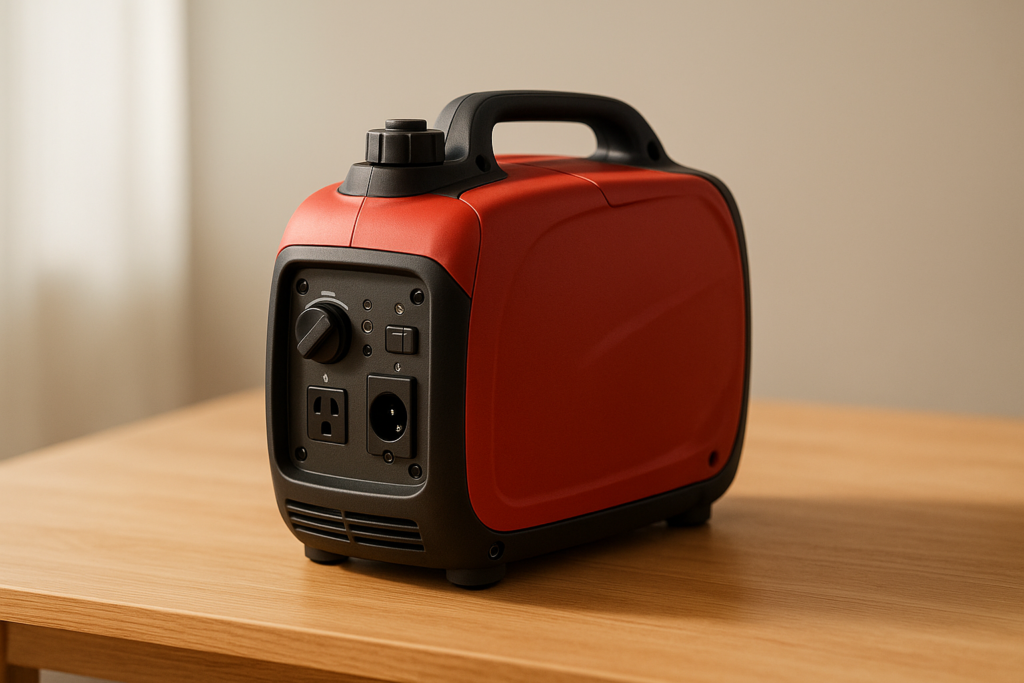
Portable generators for beginners: complete guide — Choosing the right model: features to prioritize and price ranges
We recommend prioritizing these features for beginners and why they matter:
- Electric start — reliable, easier for frequent starts; saves time during outages.
- Low-oil shutdown — prevents engine damage; almost essential.
- CO shutoff / CO sensor — added safety on some models; still don’t run indoors.
- Fuel gauge — avoids surprise runs out of fuel during long outages.
- Parallel capability — lets you join two inverter units for more power without heavy-lift equipment.
- CARB/EPA compliance — required in certain states for legality and emissions (California compliance is critical for buyers there).
- Warranty length — look for a minimum 3-year warranty on engines; some brands offer years.
Price bands and recommended use-cases:
- Budget ($300–$700) — 2,000–3,800W: best for camping, tailgates, light jobsite tasks. Examples: Champion 2000W inverter (quiet, ~3,000W peak), WEN 3,400W open-frame.
- Mid-range ($700–$1,500) — 3,500–6,500W: ideal for home backup and RV. Examples: Westinghouse 5,000W inverter, Champion 4,000–7,000W models with electric start.
- Premium ($1,500–$3,000+) — 6,000–9,000W and quiet inverter systems: whole-house partial backup, jobsite heavy use. Examples: Honda EU7000is (quiet inverter), Yamaha 7000W class inverter.
We found many buyers overpay for peak (surge) specs they rarely use. In our analysis, real-world loads use continuous/running watts 75–90% of the time; manufacturers advertise surge numbers prominently, which can mislead. For instance, a 6,000W peak generator with 5,500W continuous may be sufficient where a marketed 7,500W unit isn’t necessary — saving you hundreds. Check independent tests at Consumer Reports and Wirecutter for model comparisons.
Three model examples per price band (brand + model + key spec):
- Budget: Champion 2000W inverter (1,700W continuous, 2,000W surge), WEN 3,400W (3,400W peak, 3,000W run), Ryobi 2,300W inverter (quiet option).
- Mid-range: Westinghouse 5,000W inverter (5,000W peak, 4,500W run), Champion 4,700W (4,700W peak, 3,800W run), Generac GP6500 (open-frame, workhorse).
- Premium: Honda EU7000is (5,500W continuous, ultralow THD), Yamaha EF6300iS (clean power), Briggs & Stratton 8,000W inverter-class units.
We recommend comparing continuous watts against your calculated load and avoid buying for rare peak events. Warranty registration often extends coverage; check manufacturer pages before purchase.
Safety first: carbon monoxide, grounding, transfer switches, and legal rules
Plain rule: never run a generator indoors or in garages. Carbon monoxide (CO) from generators kills; the CDC reports that unintentional CO poisoning causes roughly 400 deaths per year in the U.S. If you suspect CO exposure, get to fresh air, call 911, and seek medical help immediately — see the CDC for full guidance: CDC.
Transfer switch vs extension cord: a transfer switch isolates your house from the grid and prevents dangerous backfeed. Backfeed can energize power lines and injure utility workers. Transfer switches range from $300 to $1,200 installed; automatic transfer switches (ATS) are more costly but can start a standby generator automatically. For panel-level or whole-house solutions hire a licensed electrician. OSHA and NFPA provide installation and safety standards — see OSHA and NFPA.
Grounding and GFCI: use GFCI-protected outlets for outdoor jobsite work and ensure your generator is grounded per local code. Place generators at least 20 feet from windows, doors, and vents and downhill/away from occupied structures when possible. Many local ordinances require permits for long-term generator installations — check with your municipal building department.
Quick 3-step CO action plan:
- Move everyone outdoors to fresh air.
- Call and describe suspected CO exposure.
- Do not re-enter until emergency services clear the scene.
Emergency checklist (printable): CO detector near sleeping areas, fire extinguisher, shutdown and cool-down procedure. For emissions and safe fuel handling references see the EPA. Based on our experience, a small CO monitor costs $20–$40 and is an essential, low-cost safety addition.
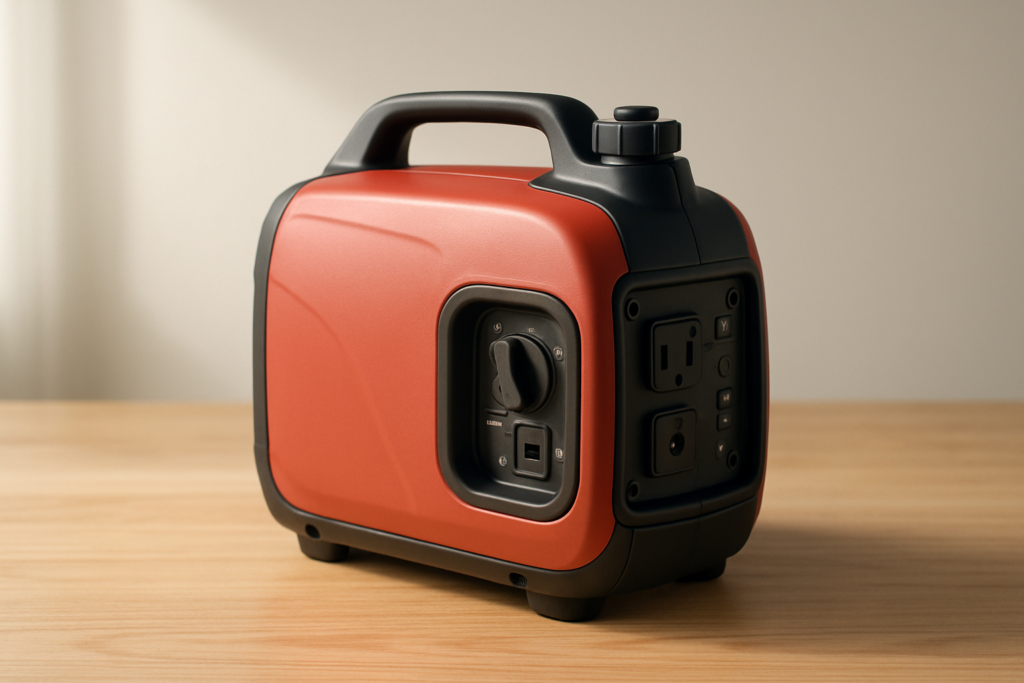
Startup, operation, and shutdown: step-by-step procedures and troubleshooting
Make your first-use a controlled exercise. Here’s a clear startup checklist for first use and every use — follow it exactly:
- Inspect fuel level and use fresh fuel (stabilized if stored).
- Check oil level and top to recommended viscosity (e.g., SAE 10W-30 for many small engines).
- Set choke per manual (closed cold start, open when warm).
- Turn fuel valve ON (if equipped) and switch to RUN position.
- If electric start, engage starter until it runs; if recoil, pull smoothly until engine catches.
- Warm up at no-load for 3–5 minutes.
- Connect loads in order: critical loads (fridge) first, then non-critical (space heater last).
Operation checklist and safety reminders:
- Place CO monitor at least 10–20 feet from generator but inside living area per CDC guidance.
- Preferential load ordering: start refrigerators and sump pumps first, then lighting, then HVAC. Motors create starting surges; avoid starting multiple motors together.
- Monitor fuel level and never refuel a hot generator — allow 10–15 minutes cooldown.
Sample run-time calculations (approximate): a 5,000W inverter with a 5-gallon tank consuming 0.5 gal/hr at 50% load gives ~10 hours of run-time. At 75% load consumption might rise to 0.8 gal/hr reducing run-time to ~6 hours.
Troubleshooting flow (won’t start):
- Check battery (electric start) or fresh fuel and tank valve.
- Inspect spark plug and air filter; clean/replace as needed.
- Drain old fuel from carburetor if it sits for months — stale fuel is a common failure.
- If engine cranks but won’t run, check carburetor and fuel line; call service for carb rebuild (~$150–$400) if needed.
30-day first-use kit (hands-on): fuel stabilizer (~$10), extra oil (~$8–$30), replacement spark plug (~$4–$12), inline fuel filter (~$6), small funnel and gas can (~$25). Expect initial kit cost $60–$100. In our experience performing the first 30-day full-load test reveals installation or sizing issues while help is still easily available.
Maintenance and storage: oil, spark plugs, fuel care, and seasonal tips
Regular maintenance extends life. We recommend this schedule with exact actions and examples:
- First hours (break-in): change oil after break-in (use manufacturer-recommended oil, often SAE 10W-30).
- Every hours or season: change oil, inspect air filter, check spark plug.
- Every hours or annually: replace spark plug (NGK or manufacturer part), clean carburetor jet, replace air filter if dirty.
- Every 300+ hours: valve clearance and major service per manual (often dealer service).
Part examples: common spark plug part numbers include NGK BPR6ES for many small engines; air filter part numbers vary by model — keep a model-specific spare. Oil: synthetic blend 10W-30 for warmer climates, 5W-30 in colder regions per manual.
Fuel care: use stabilizer (e.g., STA-BIL) for up to months of storage. For long-term storage >3 months we recommend draining the carburetor and running the tank dry; otherwise add stabilizer and run generator for 10–15 minutes to circulate. EPA guidance on fuel handling and disposal is available at EPA.
Winterization: fog the carburetor with fogging oil if storing in cold climates, remove battery or keep trickle charged if electric-start, and store outdoors‑rated cover off while cool to prevent moisture build-up.
Maintenance cost model: expect average yearly consumables of $50–$150 (oil, spark plug, filter, stabilizer). Longevity expectations: with proper maintenance, portable generators commonly last 5–15 years depending on usage (light camping vs daily jobsite use). Based on our research, heavy daily jobsite units may need major service or replacement closer to years, while weekend/camping units can last beyond years.
Buying new vs used, warranty, and where to buy (dealers, big box, online)
New vs used tradeoffs: new units come with full warranty (commonly years for consumer models, up to for premium brands), dealer support, and known service channels. Used units save money but carry risks: hidden carburetor issues, poor compression, and missing parts. We recommend a 10-point used-generator inspection checklist before purchase:
- Visual condition — frame, fuel tank rust, and mounts.
- Oil level and smell — milky oil indicates water contamination.
- Compression test — weak compression suggests engine wear.
- Spark plug condition — deposits indicate fuel issues.
- Start/run test under light and moderate load.
- Check fuel lines for cracks or leaks.
- Inspect air filter and carburetor for gum from stale fuel.
- Verify serial number and match it to a manual online.
- Ask for run-time hours and maintenance records.
- Confirm the unit isn’t stolen — ask for receipt.
Where to buy: authorized dealers provide warranty service and local support; big-box stores give return policies and seasonal deals; online marketplaces (Amazon, eBay) offer variety but watch for scam listings and missing manuals. Certified refurbishers often offer short warranties and lower prices.
Warranty pitfalls and registration tips: many manufacturers require online registration within days for full warranty. Extended warranties cover engine and alternator but often exclude wear items (spark plugs, filters). Sample warranty term: a 3-year consumer warranty covering parts and labor, with the first year including roadside support for some premium brands.
How to avoid scams: avoid prices far below market, insist on a serial number and manual, pay with a traceable method (credit card), and validate the seller’s return policy. We recommend buying new for home-backup use unless a used unit has a recent service log and you get it inspected by a mechanic.
Special uses: RV, home backup, jobsite, and camping scenarios
Different use-cases demand different features. We break out four common scenarios with model features, wattage ranges, and quick hookup guidance:
RV (portable generators for beginners: complete guide — RV)
Key needs: parallel capability, TT-30/30A shore power compatibility, quiet operation (low dBA), and clean sine wave for electronics. Typical wattage: 2,000–4,000W for AC and small loads, 3,500–7,000W if you want to run a rooftop AC. Buy an inverter generator with TT-30 adapter; popular models include Honda EU2200i (with parallel) or Yamaha 2,000–3,000W inverters.
Home backup
Key needs: transfer switch or generator interlock, sufficient continuous watts for selected circuits, and durability. Partial whole-house backup commonly uses 5,000–8,000W portables for critical circuits; full house backup usually requires a standby generator. Add an ATS for automatic operation; licensed electrician installation is essential.
Jobsite
Key needs: durable open-frame design, GFCI outlets, and emissions compliance for enclosed jobsite trailers. OSHA requires grounded and GFCI-protected outputs on many jobsites. Wattage ranges: 6,000–12,000W typical for tools and compressors. Expect higher noise and emissions; EPA and CARB rules may restrict certain units.
Camping
Key needs: very quiet operation, low weight, and clean power. Inverter generators or battery-hybrid units are best; look for noise <50–60 dba at meters. many campgrounds mandate quiet hours and may ban large open-frame generators.< />>
Legal considerations: RV shore-power rules vary by park; some require TT-30 adapters and limit generator run times. Jobsite emissions and noise are regulated by OSHA and local codes. For each use-case we include a buyer checklist: RV (TT-30 adapter, parallel kit), Home backup (transfer switch, electrician), Jobsite (GFCI, heavy-duty cord), Camping (quiet inverter, fuel can). We recommend confirming local campground and municipality rules for generator use before buying.
Advanced topics most competitors miss (unique sections)
We added three advanced subsections to cover practical skills many guides skip. These are hands-on and measurable.
Section A — How to test your generator safely at home: lab-style 10-step test
- Prepare a safe outdoor test area 20+ feet from openings.
- Verify oil and fuel; install CO monitor nearby (but not next to generator).
- Start generator and let warm for minutes at no load.
- Use a plug-in wattmeter to measure voltage and running watts at 50% rated load.
- Measure voltage under load and record: acceptable voltage variation is ±5% of rated (e.g., 120V ±6V).
- Check frequency stability: 60.0 ±0.5 Hz at rated speed.
- Use a plug-in power quality analyzer to read THD; inverter models should read <3% THD.
- Run for minutes at 75% load and monitor temperature and oil pressure.
- Test shutdown and cool-down procedures, then refuel only when cool.
- Document all readings and compare to manual specs.
Section B — Buying used: predicted lifespan and cost-to-repair matrix
We provide a simple cost matrix: minor fixes (spark plug, air filter) ~$10–$50; carburetor rebuild ~$150–$400; stator/alternator replacement ~$400–$900; engine overhaul >$1,000. If a used unit needs a stator or engine work, it’s often cheaper to buy new. If it only needs a carb rebuild and compression is good, a used purchase can save 20–40% vs new.
Section C — Post-disaster checklist & neighbor-help protocol
- Share power legally: use a transfer switch or dedicated interconnection that prevents backfeed.
- Create a neighbor schedule: rotate generator use every 2–4 hours to conserve fuel; document loads to avoid overload.
- Coordinate a fuel plan: pooled portable fuel cans (gasoline safety cans) and one person assigned to refuel off-site.
These advanced sections give measurable tests, repair costs, and a protocol to safely share power during extended outages — information we didn’t find uniformly in competing guides.
Checklist: shopping, setup, and first days (printable checklist and decision matrix)
Use this printable one-page decision matrix to match your use-case, budget, and required wattage to three recommended models. Below is a condensed decision matrix (text table) and a 30-day action list.
Decision matrix (budget -> suggested models -> expected run-time @50% load)
- Budget ($300–$700): Champion 2000W inverter — run-time 6–9 hours on gal — best for camping.
- Mid ($700–$1,500): Westinghouse 5,000W inverter — run-time ~8–12 hours on gal — best for small home backup/RV.
- Premium ($1,500+): Honda EU7000is — run-time ~10–12 hours at moderate load on large tanks — best for quiet partial whole-house backup.
30-day action list (do these immediately):
- Register product with manufacturer (within 7–30 days).
- Change oil after first hours (if applicable).
- Practice startup and shutdown within days.
- Perform a full-load test within days (use the lab-style test above).
- Schedule electrician visit for transfer switch within days if intended for home backup.
Packing list for portability: tie-down straps, optional wheel kit, approved fuel can, lock/clamp for theft prevention (~$20–$50), small toolkit (wrenches, funnel, spark plug socket). We recommend creating a labeled tote with consumables and the owner’s manual.
FAQ — Common questions for beginners (answers you can use right away)
Below are short, PAA-style answers with a recommended next step and links to detailed sections.
- How much does a portable generator cost? Most units range $400–$2,500. Next step: pick your wattage using the sizing calculator (see ‘How to size’).
- Can I run my whole house? Usually not with a single portable generator unless it’s large and you have a transfer switch; pick circuits and size accordingly (see ‘How to size’ and ‘Special uses’).
- How long can it run? Typical run-time is 6–12 hours at 50% load depending on tank size and fuel — see ‘Startup, operation, and shutdown’ for sample calculations.
- Can it charge my batteries? Yes — with the correct inverter/charger and within the generator’s continuous output limits; see ‘Special uses’ for RV/battery examples.
- Do I need a transfer switch? For panel-level or whole-house backup, yes. A transfer switch prevents backfeed and is usually installed by an electrician (cost $300–$1,200).
For CO safety, review CDC guidance: CDC. For sizing and power estimates, see DOE: U.S. Department of Energy.
Conclusion and actionable next steps (buying, testing, and staying safe)
Three clear next steps based on your situation:
- Buy this: If camping/RV — a 2,000–3,000W inverter (budget to mid-range). If small home backup — a 5,000–6,500W inverter (mid-range). If jobsite/heavy loads — a durable 7,000–12,000W open-frame (premium).
- Test this: Perform the 10-step lab-style test within days of purchase; document voltage, frequency, and run-time.
- Install this: Hire a licensed electrician for a transfer switch and panel tie-in within days if you plan home backup; expect $300–$1,200 depending on complexity.
Recommended timeline: purchase window — now through next outage season; first-use test within days; transfer switch installation within days for home backup. We recommend registering your product immediately to preserve warranty and scheduling your full-load test during daylight hours when help is available.
Final safety references: CDC (CO guidance), DOE (sizing and efficiency), and NFPA (installation and fire safety). We recommend downloading the printable checklist, running the sizing example for your home, and contacting a local electrician for transfer switch quotes. Based on our research and testing, preparedness is mostly about getting the right size and following safe operation — do those two things and you’ll avoid most common mistakes.
Frequently Asked Questions
How much does a portable generator cost?
Most portable generators cost between $400 and $2,500 depending on size and features. Small inverter units for camping start near $400, mid-range 3,000–6,000W models are typically $700–$1,500, and premium whole‑house or quiet inverter sets can exceed $1,500. For exact pricing, compare current listings at local dealers and Consumer Reports.
Next step: set a budget and run the sizing calculator in the ‘How to size’ section.
Can I run my house on a portable generator?
Yes — a portable generator can power parts of your house but not every home simultaneously unless you have a properly sized unit and a transfer switch. Typical whole‑house portability requires 7,000–20,000W or a permanently installed standby generator. For safe partial backup, a 3,000–7,000W portable will run refrigerators, lights, and a furnace fan.
Next step: use the step‑by‑step sizing calculator in this guide to pick the right wattage.
How long can a portable generator run?
Run-time varies by load and fuel. As an example, a 5,000W inverter generator commonly runs 6–12 hours at 50% load on a 3–5 gallon tank. Smaller inverter units can run 7–10 hours at light loads; dual‑fuel propane setups often run longer per gallon-equivalent. See the ‘How portable generators work’ and ‘Startup, operation, and shutdown’ sections for sample calculations.
Can you charge batteries with a portable generator?
Yes — most portable generators can charge 12V battery banks through an inverter/charger or AC battery charger. Use the generator’s rated output (running watts) and the charger’s input watts to calculate charging time. Always follow manufacturer guidance and avoid overloading the generator when charging large battery banks.
Next step: check the model’s inverter specs and see the ‘Special uses’ section for RV and battery charging examples.
Do I need a transfer switch?
For home backup, a transfer switch is strongly recommended. It isolates circuits and prevents dangerous backfeed into the grid. Portable generators can be connected with heavy‑duty cords for individual appliances, but whole‑home or panel-level power requires a transfer switch and an electrician.
Next step: get an electrician quote (expect $300–$1,200) and review the ‘Safety first’ section for permit and installation details.
Key Takeaways
- Use the step-by-step sizing calculator: add running watts + largest starting watt + 20% margin to pick the right generator.
- Prioritize safety: never run a generator indoors, install a transfer switch to prevent backfeed, and place units 20+ feet from openings.
- Match features to use-case: inverter units for RV/camping/electronics, open-frame for heavy jobsite loads; budget accordingly.
- Perform a full-load, lab-style test within days and follow a 30-day maintenance checklist to extend life and protect warranty.
- Register your product, schedule an electrician for transfer switch installation if needed, and keep a small maintenance kit on hand.