We’re here to help you size a portable generator with accuracy and safety in mind, balancing essential loads, startup surges, and runtime. We’ll map your priorities, verify each device’s peak and running watts, and account for ventilation and transfer method. Our aim is a practical headroom that’s not excessive, plus clear assumptions and a test plan. But there’s more to cover before you decide, and the next steps will tighten your criteria and prevent costly missteps.
Key Takeaways
- List essential loads (fridge, lights, sump well pump) and separate startup surges from running watts to size correctly.
- Choose a generator with surge capacity above total running watts by at least 10–20% for startup; avoid under-sizing.
- Factor runtime needs, fuel type, and efficiency to ensure the unit can run required loads during outages or camping trips.
- Verify device wattage, voltage, and duty cycle; document margins and safety requirements (CO detectors, ventilation).
- Build a simple decision matrix from pre-purchase checks to determine acceptable runtime, site requirements, and budget.
Watts 101: Difference Between Starting and Running Watts
So, what’s the real difference between starting watts and running watts, and why does it matter for choosing a portable generator? We’ll explain with precision. Starting watts reflect the surge a device needs to start, often 2–3 times its running wattage, while running watts cover steady, continuous operation. This gap matters for motors, compressors, and tools, because selecting a generator that only matches running watts can stall during kick‑off, reducing efficiency and stressing the unit. We assess two word discussion ideas to frame choices: “surge needs” and “continuous load.” We debunk wattage myths by verifying rating labels, using peak vs.Rated values, and accounting for age, temperature, and altitude. Practical takeaway: size modestly above total running watts to ensure reliable startup without oversizing. Safety and clarity guide our analysis every step.
Identify Essential Home Circuits for Outages
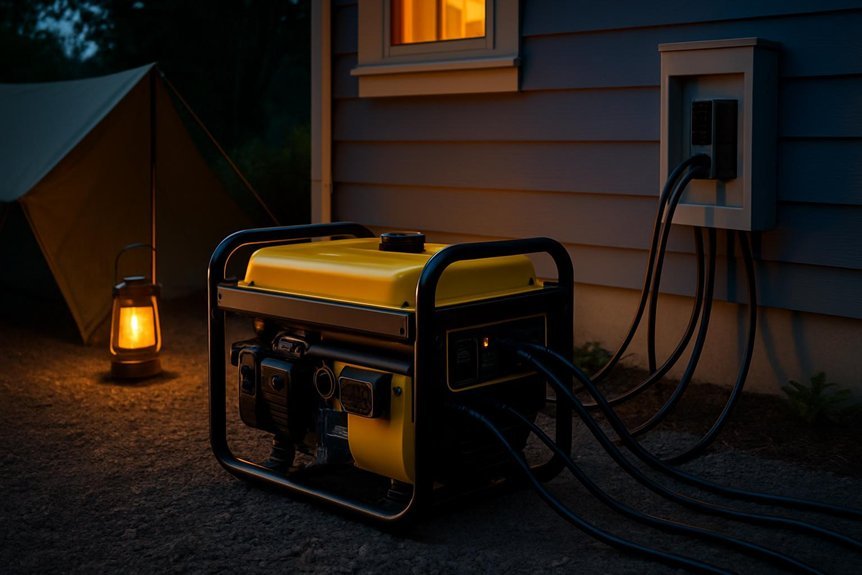
When planning for outages, we start by mapping the home’s electrical usage to keep critical functions running. We identify essential circuits that must remain powered, such as lighting, refrigeration, medical devices, sump pumps, and communications. Our outage planning prioritizes circuits connected to these loads, noting their amperage and receptacle types. We document panel layouts, note which breakers feed essential circuits, and determine if tandem or dual-pole breakers are in use. We assess startup surges and running loads, avoiding overloading the generator during peak demand. We also flag safety-critical components like carbon monoxide detectors and alarms. By clearly marking essential circuits and their priorities, we create a practical, repeatable framework that informs generator sizing, placement, and safe connection practices.
Size for Home Use: Step-by-Step Load Estimation
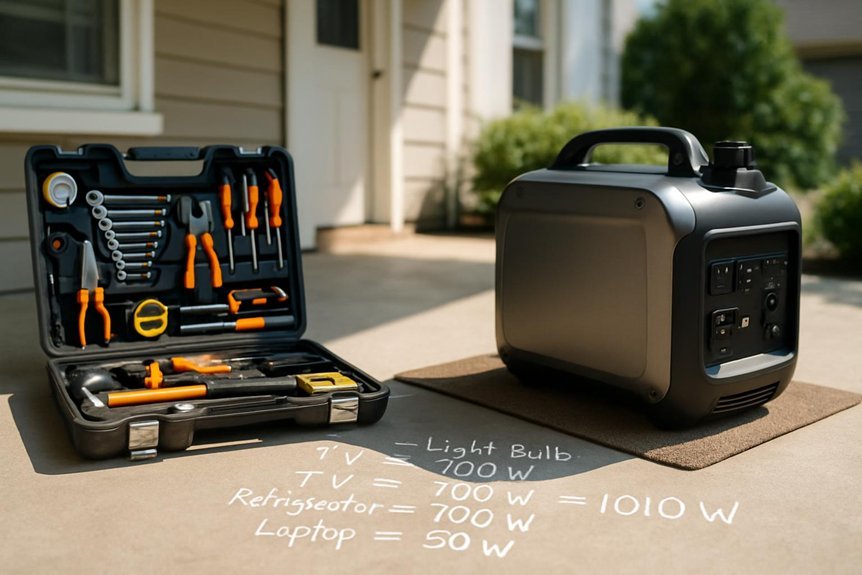
We’ll walk you through Load Calculation Steps and Essential Household Loads to establish a precise, safe starting point for generator sizing. By listing critical circuits, identifying nonessential loads, and applying load factors, we keep our estimation rigorous and conservatively rated. This approach guarantees reliability and repeatable results for a home-use setup.
Load Calculation Steps
Determining the correct home-use generator size starts with a precise load calculation: we identify every device and circuit that will draw power, estimate their running and startup requirements, and total them into a continuous-wupply (AC) demand. Our method follows a disciplined sequence: catalog loads, assign realistic duty cycles, separate continuous from surge requirements, and apply safety margins for margin-ready operation. We perform load estimation by combining essential wattage with expected runtime, then validate against generator rating curves to avoid overloading. We factor diversity factors and consider power quality and voltage consistency, ensuring wiring and breakers remain within code limits. This is a power budgeting discipline, not guesswork. Documentation of assumptions and a conservative, testable plan guards against outages and promotes predictable, safe performance.
Essential Household Loads
Ever wonder which household loads must be included first to size a home-use generator accurately? We begin with essential loads—the devices and systems that ensure safety, health, and basic comfort during an outage. Fridge and freezer demand high starting current and steady runtimes; prioritize them with surge allowances, and plan for continuous cycling. Lighting and essential outlets support navigation and communication, while sump pumps, well pumps, and HVAC controls prevent damage and moisture buildup. We evaluate daily essentials like clocks, radios, and modems as low-priority, but still cap them within total load to avoid nuisance trips. We apply conservative demand factors, verify wattage ratings, and document backup runtimes. Safety first: properly size cords, breakers, and transfer routes to avoid overloads or backfeed.
Size for Camping: What a Weekend Setup Really Demands
Planning a weekend setup starts with sizing your portable generator for the essentials you’ll actually run in the field: lights, refrigeration, charging, and a few power-hungry devices. We approach camping with a methodical mindset, prioritizing reliable runtime, fuel planning, and load balance to preserve safety and performance. Our aim is to match generator capability to a defined camping essentials profile, avoiding overkill while ensuring critical needs are met. We assess runtime versus fuel, consider starting surges, and plan for safe operation in outdoor environments. By identifying continuous and peak loads, we choose scalable options and maintain clear duty cycles. This disciplined approach minimizes noise, emissions, and risk while supporting a practical weekend setup.
Planning a weekend setup: size, balance, and reliable runtime for camping essentials.
- weekend setup
- camping essentials
- load-balanced operation
Surges vs Running Watts in Real Use
We’re going to clarify how surges and running watts translate to real use, so you know what your generator must handle. In practice, startup surges can spike well above running watts, but safety and efficiency hinge on staying within the unit’s surge and continuous ratings. We’ll frame this with real-world demands to help you size for reliable starts, steady loads, and safe operation.
Surges vs Running Watts
Surges and running watts are not the same thing, and confusing them leads to under- or over-sizing a generator. We distinguish surge watts as the temporary peak a device demands, while running watts are the steady draw. In practice, surges vs running watts shape how we select a unit with enough headroom for startup loads without wasting fuel or risking overheating. We apply watts 101 thinking: identify each appliance’s running wattage, then add the highest startup requirements to confirm a margin. This prevents nuisance shutoffs and ensures safe operation.
- Understand surge vs running distinction for each circuit
- Catalog devices’ peak startup and continuous loads
- Size with an ample safety factor to accommodate unexpected spikes
Real-World Power Demands
Real-world loads show how surges and running watts play out under typical use, not just in static numbers. We, in practice, map equipment startup transients to the generator’s surge capacity, then verify continuous running watts align with expected load. Critical loads—refrigeration, sump pumps, and communications gear—often spike briefly yet demand steadier power once motors start. Two word discussion ideas emerge: sizing margin and duty cycling. We measure real world demands by listing devices, recording startup surges, and summing continuous loads, then compare to rated output. Safety matters: provide appropriate transfer switching, handle inrush, and avoid overloading outlets. Analytical reasoning shows that a generator with a comfortable margin handles sporadic surges without overheating or nuisance shutdowns, delivering reliable, real-world power demands. Subtopic not relevant to the Other H2s listed above real world power demands.
Fuel Options and Efficiency for Longer Run Time
When planning longer run times for a portable generator, choosing the right fuel option and maximizing efficiency are critical for reliability and safety. We evaluate fuel choices to balance availability, storage, and emissions while targeting extended runtime without sacrificing performance. We consider energy density, burn rate, and generator design to minimize fuel waste and heat. Practical decisions include weathering storage risks, monitoring fuel quality, and implementing automatic shutdown safeguards during low-oil or overheating conditions. By optimizing operation, we extend runtime without overloading circuits or sacrificing starting reliability. Our approach emphasizes clear maintenance intervals and fuel stabilization practices.
- fuel choices: prioritize stability and storage safety for extended runtime
- efficiency: match load, cooling, and carburetion to sustain steady output
- safety: implement monitoring and safe handling protocols
A Practical Step-by-Step Sizing Method You Can Follow
To size a portable generator accurately, we start by translating your longer-run fuel and efficiency goals into a concrete power target. We then list essential loads, differentiate starting surges from running draws, and set a safety margin to accommodate transient spikes. Our step-by-step method focuses on verifiable numbers: wattage, voltage, duty cycle, and run-time requirements, not vague estimates. We build a load profile, verify continuous versus intermittent needs, and select a generator with at least 10–20% headroom for reliability. We document assumptions and perform a sensitivity check to reveal how subtopic idea impacts results, while avoiding overreliance on anecdote. If you encounter an unrelated discussion, we isolate it from the sizing math to preserve accuracy and safety. This disciplined approach yields a reproducible, defensible target.
Decide Your Priorities: Budget, Portability, and Noise
Why choose the right balance among budget, portability, and noise? We approach this with clear criteria, aligning equipment specs to your needs. Our method emphasizes budget planning, assessing upfront costs against long-term operating expenses, maintenance, and fuel. We then weight portability priorities against space, weight, and setup practicality, ensuring you can transport and deploy efficiently. Finally, we quantify noise tolerance, selecting units with appropriate decibels and enclosure design to protect neighbors and reduce fatigue. By framing decisions around these axes, we avoid overbuying or underestimating demand.
- Budget planning: initial cost, fuel, and service lifecycle
- Portability priorities: weight, dimensions, ease of transport
- Noise considerations: decibel targets, enclosure, and usage timing
Pre-Purchase Checklist: Concrete Questions to Answer
How can we quickly verify essential needs before buying a portable generator, ensuring we don’t overestimate demand or overlook critical constraints? We answer with a structured pre-purchase approach, focusing on concrete questions that sharpen scope and safety. Our method emphasizes two word discussion ideas: pre purchase and checklist relevance, guiding careful evaluation of loads, runtimes, and site requirements before committing. We’ll list essential checks, then translate them into a concise decision matrix for clarity and repeatability.
| Question | Rationale |
|---|---|
| What loads are critical? | Prioritizes essential safety and comfort |
| What’s the acceptable runtime? | Matches usage patterns to fuel strategy |
| Where will it operate? | Addresses ventilation, arcing, and permits |
| What are safety constraints? | Ensures CO, electrical, and grounding compliance |
| What’s the budget boundary? | Keeps selection aligned with needs |
This checklist supports precise, safer, and informed choices.
Common Wattage Myths and Quick Reference Cards
We cut through wattage myths with precise, practical guidance and clear safety thresholds. We’ll compare common misperceptions to actual load profiles, then pair that with concise quick reference cards you can trust on site. Our aim is to equip you with accurate numbers, risk awareness, and actionable steps for responsible generator sizing.
Wattage Myth Busting
Wattage myths can trip you up when selecting a portable generator, so we cut through the noise with clear, data-backed guidance and quick-reference checks you can trust. We debunk two word discussion ideas and wattage myths with precise reasoning, detailing real-load versus peak-load distinctions, duty-cycle limits, and startup surges. Our approach emphasizes safe, repeatable sizing that accounts for essential circuits and appliance profiles, not marketing numbers.
- Myth: watts equal continuous output; reality: surge vs. running wattage matters
- Myth: every device starts at same wattage; reality: inductive and motor loads spike
- Myth: larger is always better; reality: efficiency, runtime, and transfer-switch compatibility
We present concise checks, aligned with safety standards, to empower informed, repeatable decisions.
Quick Reference Cards
Quick Reference Cards distill common wattage myths into actionable, safety-focused guidance you can trust. We present concise facts to protect you and your gear, emphasizing safe operation, proper load estimation, and ventilation awareness. We highlight how portable ventilation supports cooling and prevents overheating under load, and we note that crankshaft efficiency affects fuel economy and continuous duty. By translating myths into numbers, we empower informed choices about starting surges and running watts versus peak loads. Before every use, verify receptacle ratings, circuit protection, and air flow. This frame keeps troubleshooting linear and predictable.
| Factor | Guidance |
|---|---|
| Start-up surge | Plan for 2–3x running watts; allow for brief spikes. |
| Run-time efficiency | Optimize rpm; balance load to protect crankshaft efficiency. |
| Ventilation | Ensure unobstructed intake/exhaust and ambient clearance. |
Frequently Asked Questions
How Long Can a Portable Generator Run Continuously?
We can run a portable generator continuously for about 8–12 hours on a full tank, depending on load; monitor fuel levels, plan refueling every 8–12 hours, and consider noise considerations for safe, efficient operation.
Do Inverters Handle Surge Loads Differently From Non-Inverter Models?
We’ll say this plainly: inverter surge handling is gentler on delicate loads, unlike non inverter efficiency, which can spike during surges. We perceive inverter surge as smoother, while non inverter efficiency fluctuates, risking overloads with high-inrush appliances.
Can I Run a Generator Indoors With Proper Ventilation?
We don’t run a generator indoors; proper ventilation is essential. Indoor ventilation must pipe exhaust outdoors, and ventilation safety requires continuous monitoring, carbon monoxide detectors, and respecting manufacturer guidelines to prevent dangerous buildup while we operate outdoors safely.
What Maintenance Schedule Extends Generator Lifespan the Most?
Most want simple tips, but we insist on precise maintenance scheduling that truly extends lifespan. We monitor oil, filters, and cooling; we set calendar reminders, track hours, and prioritize tasks for lifespan optimization while staying safety-focused.
How Do Weather Conditions Affect Generator Efficiency?
Weather impact lowers efficiency when temperatures extreme or humidity high, because air density and cooling shifts reduce spark timing and fuel vaporization. We analyze efficiency factors, monitor dew, and apply preventive maintenance to maintain reliable performance for you.
Conclusion
We’re like navigators charting a safe harbor, steering by the stars of watts and surges. Our plan is a sturdy bridge: identify essential loads, add headroom, and respect startup spikes. With precise measurements, we map run-time and budget, then test in calm, controlled conditions. Symbolically, the generator becomes our beacon, quiet yet steadfast, illuminating risk and refuge alike. By documenting assumptions and priorities, we move forward with confidence, safety, and clarity, arriving at the right size for home or camp.