P5000 Pro Power Station: Overview and First Impressions
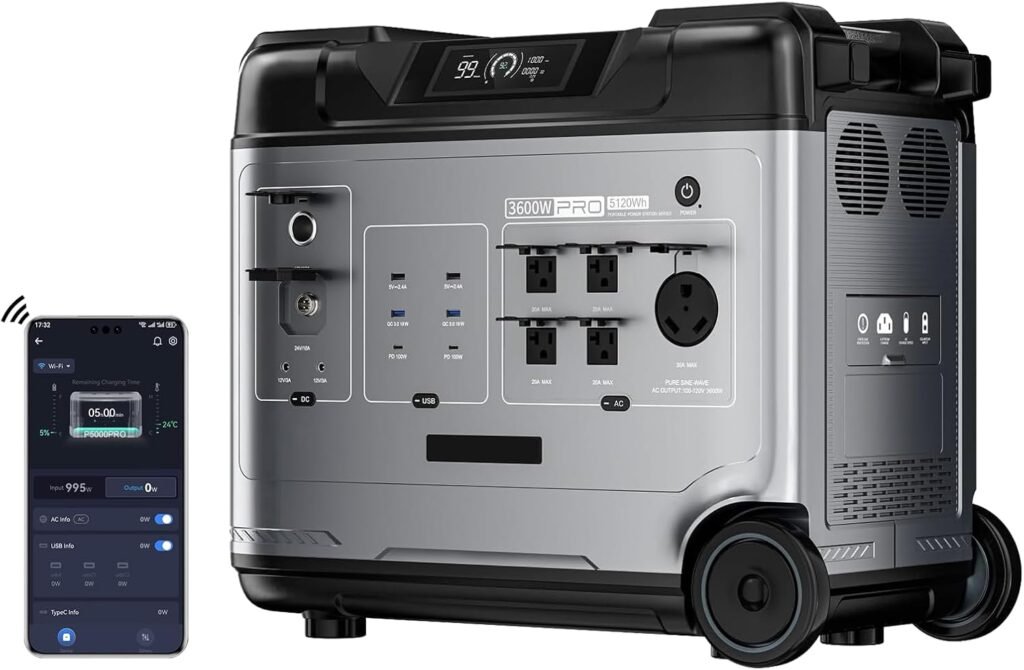
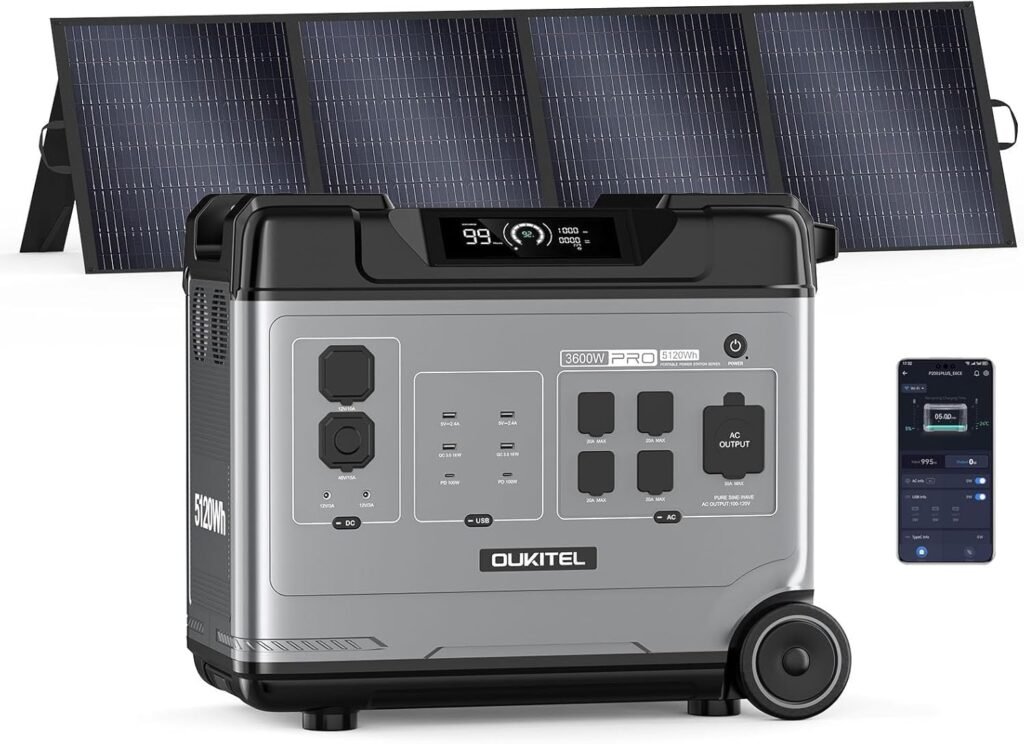
Does a $1499, 5120Wh portable power station provide enough capability and convenience for home backup, RV travel, camping, and job-site work? The P5000 Pro power station makes a strong case when heavy appliances matter more than lightweight portability. It combines a 3600W pure sine wave inverter, output ports, app control, solar charging, and a claimed sub-0.01-second EPS switchover in one rollable unit.
In 2026, we see the P5000 Pro power station as a high-capacity backup system rather than an easy-to-carry camping power bank. It is listed as in stock, and its main appeal is straightforward: support for demanding appliances, rapid AC recharging, long-cycle LiFePO4 cells, and wheels that make repositioning easier. Our review examines practical capacity, charging, backup reliability, portability, accessories, customer evidence, and whether the $1499 asking price makes sense.
The early impression is positive but qualified. This is potentially useful for several nights of moderate loads or short outages, yet its 112-pound mass means convenience depends heavily on level floors, ramps, vehicle access, and storage space.

Specifications, Capacity, and What the $1499 Price Buys
The core specification is impressive for the price, but watt-hours and watts describe different abilities. Battery capacity indicates how much energy is stored; inverter output indicates how much power can be delivered at one time. A microwave, hair dryer, or power tool may challenge the output ceiling, while a refrigerator or electric blanket usually draws power intermittently and uses capacity over a longer period.
| Specification | Listed detail |
|---|---|
| Battery capacity | 5120Wh |
| AC output | 3600W pure sine wave |
| AC input | 1800W |
| Solar input | 1000W |
| Weight | 112lb / 51kg |
| Outputs | 15 ports |
| Battery chemistry | LiFePO4 |
| Support | Three-year customer service and technical support |
With the P5000 Pro power station, actual runtime will vary with appliance wattage, inverter losses, duty cycle, ambient conditions, and the reserve the system keeps before shutting down. A refrigerator that cycles on and off cannot be estimated in the same way as a continuously running 100W device. We also found no independent measured usable-capacity result in the supplied listing.
At $1499, buyers should compare more than the headline 5120Wh figure. Output headroom, recharge speed, battery chemistry, included cables, support terms, and usable energy all affect value. The listing mentions three-year customer service and technical support, but it does not provide a detailed warranty statement; shoppers should confirm coverage, exclusions, return terms, and regional service before ordering.
P5000 Pro Power Station Performance and Heavy-Load Capability
The P5000 Pro power station uses a 3600W pure sine wave inverter, a waveform well suited to electronics, networking equipment, appliances, medical devices, and power tools. Pure sine output does not remove every compatibility concern, but it is preferable to less refined inverter designs for equipment with motors, chargers, or sensitive power supplies.
A 3600W continuous rating gives more headroom than many smaller camping units. It can support listed load types such as microwaves, refrigerators, hair dryers, electric blankets, mini-fridges, projectors, CPAP machines, and multiple small electronics. However, refrigerators, pumps, compressors, and some tools can demand a brief startup surge above their running wattage, so the continuous number alone is not enough.
Our practical load-planning method is simple:
- Record the running wattage of every essential device.
- Identify the highest startup or surge demand, especially for motor-driven equipment.
- Add the running wattages of devices that may operate simultaneously.
- Keep a sensible margin below the inverter limit rather than operating at the ceiling.
The P5000 Pro power station produces no direct exhaust while operating, unlike a fuel generator, but it still needs dry placement, ventilation, sensible cable routing, and safe charging. Never treat it as permission to use fuel-generator practices indoors, block cooling areas, overload outlets, or charge it where moisture can reach the equipment.

Charging Options: AC, Solar, and Vehicle Recharging
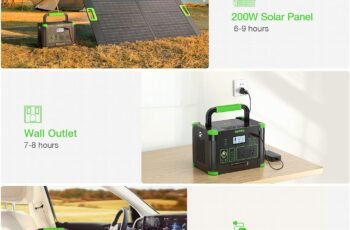
The P5000 Pro power station lists two AC charging figures: 0–100% in as little as 2.2 hours through the 1800W ultra-fast input, or 3.5 hours using standard AC charging. That distinction matters during an approaching storm, when rapid preparation can be more useful than a lower maximum input. It also makes routine backup maintenance less burdensome than slow overnight charging.
Solar input is rated at 1000W, with an advertised 23% solar conversion rate. Those are input and conversion claims, not guarantees of real-world harvest. Sun intensity, panel wattage, panel angle, temperature, shading, connector losses, and the solar cable can all reduce the reading shown by the station.
The listed package includes an AC charging cable, solar charging cable, and car charging cable, allowing charging from mains electricity, compatible solar panels, or a vehicle. Solar panels themselves are not listed among the included contents, so an off-grid setup may require additional spending.
- Verify the panel voltage and connector match the station’s solar requirements.
- Place panels in unobstructed sunlight and set them at a useful angle.
- Monitor input wattage in the app during changing conditions.
- Stay within the station’s voltage, current, and 1000W solar-input limits.
For emergency preparation, 2.2-hour AC charging is attractive. Weekend RV users may value the combination of AC and vehicle charging, while extended off-grid users should calculate whether available panels can replace daily consumption. The P5000 Pro power station offers flexibility, but solar independence depends on the panel system purchased alongside it.
Battery Longevity, Safety Systems, and EPS Backup
The P5000 Pro power station uses automotive-grade LiFePO4 cells and advertises more than charge cycles, alongside a claim of up to a 20-year service life under suitable conditions. LiFePO4 chemistry generally appeals to buyers seeking longer cycle life and better thermal stability than conventional lithium-ion cells, but neither the cycle figure nor the calendar-life claim guarantees a particular result for every household.
Real service life depends on depth of discharge, storage temperature, charging habits, usage frequency, and maintenance. A unit repeatedly emptied in hot conditions will not necessarily age like one kept partly charged in a moderate, dry environment. The built-in Battery Management System is stated to monitor voltage, current, and temperature, supporting safer charging and discharging by watching the conditions most relevant to battery stress.
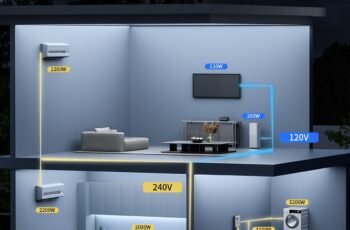
EPS mode is advertised with a sub-0.01-second switchover for desktop PCs, file servers, routers, and networking equipment. That is promising for short interruptions, but EPS is not the same as a certified permanent home standby system. We recommend checking connected-load limits, transfer behavior, device compatibility, and local electrical requirements before trusting it with critical equipment.
Before severe weather, charge the station and test each intended device individually. Keep firmware and app settings current, then store the unit according to the manual. The P5000 Pro power station should be treated as backup equipment that deserves testing, not as a device to unpack for the first time during an outage.
Ports, Device Compatibility, and App Controls
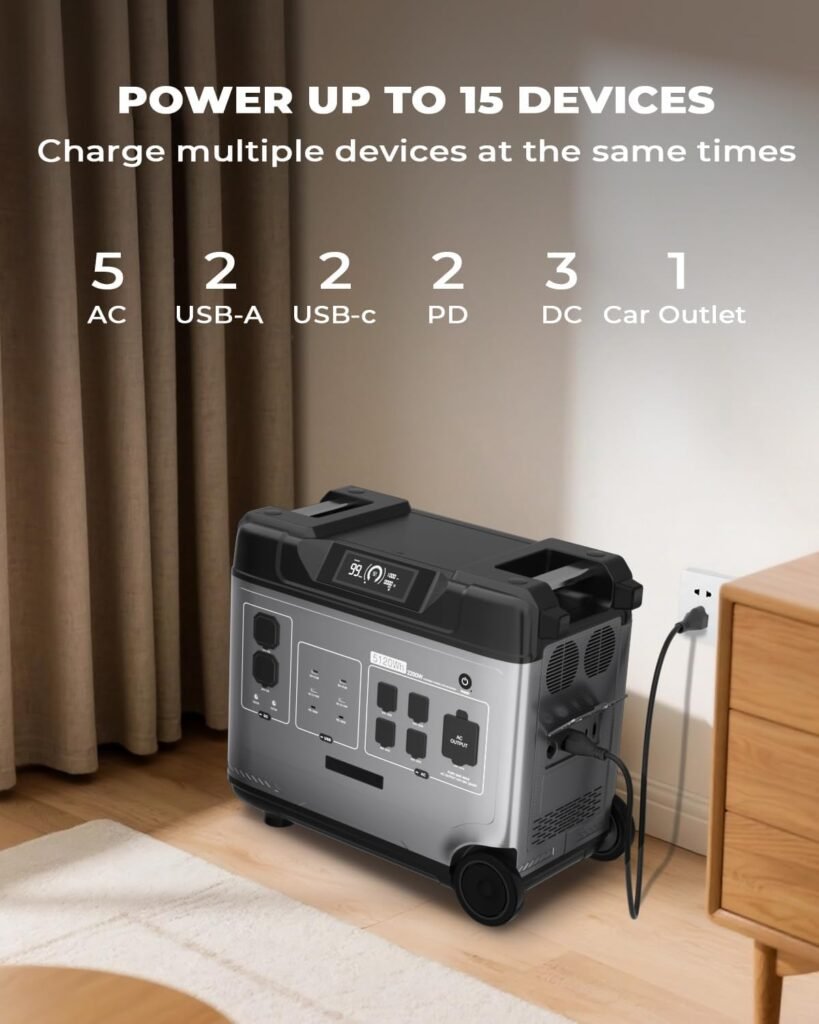
The P5000 Pro power station lists outputs: five AC outlets with 3600W total output, four USB-A ports, two USB-C PD ports, two DC ports, one cigarette-lighter socket, and one airline socket. This mix is practical for a household or campsite where phones, laptops, cameras, lights, CPAP machines, projectors, mini-fridges, and camping accessories use different connection types.
Several device categories can operate together, but the combined draw must remain within the inverter rating and each individual port’s limit. The listing does not specify the exact USB-C power delivery wattage or every DC voltage limit, so owners should consult the manual before connecting equipment with unusual charging requirements.
The dedicated mobile app is intended to show real-time input and output statistics, remaining battery life, and adjustable settings. A sensible setup takes only a few stages:
- Install the app and pair the station.
- Label the loads you expect to use during an outage.
- Run a low-risk test while reviewing input and output readings.
- Disable unnecessary wireless features when conserving battery.
We would also confirm wireless connection range, supported firmware, update procedures, and whether remote control remains available without local connectivity. The P5000 Pro power station has a useful control concept, but app reliability and the exact behavior of remote settings should be verified rather than assumed from the feature description.
Portability, Build, and Included Accessories
At pounds, or kilograms, the P5000 Pro power station is portable in the rolling-equipment sense, not the carry-anywhere sense. Its heavy-duty pull handle and durable wheels should make movement across a flat garage, house floor, RV pad, or suitable job-site surface easier, but most people will not want to carry it far by hand.
The listing claims it is 39% smaller and lighter than competitors. Because no comparison model or measurement method is identified, we would not treat that percentage as a universal ranking. The more useful question is whether the route from storage to the intended outlet has level surfaces, adequate doorway clearance, and no stairs.
Stairs, gravel, mud, narrow doorways, vehicle loading, and wet conditions can quickly reduce the practical benefit of wheels. Protect the equipment from moisture and extreme temperatures, and plan how two people will handle it when lifting is unavoidable. This is better suited to a garage, RV, workshop, or accessible job site than backpacking.
The listed box contents are the power station, AC charging cable, car charging cable, solar charging cable, and user manual. On arrival, inspect the package, photograph shipping damage, confirm every cable is present, and perform a low-risk charge-and-output test before an emergency. The P5000 Pro power station is much easier to evaluate while returns or support are still available than after a prolonged outage begins.
What Customers Are Saying About the P5000 Pro
No reliable Amazon rating or review count was included in the supplied product data, so we cannot honestly report a quantified customer sentiment score for the P5000 Pro power station. Specifications alone cannot establish whether buyers consistently experienced fast charging, accurate battery readings, quiet fans, reliable app connections, or useful refrigerator runtime.
That limitation also means we cannot verify recurring reports about appliance wattages, measured recharge times, solar-panel setups, outage durations, packaging, missing accessories, heat, or customer support. We will not turn the manufacturer’s feature claims into customer experiences. Buyers should inspect the current listing and sort reviews by recent date before placing substantial weight on any isolated comment.
When review evidence is available, the most useful reports name the connected appliance, its running or startup wattage, the duration of the outage, the input source, and the displayed battery change. A statement such as “very powerful” tells us far less than a documented refrigerator test or measured 1800W recharge.
Our advice is to separate setup mistakes from defects. Check whether a complaint involves a mismatched solar configuration, an overloaded port, an app pairing problem, or a genuine failure, and look for a manufacturer response to support issues. Until a verified rating and review total are available, the P5000 Pro power station should be judged primarily on its stated specifications, with customer confidence marked as unconfirmed.
P5000 Pro Power Station Compared With Alternatives
The P5000 Pro power station and Anker SOLIX F3800 target different priorities. The P5000 Pro lists 5120Wh, 3600W output, 1800W AC input, and 1000W solar input. The Anker is commonly marketed with 3840Wh, 6000W output, 2400W solar input, expandable storage, and 120V/240V dual-voltage capability, making it potentially better for higher-demand or expandable home-backup installations.
That does not make the Anker automatically better. Buyers prioritizing the P5000 Pro’s larger listed base capacity, fast 1800W AC charging, wheels, broad port mix, and included AC, car, and solar cables may prefer its simpler self-contained format. The Anker may suit households that need more output headroom, dual-voltage operation, or a path toward substantially greater storage.
A Jackery high-capacity Explorer model is another possible alternative, but the exact model, current price, capacity, output, solar limit, included accessories, and warranty terms were not supplied here. We cannot make a fair model-to-model verdict from brand names alone. Compare usable watt-hours, continuous and surge output, solar input, EPS behavior, LiFePO4 chemistry, outlet count, weight, and whether panels are included.
Competitor configurations and prices change, so use current listings and identify when an alternative costs more or includes fewer cables. The P5000 Pro power station makes the most sense when emergency appliance support and a large fixed base capacity matter more than 240V functionality or expandable household energy storage.
Who Should Buy the P5000 Pro?
The strongest audience for the P5000 Pro power station is homeowners seeking substantial short-term outage support for a refrigerator, networking equipment, medical devices, lighting, and selected kitchen appliances without operating a fuel generator indoors. Its large stored-energy reserve can also suit several nights of moderate loads rather than merely charging a phone or laptop.
RV travelers, campers, mobile workers, photographers, contractors, and job-site users may benefit from the combination of high capacity, heavy-load inverter output, wheels, and varied connections. The fit is strongest where the unit can remain on a level floor or be rolled from a vehicle to a working area. It is a poor choice for backpacking, frequent stair use, or any situation where one person must carry equipment a significant distance.
Consider an alternative if you need lightweight portability, whole-home 240V support, expandable battery storage, integrated solar panels, or a permanently installed transfer-switch system. Those requirements involve different hardware and installation expectations than a rollable standalone station.
- List essential loads and their running wattages.
- Calculate simultaneous demand and identify startup requirements.
- Estimate required watt-hours for the intended outage or trip.
- Select AC, solar, vehicle, or mixed charging.
- Check physical access and storage conditions.
- Compare the $1499 cost with alternatives and verified customer evidence.
For buyers whose environment matches those conditions, the P5000 Pro power station is a more logical purchase than a smaller phone-charging unit, though its mass should be accepted before ordering.
Value Assessment: Is the P5000 Pro Worth $1499?
At $1499, the P5000 Pro power station offers a substantial collection of capabilities: 5120Wh capacity, 3600W pure sine wave output, 1800W AC charging, 1000W solar input, LiFePO4 cells, EPS functionality, ports, app management, and AC, car, and solar cables. That package is easier to justify for frequent outages, RV or off-grid use, multiple simultaneous loads, high-value electronics, or buyers planning to keep the unit for many years.
The price is harder to defend for occasional phone charging, short low-demand camping trips, or shoppers without dry storage and accessible floors. Solar panels may also need to be purchased separately, increasing the cost of a genuinely off-grid setup. The headline watt-hour number should therefore be only one part of the decision.
The advertised more-than-3500-cycle figure provides a useful reference point, but it is not a guarantee of free energy or a 20-year result. Depth of discharge, temperature, storage, charging habits, and maintenance affect real ownership. Buyers should also confirm exactly what the three-year customer service and technical support promise covers, including warranty exclusions, returns, replacement procedures, and regional assistance.
Our buying framework is simple: match capacity to runtime, output to starting and running loads, recharge speed to emergency preparation, portability to the route it must travel, and support terms to the purchase risk. Then check current competitor features and customer reviews. On that basis, the P5000 Pro power station is worth considering at $1499 for serious backup and mobile power, but excessive for light recreational use.
Pros and Cons
Pros
- Large listed 5120Wh capacity for extended moderate-load backup
- 3600W pure sine wave output supports many demanding appliances and tools
- Fast claimed 2.2-hour AC recharge with 1800W input
- LiFePO4 battery chemistry with an advertised more-than-3500-cycle lifespan
- 15 output ports, app monitoring, EPS mode, and included AC, car, and solar cables
Cons
- 112lb / 51kg weight limits true carry portability
- Solar panels are not listed among the included accessories
- No independent usable-capacity measurement was supplied
- The detailed warranty coverage and return terms require confirmation
- No reliable rating or review count was provided, so customer sentiment cannot be quantified
Final Verdict
Key Takeaways
- The $1499 P5000 Pro combines a listed 5120Wh capacity, 3600W pure sine wave inverter, 1800W AC input, and 1000W solar input.
- Its LiFePO4 battery, claimed more-than-3500-cycle life, EPS mode, app controls, and outputs make it suited to serious backup and RV use.
- At pounds, it rolls more easily than it carries; stairs, rough ground, and vehicle loading remain significant limitations.
- The listing does not provide an independent usable-capacity test, detailed warranty terms, or a reliable rating and review count in the supplied data.
- It is a stronger value for outages, mobile work, and multiple loads than for occasional phone charging or lightweight camping.
Frequently Asked Questions
Which solar generator is better, Anker or Jackery?
Neither is universally better. Anker SOLIX F3800 specifications favor higher output, 2400W solar input, expandable storage, and 120V/240V operation, while a Jackery Explorer model may be preferable for a particular combination of weight, accessories, price, or warranty. Compare the exact models on usable capacity, continuous and surge output, charging limits, battery chemistry, EPS behavior, and portability.
Are Anker solar generators any good?
Anker solar generators can be a good fit when buyers need high output, fast solar charging, or expandable home-backup storage. The SOLIX F3800 is commonly marketed with 3840Wh, 6000W output, 2400W solar input, and 120V/240V capability, but shoppers should confirm current specifications, pricing, installation requirements, and recent customer feedback.
What is the best solar-powered generator for the money?
The best value depends on the loads and charging method rather than capacity alone. For the P5000 Pro, the $1499 price buys 5120Wh, 3600W output, fast AC input, LiFePO4 cells, EPS, and ports; buyers should compare those features with usable capacity, solar panels, warranty coverage, weight, and verified reviews from competing models.
What are the downsides of solar generators?
Common drawbacks include high upfront cost, heavy weight at larger capacities, slower or weather-dependent solar recharging, limited energy compared with fuel storage, and the need to buy compatible panels separately. They also require careful load planning, and an EPS feature should not be treated as a permanent whole-home transfer-switch installation without checking electrical requirements.
Disclosure: As an Amazon Associate, I earn from qualifying purchases.