At 63 dBA, the Champion 12.5-kW Home Standby Generator operates at a noise level worth weighing alongside its backup capacity. We can expect up to 12,500 watts on propane or 11,000 watts on natural gas, but that output is intended for selected essential circuits, not an entire home. Its 100-amp automatic transfer switch supports up to 16 circuits. We’ll examine what its features, installation needs, and limitations mean for a practical backup setup.
Key Takeaways
- Delivers up to 12,500 watts on propane or 11,000 watts on natural gas for selected essential circuits.
- The included 100-amp ATS100 transfer switch covers up to 16 circuits, so this is not whole-home backup.
- Automatic outage operation, weekly self-tests, and a battery charger help keep the generator ready.
- Runs at 63 dBA and starts from -22°F to 104°F without a warming kit, but requires a properly sized fuel supply.
- Professional installation is required; a 10-year limited warranty and nationwide service network add support.
12.5-kW Standby Generator
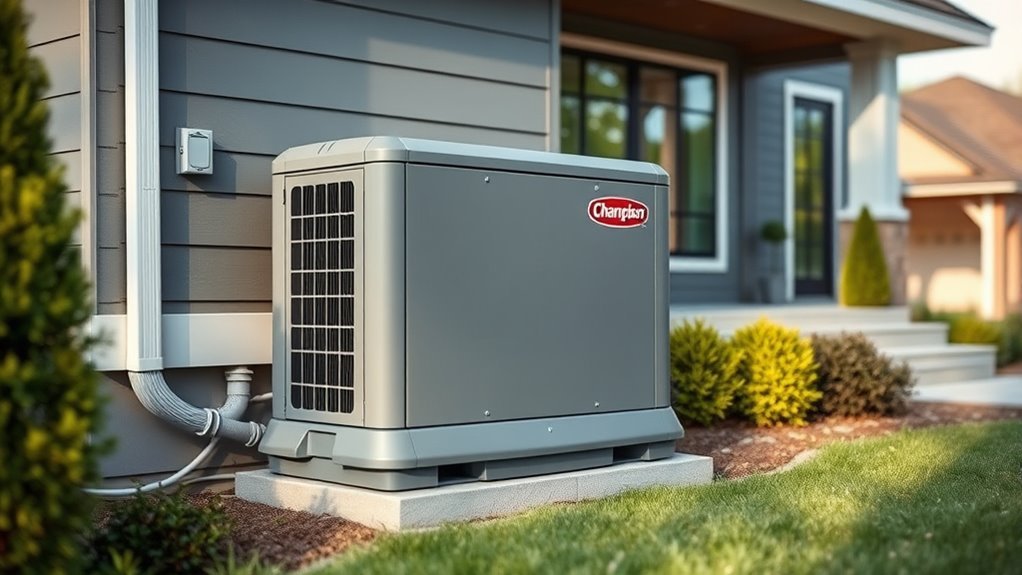
When you need automatic backup for essential circuits, the Champion 12.5-kW standby generator offers up to 12,500 watts on propane or 11,000 watts on natural gas. We can compare these ratings with your essential loads to determine whether its capacity suits your needs; it’s designed for selected circuits, not whole-home coverage. At 240 volts, output reaches 52.1 amps on propane or 45.8 amps on natural gas. The fuel source may affect fuel efficiency and operating expense, so consider local utility rates and propane pricing. We should also account for installation costs, including electrical work, transfer-switch setup, and connection to an existing gas supply.
Detailed features
Beyond its rated output, the Champion 100179 pairs automatic operation with features designed for outdoor standby use. It delivers 12,500 watts on propane or 11,000 watts on natural gas, with less than 5% total harmonic distortion. The included ATS100 transfer switch supports 100 amps across 16 circuits, so we can prioritize essential household loads. An onboard charger maintains the battery, while weekly self-tests check readiness. Its enclosed NEMA 3R housing provides climate protection, and gull-wing panels give us access to the engine and controls. A 24-volt starting system operates from -22°F to 104°F without a warming kit; noise is rated at 63 dBA.
Pros and Cons
We’ll weigh the generator’s strengths, including automatic operation, dual-fuel output, and its 10-year limited warranty, against its limitations. We’ll also consider that the included 100-amp transfer switch supports essential circuits rather than a whole home. This comparison will help you assess whether its capabilities fit your backup-power needs.
Pros
Because the Champion 100179 runs on a home propane or natural-gas supply, it starts automatically during an outage and avoids manual refueling. We also get automatic transfer, weekly self-tests, and an onboard battery charger.
| Advantage | Specification | Practical benefit |
|---|---|---|
| Flexible fuel | 12,500 W propane; 11,000 W natural gas | Choose available supply |
| Quiet operation | 63 dBA; sound-dampening design | Less intrusive backup |
| Cold weather reliability | Starts from -22°F to 104°F | No warming kit required |
| Circuit control | 100-amp, 16-circuit ATS | Prioritize essentials |
Its under-5% THD output suits sensitive electronics. We also value the 10-year limited warranty, lifetime technical support, and nationwide service network. Together, these features make routine readiness and outage response more convenient for households.
Cons
The Champion 100179’s main drawbacks are its limited circuit capacity and installation demands: the included 100-amp ATS supports 16 circuits, so it prioritizes essentials rather than powering an entire home. Limited circuit capacity means we’ll need to choose which loads receive backup and may require load management. The high installation cost can also add substantially to the purchase price, since a qualified professional must connect the unit to the home’s electrical system and gas supply. At 455.5 pounds, the generator requires suitable placement and handling. Its fixed natural-gas or propane connection avoids refueling, but it also depends on an available, properly sized fuel supply.
Concluding thoughts
For homes that need backup for essential circuits rather than whole-house coverage, the Champion 100179 offers automatic operation, 12,500 watts on propane or 11,000 watts on natural gas, and a 100-amp transfer switch. Its weekly self-tests, onboard battery charger, and 10-year limited warranty support reliability expectations, while output below 5% THD suits sensitive electronics. However, you’ll need installation planning to confirm circuit priorities, fuel access, and professional setup. The 100-amp switch serves up to 16 circuits, not the entire home. If those limits match your needs, we find this model a capable standby option, backed by lifetime technical support and a nationwide service network.
Frequently Asked Questions
What Fuel Consumption Should I Expect When Running on Propane or Natural Gas?
We can’t estimate fuel consumption from the provided specifications: they list 12,500 watts on propane and 11,000 on natural gas, but no consumption rates. Propane runtime estimates require tank size; Natural gas efficiency depends on load.
What Propane Tank Size Is Recommended for This Generator?
We recommend a 500-gallon propane tank for this generator, though actual Propane Tank Capacity depends on runtime, load, and climate. We’d verify sizing with your propane supplier and maintain Cold Weather Reserve for reliable operation.
Can a Licensed Electrician Install the Generator and Transfer Switch?
Yes—your licensed electrician can install the generator and transfer switch, provided they meet local electrician qualifications. Check permit requirements before work begins; we recommend confirming inspections, utility coordination, and applicable electrical codes with your authority.
How Often Should the Generator Receive Professional Maintenance?
We recommend following Champion’s owner’s manual for the maintenance schedule and service intervals; have a qualified technician inspect the generator annually, and arrange service sooner if diagnostics, operating conditions, or manufacturer guidance indicate a need.
Is the Generator Compatible With Solar Power or Battery Storage?
We can’t confirm Solar integration or Battery compatibility from the specifications; coincidentally, both depend on system design. Ask Champion and your installer whether compatible controls can coordinate the generator, solar inverter, batteries, and transfer switch safely.
Conclusion
We wouldn’t treat 12.5 kW as whole-home coverage: the Champion is designed to support selected essential circuits, with capacity reaching 12,500 watts on propane or 11,000 on natural gas. Its 100-amp ATS manages up to 16 circuits, but careful load selection and professional installation remain essential. Automatic transfer, weekly self-tests, and a battery charger support readiness; they can’t compensate for inadequate fuel or poor placement. At 63 dBA and 455.5 pounds, this unit demands practical site planning.