Did you know that a generator’s efficiency isn’t just about its rated wattage but how its engine size, throttle strategy, and load pattern align with your actual use? We’ll unpack how mid-range, stable RPMs and smart cooling minimize parasitic losses, why real-world duty cycles matter, and what that means for fuel costs and reliability. There’s more to optimize beyond max output, so stay with us as we connect theory to practical choices.
Key Takeaways
- Efficiency hinges on load matching: generators run most efficiently at mid-to-high loads (roughly 50–80% of rated output), not at light loads.
- Fuel type and engine design matter: diesel often yields better specific fuel economy than gasoline, with turbo or advanced governors further improving efficiency.
- Parasitic losses reduce real efficiency: accessories (alternator, cooling, exhaust) and startup surges increase fuel use.
- Real-world testing matters: standardized load conditions (25%, 50%, 75%) reveal true efficiency versus marketing claims.
- Regular maintenance and smart operation save fuel: maintain filters, spark plugs, and use digital meters to optimize runtime per gallon.
Key Factors That Determine Portable Generator Fuel Efficiency
The fuel efficiency of portable generators hinges on several core factors that determine how much power you get per gallon. We analyze engine displacement, load factor, and throttle strategy, since these directly shape specific fuel consumption. Fuel type matters for efficiency curves too; gasoline vs diesel engines exhibit distinct energy releases, combustion temps, and maintenance implications that shift overall performance. Start mechanism also influences idle losses and startup surge, with electric start vs recoil offering different parasitic loads and usability trade-offs. Component efficiency—alternator, cooling, and exhaust systems—affects heat losses and parasitic draw, refining usable output per unit fuel. Finally, gearing toward optimal load at design point minimizes inefficiency, delivering stable, predictable runtime without overworking the engine.
How Fuel Consumption Is Measured and Why It Matters
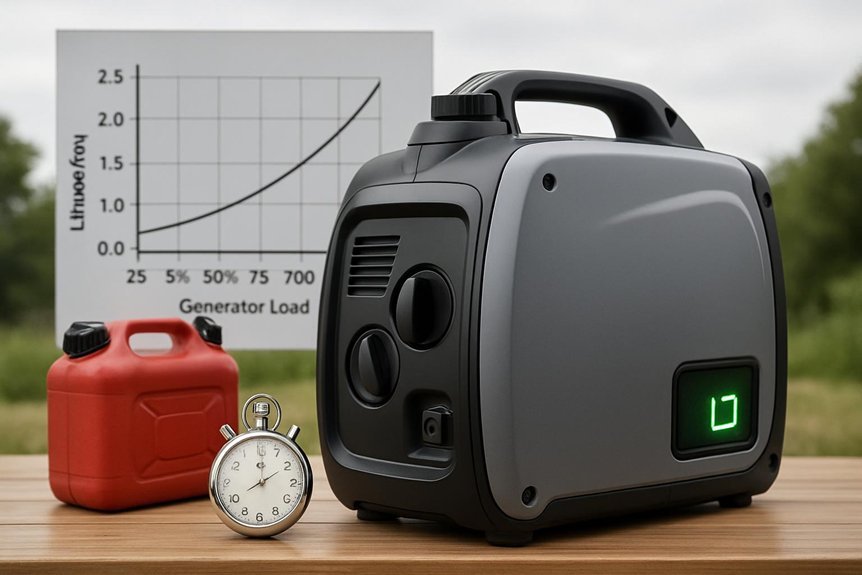
We measure fuel consumption by quantifying how much fuel a portable generator uses to produce a given amount of usable electricity under defined operating conditions. We present results to compare efficiency across models, assess cost implications, and understand performance under load, ambient, and age factors. Our approach emphasizes standardized testing, clear reporting, and relevance to decision making. We also consider fuel pricing trends and their impact on total cost of ownership, as well as battery alternatives for hybrid or standby configurations. The following table summarizes key measurement inputs, outputs, and interpretation for readers evaluating generators.
| Parameter | Measurement Method | What It Indicates |
|---|---|---|
| Load Condition | Defined % of rated output | Real-world efficiency influence |
| Fuel Type | Specified grade/quality | Consistency of results |
Matching Engine Size to Your Power Needs
How do you guarantee your portable generator isn’t overpowered or underpowered for its intended use? We approach engine-size matching with precise calculations and clear constraints. Our goal is to balance starting surges, continuous load, and efficiency, avoiding fuel usage myths and excessive noise. By aligning rated output with typical peak and running demands, we minimize stress on components and maximize reliability while pursuing noise reduction.
- Assess critical loads first to determine baseline power
- Compare startup surges to generator rating and choose margin
- Factor anticipated duty cycle for efficient operation
- Validate with real-world load tests rather than rumors
This method preserves performance, reduces unnecessary fuel burn, and keeps noise levels within acceptable limits while ensuring durable, predictable power.
How Load, Duty Cycle, and Runtime Drive Fuel Use
We’ll start by examining how load affects efficiency, noting that higher loads generally improve specific fuel consumption up to the generator’s rated sweet spot. We’ll then look at duty cycle trends, showing how sustained versus intermittent use shifts fuel burn versus output. Finally, we’ll link runtime to consumption, illustrating how longer operation at fixed load influences total fuel use and how this informs real-world sizing and usage patterns.
Load Impact on Efficiency
When a portable generator isn’t loaded to its ideal range, fuel use per kilowatt hour climbs due to inefficiencies in the engine and alternator. We analyze load as a primary driver of fuel economy, not just runtime. At mid to high loads, thermal efficiency improves, while light loads waste energy maintaining idle governors. We compare fuel types and noise reduction implications, noting gasoline vs diesel behavior under varying loads. To illustrate, consider these points:
1) Underloading raises specific fuel consumption per kW.
2) Peak efficiency aligns with rated continuous load.
3) High loads increase exhaust heat and material stress.
4) Lightweight duty cycles shorten engine life unless matched to demand.
We quantify how load patterns shape overall cost and performance, guiding choice and operation.
Duty Cycle Fuel Trends
Duty cycle shapes total fuel consumption as much as load level does, because runtime at different duty cycles integrates both engine efficiency and auxiliary losses over time. We examine how fuel trends shift with duty cycle, separating baseline engine burn from parasitic losses and cooling overhead. Higher duty cycles raise average torque and heat, altering volumetric efficiency and frictional losses, while low cycles emphasize startup fuel hits and transient inefficiencies. Our analysis targets measurable patterns: incremental increases in specific fuel consumption with rising duty, and diminishing returns as engines reach optimal torque bands. This perspective helps readers compare generators beyond rated output.
| Condition | Impact on Fuel Trends |
|---|---|
| Low duty | Higher startup loss; lower steady burn |
Runtime and Consumption Link
Runtime and Consumption Link: as load changes and duty cycle shifts, total fuel use reflects how long a generator runs at a given power output plus the fuel burned during startup and any cooling overhead. We analyze how these factors translate into real-world efficiency and environmental impact, separating runtime duration from per-hour consumption. Our focus is on measurable inputs, not vague impressions, to inform the fuel efficiency debate.
1) We quantify startup surge vs. steady-state burn to clarify true consumption.
2) We compare light loads to peak loads to show duty-cycle effects.
3) We assess cooling and idling overhead as nontrivial cost factors.
4) We link runtime data to emissions implications for environmental impact.
Fuel Options and Their Costs for Generators
What fuel options do portable generators offer, and how do their costs compare in real-world use? We evaluate gasoline, diesel, propane, and natural gas on energy content, availability, and price volatility. Gasoline remains common for consumer models, but price per kilowatt-hour fluctuates with refining margins and seasonal demand; fuel quality directly affects engine efficiency and maintenance intervals. Diesel provides high energy density and longevity in industrial units, yet upfront costs and infrastructure limits matter. Propane offers clean combustion and stable storage, though cost per hour can rise with supply constraints. Natural gas is convenient where a utility line exists, but conversion kits and pressure losses influence performance. Storage stability and fuel quality drive total ownership costs, influencing fill-frequency and service intervals.
Design Features That Save Fuel Without Compromising Safety
We examine how fuel-saving design features and safety-compliant efficiency measures work together in portable generators. Our analysis focuses on mechanisms that reduce consumption without compromising protection, including optimized ignition, load management, and cooling strategies. We’ll assess trade-offs and benchmarks to explain how these features deliver real gains in efficiency while upholding safety standards.
Fuel-Saving Design Features
How can portable generators maximize fuel efficiency without sacrificing safety? We analyze practical design features that lower consumption while maintaining reliability. Our focus centers on quantifiable gains from core systems, avoiding extraneous claims.
1) Optimized engine efficiency through precise air-fuel metering and ignition timing, reducing fuel matching to load.
2) Lightweight, high-strength components that minimize parasitic drag and improve overall fuel saving without compromising durability.
3) Advanced cooling strategies that maintain optimal operating temperatures, preventing inefficiencies from thermal throttling.
4) Intelligent governors and load-sensing electronics that stabilize rpm and throttle response under variable demand, boosting endurance.
Together these features enhance engine efficiency and promote fuel saving across typical load profiles, delivering consistent performance, reduced emissions, and dependable operation for users seeking economical power sources.
Safety-Compliant Efficiency Measures
Safely optimizing fuel use hinges on integrating design features that curb consumption without elevating risk. We assess how targeted measures translate to real-world performance, balancing fuel economy with stringent safety considerations. Our analysis identifies governance-aligned controls, like load-responsive governors and calibrated ignition timing, that minimize parasitic losses while preserving steady output. We examine alternator and cooling-system architectures to prevent overcooling or overheating under varied loads, ensuring reliable operation without waste. Emission-reduction strategies—such as optimized combustion chambers and clean exhaust routes—contribute to efficiency without compromising safety. Noise and vibration suppression are evaluated for operator protection and durability, preventing efficiency penalties from service interruptions. Overall, these safety-compliant efficiency measures demonstrate that higher fuel economy can coexist with rigorous risk management and consistent performance.
Real-World Fuel Economy Comparisons of Popular Models
What do real-world fuel economy tests reveal about the most popular portable generators, and how do their performances compare under typical loads? We analyze measured fuel consumption across load strata, factoring engine displacement, governing behavior, and fuel type. Results show meaningful variation between models at 25%, 50%, and 75% loads, with efficiency gaps driven by carburetion and turbine losses. We also examine how rated wattage aligns with practical output, revealing why some units underperform predictions. Our findings address fuel economy myths by separating marketing claims from data-driven results, and we note noise reduction tradeoffs tied to engine speed and muffler design.
- Consistent under heavy load matters more than peak ratings
- Smaller displacement can outperform larger rivals at mid-load
- Quieter models don’t always imply best efficiency
- Real-world testing reduces guesswork about reliability
Practical Tips to Stretch Every Gallon
Optimizing fuel use with a portable generator hinges on controlled, replicable practices rather than relying on unused capacity. We, as pragmatic operators, examine load profiles, startup transients, and duty cycles to quantify efficiency gains. Keep our loads near a steady state—ideally between 50% and 80% of rated output—and avoid sustained operation at light throttle, which wastes fuel and causes rough engine behavior. Regular maintenance, including air filtration, spark plug condition, and clean fuel, minimizes parasitic loss. Use digital meters to monitor fuel flow, efficiency, and runtime per gallon, then adjust usage patterns accordingly. Consider eco trends and market pricing to select models with better load tolerance and longer fuel economy. Document results to validate strategy and guide responsible, repeatable practices.
How to Choose a Fuel-Efficient Generator for Your Use Case
To choose a fuel-efficient generator for your use case, we start by aligning performance targets with real-world load profiles established from our earlier work on practical fuel management. We then evaluate options with a focus on fuel type and warranty implications to maximize reliability and cost-effectiveness.
1) Compare output efficiency at expected loads for each fuel type.
2) Assess long-run fuel costs and availability in your region.
3) Verify applicable warranty implications across operating conditions.
4) Prioritize models with precise telemetry and maintenance predictability.
Frequently Asked Questions
What Maintenance Impacts Generator Fuel Efficiency Over Time?
We find that maintenance impacts generator fuel efficiency over time through injector cleanliness, air filter condition, spark performance, and oil quality, affecting combustion efficiency; warranty considerations and aftermarket fuel options can influence maintenance choices and long-term reliability.
Do Generator Run-Time Hours Affect Fuel Economy Significantly?
We find that run-time hours do modestly affect fuel economy; idle load and startup peaks introduce short-term inefficiencies, but steady, light loads sustain better efficiency, whereas long runtimes with frequent starts increase consumption more than continuous modest loads.
How Do Weather Conditions Influence Fuel Consumption in Gensets?
Weather impact can raise fuel consumption; we see higher loads from heat and humidity, and altitude effects lower air density, reducing efficiency. We’ll quantify, compare, and adjust operation to minimize fuel use while maintaining power reliability.
Can Fuel Additives Improve Efficiency or Damage Engines?
Fuel additives can improve burn efficiency in some fuels, but improper use can cause deposits or lubrication issues; maintenance impact matters most. We analyze formulations, manufacturer guidance, and engine design to determine net efficiency and potential risks for gensets.
Is There a Measurable Difference: Inverter vs. Conventional Generators?
Yes, there’s a measurable difference: inverter efficiency generally surpasses conventional efficiency due to PWM control, but conventional tradeoffs—cost, weight, and robustness—remain. We, readers, compare inverter efficiency against steady-output performance and practical reliability in real workloads.
Conclusion
We’ve shown how efficiency hinges on matchless engine size, load, and duty cycle, then how design choices and fuel type shape real-world fuel use. For example, a mid-range 2,000–3,000-watt inverter generator paired with a stable 60–70% load maintains higher specific fuel economy than a larger unit running near idle. By tailoring size to typical loads, maintaining the unit, and choosing the right fuel, you gain meaningful miles-per-gallon and reliable power when you need it.