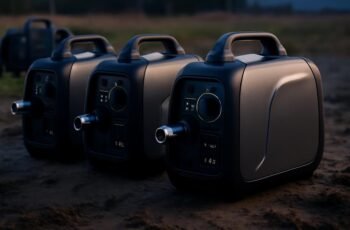
We’ll explore 10 portable generators that suit apartment living—compact, quiet, and safe power options for laptops, lights, and essential devices. We’ll compare capacities, inputs, and features like LiFePO4 safety and pass-through charging. If you’re weighing battery only vs. solar-ready units, we’ll break down what fits your space and budget. And we’ll point out practical trade-offs you’ll want to know before you commit.
Key Takeaways
- Prioritize lightweight, compact units (roughly 2–7 lb, under 300Wh) for easy apartment storage and solo transport.
- Favor pure sine-wave inverters with 100–300W continuous output and 600W surge for essential appliances.
- Ensure multiple charging options (AC, car, solar) plus pass-through charging to power devices during recharging.
- Choose LiFePO4-based packs with robust BMS and safety protections for longer life and safer indoor use.
- Look for built-in handles, real-time LCDs, and compact form factors that fit on shelves or in closets.
BailiBatt 300W Portable Power Station, 266Wh Solar Generator
If you’re apartment-bound and need reliable power without lugging heavy gear, the BailiBatt 300W Portable Power Station stands out with its compact 266Wh battery and a full 7-output setup, including a pure sine-wave 110V AC outlet. We value its 300W continuous, 600W surge, and 6.5 lb frame, making it easy to stash. It handles MacBooks, iPhones, drones, CPAP, and camping lights, with dual USB-C PD ports for fast charging. Safety features include a multi-layer BMS and protections against over-charge, over-discharge, short-circuit, and overheating. Real-time LCD shows input/output wattage and remaining battery, with solid 24-month warranty and 24/7 support.
Best For: apartment dwellers and weekend campers seeking a compact, lightweight 266Wh power solution with multiple outputs for laptops, phones, CPAP, and lights.
Pros:
- Very light and compact (6.5 lb, 8.7 x 5.1 x 7.9 inches) for easy transport and storage
- 7 outputs including pure sine wave 110V AC, dual USB-C PD, USB-A, 12V car port, and DC output for versatile charging
- Real-time LCD display with safe multi-layer BMS and robust protections (over-charge, over-discharge, short-circuit, overheating)
Cons:
- Maximum continuous output of 300W may limit use with higher-wattage devices
- 266Wh capacity could require frequent recharges during extended outages or heavy usage
- No built-in wireless charging or solar input details in the listing (requires separate solar panel and setup)
MARBERO 88Wh Portable Power Station with Solar Optional
The MARBERO M82 88Wh power station stands out for ultra-compact portability with solid 120W peak output, ideal for apartment dwellers needing a lightweight backup that fits on a shelf or in a closet. We value its 88Wh lithium-ion battery, 2.29 lb weight, and eight ports (AC, DC, USB, USB-C PD) plus a car charger. It charges to 80% in about 2 hours and supports 30W–60W MARBERO solar panels for optional solar input. It’s compact, with a handle, safe BMS, built-in flashlight, and auto shutoff. Real-world use includes phones, laptops, small appliances, or a car fridge during outages.
Best For: Ultra-portable backup power for apartment dwellers, campers, and travelers who need a compact, lightweight power source with multiple ports and built-in safety features.
Pros:
- Ultra-lightweight and compact design (about 2.29 lb) with a handy grip for easy portability
- 8-port versatility (AC, DC, USB, USB-C PD) plus a car charger, suitable for phones, laptops, small appliances, and devices like a car fridge
- Fast wall charging (0–80% in ~2 hours) with optional solar input (30W–60W panels) and built-in safety features (BMS, auto shutoff)
Cons:
- 88Wh capacity may be limiting for larger appliances or extended outages
- Some users report slower full charging and occasional reliability concerns over long-term use
- Output peak is 120W, which may not cover power-hungry devices simultaneously for extended periods
DaranEner 56000mAh Portable Power Station with AC Outlets
The DaranEner 56000mAh Portable Power Station is ideal for apartment dwellers needing compact, safe backup power with multiple outlets. We appreciate its 179.2Wh capacity (56000mAh @ 3.2V) and 300W inverter (600W surge), backed by LiFePO4 chemistry and 12 safety features. At ~5.7–6.2 lbs, it’s truly portable, with 7 ports total: 2 USB-A, USB-C 60W, 3 DC5521 inputs, and 2 AC outlets. It powers laptops, phones, lights, fans, and small appliances like a mini-fridge within 300W. Fast charging delivers 100% in 1.5 hours from a wall outlet; car or solar setups reach full in about 2 hours. Warranty is 2 years.
Best For: apartment dwellers needing compact, safe backup power with multiple outlet options for everyday electronics and small appliances.
Pros:
- Fast AC charging: 100% in 1.5 hours from a wall outlet
- LiFePO4 chemistry with 12 safety features and ~3,500+ cycle longevity
- Portable with a 7-port design (USB-C 60W, USB-A, DC inputs, and AC outlets) suitable for diverse devices
Cons:
- 179.2Wh capacity may be limiting for higher-wattage devices or prolonged outages
- Maximum inverter output of 300W (600W surge) restricts larger appliances
- Real-world performance may vary on high-load devices and battery endurance over time
HOWEASY Portable Power Station 88Wh Solar Generator
For apartment dwellers who need portable power with minimal bulk, the HOWEASY 88Wh Solar Generator stands out with its compact 2.3‑lb frame and eight-output versatility. We value its 88Wh lithium battery, 120V AC 150W peak, and diverse outlets: 2 AC sockets, 1 USB-C (18W), 2 QC 3.0 USB, 1 USB-A (5V 2.4A), and 2 DC (12V/10A). Built-in LED shows status, remaining power, and offers three lighting modes. It supports AC, solar, and car charging, plus a hidden carry handle for portability. With a 1500+ cycle life and 24‑month warranty, it fits home and on‑the‑go needs without excess bulk.
Best For: apartment dwellers and light outdoor enthusiasts who need compact, multiport portable power for phones, laptops, lights, and small devices without adding bulk.
Pros:
- Very portable at 2.3 lb with a hidden carry handle
- 8-output versatility (AC, USB-C, USB-A, QC USB, DC) for multiple devices
- Flexible charging options (AC, solar, car) with a clear status display and LED lighting
Cons:
- 88Wh capacity may limit longer off-grid use and some laptops may require higher input (20V) for full compatibility
- Solar panel not included; charging speed can vary by source
- Limited peak AC output (150W) may not support higher-wattage devices simultaneously
EnginStar 300W Portable Power Station with Solar Generator
Powered by a compact 300W rating, the EnginStar Portable Power Station fits tight apartment spaces without sacrificing essential outlets. We like its 296Wh capacity and dual 110V pure sine wave outlets keep laptops, lamps, and small appliances running smoothly. With 6.5 pounds and compact dimensions, it’s portable yet capable, featuring a built-in LED light and large LCD for easy monitoring. It also provides USB-C fast charge, USB-A, and DC outputs for phones, cameras, or CPAPs. Charging options include wall, car, or solar (panel sold separately). Remember its 300W limit, and store away from extreme temps for longevity.
Best For: Weekend campers, small-space apartments needing a compact, reliable portable power source for essential devices.
Pros:
- 296Wh capacity in a compact 6.5 lb package with dual 110V pure sine wave outlets
- Multiple charging options (wall, car, and solar panel compatibility) and convenient USB-C/ USB-A ports
- Built-in LED light, large LCD display, and smart battery management with multiple safety protections
Cons:
- Continuous power limit of 300W means it can’t run high-wattage appliances (e.g., induction cookers, microwaves, full-size refrigerators)
- Solar charging requires a separate solar panel (not included)
- Requires proper temperature and storage conditions for longevity; avoid extreme temps for best lifespan
MARBERO 88.8Wh Solar Generator with Panel Included
MARBERO’s 88.8Wh solar generator stands out for campers and short-term outages with a built-in 21W panel, letting us rely on sun-powered charging when you’re away from outlets. We see it as a portable power station offering 88Wh capacity and up to 80W input/120W max, practical for lights, laptops, and small fridges during outages or outdoor trips. The included 21W panel enables daytime charging, while the unit provides full power at night or on cloudy days. It’s an eco-friendly option that minimizes emissions and supports off-grid stays. With the package, you get both the station and the solar panel for versatile use.
Best For: campers and short-term outages who want off-grid charging with an included solar panel.
Pros:
- 88.8Wh capacity provides a compact, portable power source for lights, phones, and small devices
- Integrated 21W solar panel enables daytime sun charging to replenish power on the go
- Lightweight and portable design suitable for camping, road trips, and emergency use
Cons:
- 21W panel is relatively small, resulting in slower recharge times in less-than-ideal sunlight
- Output may be limited for power-hungry devices (e.g., full-size appliances or multiple high-draw tools)
- Built-in solar panel may add cost and weight compared to standalone generators or larger battery packs
Anker SOLIX C1000 Gen 2 Portable Power Station
The Anker SOLIX C1000 Gen 2 stands out for apartment dwellers thanks to its massive 2,000W continuous output paired with a 1,024Wh LiFePO4 battery, plus ultra-fast 49-minute recharges. We appreciate the 10 ms UPS backup for essential devices and the versatility of 10 ports that power up to 10 devices at once. It’s 14% smaller and 11% lighter than similar models, with a sturdy handle for portability. Solar charging adds convenience: 1.8 hours at 600W, or 49 minutes via HyperFlash. TOU mode helps curb peak charges, while the LiFePO4 chemistry promises long life and reliable performance.
Best For: Apartment dwellers and small-space homes needing a powerful, fast-charging, long-life portable power station with flexible charging options and UPS backup for essential devices.
Pros:
- 2,000W continuous output with 1,024Wh LiFePO4 battery for reliable operation of multiple devices
- Ultra-fast 49-minute recharge (HyperFlash) and 10 ms UPS backup for critical loads
- Versatile charging and inputs (AC, solar up to 600W, car/DC) plus TOU mode to manage peak electricity usage
Cons:
- Some listings omit battery details or accessories, leading to uncertainty about included cables
- App may have limitations (e.g., power consumption history) and occasional compatibility caveats
- Limited DC/AC input configurations when charging while discharging and potential solar configuration considerations
Jackery Explorer 300 Portable Power Station (293Wh)
The Jackery Explorer 300 stands out for apartment dwellers thanks to its compact 293Wh lithium battery and 300W max output, delivering quiet, clean power without fumes or maintenance. We view it as a reliable, portable option with two Pure Sine Wave outlets, a 60W USB-C input/output, and multiple charging paths. It weighs about 7.1 pounds, supports pass-through charging, and runs gadgets like laptops, phones, TVs, cameras, and more. Fast wall recharge hits 80% in 2 hours, while car or solar charging adds flexibility. It’s ideal for emergencies, camping, or small backups, though not suited for high-power appliances.
Best For: Apartment dwellers and casual outdoor enthusiasts seeking a compact, quiet, reliable 293Wh power station for emergency backups, small devices, and off-grid use.
Pros:
- Quiet, clean power with no fumes and low maintenance
- Lightweight (about 7.1 pounds) and compact for easy portability
- Pass-through charging and multiple charging options (wall, car, solar)
Cons:
- Not suitable for high-power appliances like induction cooktops or blenders
- Only 300W max output may limit running larger devices
- Solar panel not included in the package
BLUETTI Elite 30 V2 Portable Power Station
With 600W continuous output and a compact 9.4 lb frame, the BLUETTI Elite 30 V2 is ideal for apartment dwellers who need reliable, on-demand power without lugging around heavy gear. We appreciate its 288Wh LiFePO4 battery and 10 ms UPS, delivering fast, steady support for essentials like lights, laptops, CPAP, and small kettles. Eight charging modes include AC, solar, and car, with 0–80% in 45 minutes and 0–100% in 70 minutes for battery safety. We value its Power Lifting Mode up to 1500W, 50% lower power use via UltraCell tech, and straightforward setup with included cables.
Best For: apartment dwellers and on-the-go users who need reliable, lightweight backup power for essentials like lights, laptops, CPAP, and small appliances without lugging heavy gear.
Pros:
- Lightweight and compact at 9.4 lbs with a portable form factor
- 288Wh LiFePO4 battery plus 10 ms UPS for fast, reliable power and device protection
- Multiple charging modes (AC, solar, car) and quick 0–80% in 45 minutes / 0–100% in 70 minutes for battery safety
Cons:
- 600W continuous output may limit use with higher-watt appliances
- Small form factor means lower total energy capacity for long outages
- 8 charging modes could be excessive for some users seeking a simpler setup
Portable Solar Generator with Foldable 60W Panel (300W)
A standout choice for apartment dwellers is this 300W portable solar generator with a foldable 60W panel, offering clean power without gas, indoors or outdoors. We value its 280Wh Li-ion pack, 110V pure sine output, and 2 AC outlets plus DC and USB ports for versatile charging. We appreciate the 60W panel, MPPT charging, and recharge options from wall, car, or solar. We remind readers to avoid devices over 300W and to keep the junction box dry. We like its portability at 5.08 pounds, compact dimensions, and 7/24 support, while noting performance varies with sunlight and user tips.
Best For: apartment dwellers and outdoor enthusiasts seeking clean, portable power with a foldable solar panel for indoor or outdoor use.
Pros:
- Lightweight and compact (5.08 pounds; 8.5 x 6.7 x 4.1 inches) with a 300W capacity and 280Wh battery.
- Includes a foldable 60W solar panel with MPPT charging for flexible recharging options (wall, car, solar).
- Pure sine wave 110V outlets and multiple ports (USB A/C/DC) suitable for smartphones, laptops, cameras, and small devices; 24/7 support and warranty available.
Cons:
- Maximum practical load is 300W; power-hungry devices (coffee makers, hair dryers) may trip or damage the unit.
- Junction box is not waterproof; keep dry and protect from moisture.
- Solar panel performance varies by sunlight and conditions; some users report panel issues prior to replacement/refund.
Factors to Consider When Choosing Portable Generators for Apartment
We’ll start by weighing power output limits, battery capacity, and how long you’ll need run time for typical apartment use. We’ll also compare portability, weight, charging options, and how flexible each setup is for different living spaces. Finally, we’ll consider noise and heat management, so you can pick something that fits your building rules and comfort level.
Power Output Limits
Are you staying within your apartment’s power limits while still getting reliable backup power? We know apartment circuits favor lower draws, so we target units with continuous wattage under 500W and a clear surge rating for startup spikes. Look for a model that lists running watts and peak watts, since fans, routers, and small appliances demand brief surges even if the steady load stays modest. Pure sine wave inverters deliver cleaner, safer power for sensitive electronics than modified sine, reducing risk at shared outlets. Count ports and distribution: AC, USB-C, USB-A, and DC matter, but don’t overcommit continuous watts across outlets. Higher-capacity units—around 1000Wh with multiple ports—extend runtimes, but demand careful budgeting to avoid tripping apartment breakers.
Battery Capacity Considerations
Battery capacity matters because it directly tunes how long your essentials stay powered. We balance capacity with weight and indoor safety, since bigger packs mean more bulk and tougher cooling. For most apartments, aim 200–600Wh to keep lights, phones, and a laptop running for several hours without overloading space or heat. Battery chemistry matters too: LiFePO4 offers longer cycle life and safer chemistry than many alternatives, typically 3,000–4,000+ cycles. Remember, higher Wh extends runtime for the same load, but adds weight. Check if the unit supports pass-through charging and recharging while in use, which boosts continuous power during outages. In practice, pick a pack that meets your essential load while staying manageable and safe indoors.
Portability And Weight
Portability and weight matter as much as capacity when you’re picking a portable generator for apartment living. We look for power stations in the 2–7 pound range with under 300Wh so you can carry them easily and store them discreetly. A compact form factor, roughly 6–9 inches in at least one dimension, helps you tuck units beside furniture or in closets without crowding space. Lighter models often trade some continuous output, so we check that the steady wattage meets essentials—aiming for 100–300W for common apartment needs. Built‑in handles and ergonomic designs make solo transport through hallways and into rooms smoother. If a unit weighs under 10 pounds, placement on shelves or desks becomes practical, reducing the need for frequent moves.
Charging Options Flexibility
Charging options flexibility is essential when selecting a portable generator for apartment living, because outages and space limits demand adaptable recharging. We look for multiple charging options—AC wall, car/cigarette lighter, and solar MPPT—to ensure we can recharge during outages or when solar is available. Prioritizing models with rapid recharging helps minimize downtime in urban settings with limited storage. Pass-through charging matters, so you can power devices while the unit recharges. We also assess inverter size and stable pure sine wave output to protect sensitive electronics common in apartments. Finally, we consider whether the package includes a solar panel or requires separate panels, affecting overall cost and compatibility with apartment-friendly solar setups. This combination improves reliability and flexibility for daily use.
Noise And Heat Management
Noise and heat are top concerns when choosing a portable generator for apartment living. We look for units marketed as quiet or with low dB ratings, since portable power stations tend to stay calm, but fan noise and inverter hum still matter. Heat management matters too: most models use active cooling or thermal protection, so we need adequate ventilation and to avoid blocking vents in tight spaces. Higher continuous wattage and surge can push fans harder, increasing noise, so we match capacity to typical apartment needs. Thermal cycling matters with LiFePO4 and similar chemistries, offering steadier temps and less overheating during long use. Placement helps: keep space from walls, use heat-dissipating surfaces, and favor models with automatic output reduction if heat rises.
Safety Protections And Longevity
Safety protections and longevity are non-negotiable for apartment use, where a single fault can affect neighbors and sensitive devices. We look for a robust Battery Management System (BMS) that constantly monitors voltage, current, and temperature to prevent overcharging, over-discharging, short-circuits, and overheating. LiFePO4 chemistries offer longer cycle life and stable longevity, helping you avoid frequent replacements. In an apartment, prioritize units with multiple safety protections—overload, short-circuit, overheating, and surge protection—to shield your electronics. A clear, real-time LCD display showing remaining battery and input/output wattage helps you manage power use and prevent outages. Higher surge and continuous output ratings, like 300W continuous with 600W surge, provide a buffer for brief high-draw appliances, enhancing reliability.
Frequently Asked Questions
Are These Units Safe for Indoor Use in Apartments?
Yes, these aren’t safe for indoor use in apartments. We strongly recommend outdoor installation with proper ventilation, carbon monoxide detectors, and following manufacturer guidelines to protect you, your neighbors, and your property from CO poisoning risks. Stay safe.
Which Models Have True Sine Wave Output?
Yes, some models have true sine wave output. We recommend Honda EU2200i, Generac iQ3500, Westinghouse WH2200iX, Ryobi RYI2300, and Champion 200964. We’ll help you compare features and guarantee smooth, clean power for sensitive devices.
How Long Can They Run Essential Appliances?
We can run essential appliances for several hours to all day on a portable generator, depending on tank size and load; choose efficient models, monitor runtime, refuel safely, and avoid overload to protect appliances and power reliability.
Do They Require Ventilation or Heat Management?
Yes, they require proper ventilation and heat management. We monitor exhaust closely, keep units outdoors or in well-ventilated areas, use clearance space, and avoid enclosed configurations to prevent overheating and dangerous fumes for everyone nearby.
Are There Stackable/Expandable Battery Options?
Indeed. Yes, there are stackable/expandable battery options, like modular packs you can daisy-chain, and some systems offer expandable capacity with swappable cells. We’ll assess compatibility, safety, and real-world runtimes for your setup together.
Conclusion
We wrapped up the essentials to power laptops, lights, and small appliances during outages, all in compact, apartment-friendly packs. One intriguing stat: portable power stations around 300W typically offer 260–300Wh capacity, meaning you can run a laptop for about 2–3 hours or a bright LED light for 10–20 hours on a single charge. Ready to pick the right fit for your space and daily routines? We’ve got you covered.