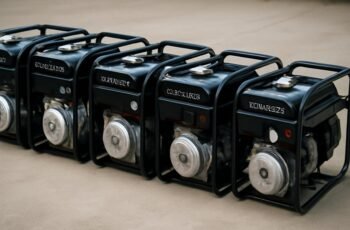
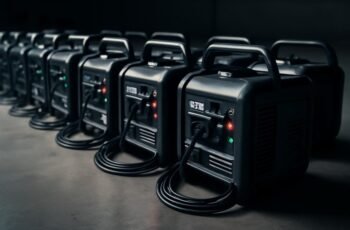
We’re looking at 10 portable solar generators that blend LiFePO4 reliability, fast recharges, and foldable panels for camping, RV trips, or emergencies. From high surge capacity to UPS-style switching, these units aim to power what matters anywhere you go. Each option brings smart charging and rugged builds, but the best fit depends on your plans. Curious which model matches your gear list and budget, and how to balance panel input with battery life? Let’s weigh the choices.
Key Takeaways
- Choose high-capacity LiFePO4 packs (e.g., 1000–1070Wh) for longer runtime and longer cycle life on the go.
- Look for UPS-capable models with fast recharging (AC, solar, or hybrid) for essential device protection.
- Prioritize portable units under ~25 lb with foldable panels to maximize travel ease and setup speed.
- Favor kits offering multiple outputs (AC, USB-C/USB-A, DC) to power diverse devices simultaneously.
- Consider modularity and expandability (additional panels or units) to scale power for RV or camping trips.
Jackery HomePower 3600+ Portable Power Station with Solar
The Jackery HomePower 3600+ stands out for its massive expandability and dual-voltage capability, making it our top pick for households that want flexible power from a single system. We rely on 3600W output (7200W in parallel) and 120V/240V in parallel to cover everything from kitchen appliances to tools. With 3584Wh, expandable to 21kWh per unit or 43kWh with multiple units, it powers a 3-person home for over two weeks. Safety shines with high-temp ceramic membranes and a 6,000-cycle, 10-year lifespan. Charging options include 2x200W solar panels; full recharge in about 2 hours AC/DC, or 4 hours solar.
Best For: households needing massive expandability and dual-voltage support for whole-home backup and heavy-load scenarios.
Pros:
- Extremely high expandability (up to 21 kWh per unit or 43 kWh with multiple units) and 3600W continuous output (7200W in parallel) with 120V/240V in parallel.
- Robust safety and lifespan claims (high-temp ceramic membranes, 6,000 cycles, 10-year lifespan) suitable for long-term use.
- Versatile charging options, including solar (2x200W panels), AC/DC full recharge in about 2 hours, and rapid recharging via multiple methods.
Cons:
- Real-world performance notes include battery drain in UPS mode (~50W) and occasional software/app connectivity quirks.
- Some users report customer service interactions and separate packaging/shipping for components (units and solar panels arriving separately).
- Heavy/large footprint relative to smaller portable units, despite being designed as portable; may require setup space for multiple-unit configurations.
Anker SOLIX C1000 Gen 2 Portable Power Station
Is power reliability a priority for you? We trust the Anker SOLIX C1000 Gen 2 to keep essentials online. It delivers 2000W continuous and 3000W peak from a 1024Wh LiFePO4 pack, with a 10 ms UPS backup for critical devices. Recharging is blistering fast—HyperFlash at 1600W fills in 49 minutes, or 1.8 hours from solar (600W). It powers up to 10 devices across 10 ports, and its 14% smaller, 11% lighter profile fits home or campsite shouldering. With a 10-year InfiniPower life and a 5-year warranty, reliability isn’t vague—it’s built in.
Best For: Those seeking a high-capacity, fast-recharging power station with reliable LiFePO4 chemistry for home backup, camping, or off-grid use.
Pros:
- Ultra-fast recharging with HyperFlash (1600W) and solid 1024Wh LiFePO4 battery for long life
- True UPS capability with 10 ms backup for essential devices
- Robust build, portable design, 10-port output and strong warranty (10-year InfiniPower, 5-year warranty)
Cons:
- Some accessories and wiring for solar connections may be missing in listings
- App features like power usage history may be limited in practice
- Potential DC/AC input limitations when charging while discharging and shading considerations for solar setup
BLAVOR 1600W Portable Power Station with Solar Panel
Looking for a reliable power source for home backups or adventures? We’ve got the BLAVOR 1600W Portable Power Station with Solar Panel. It packs 1024Wh and a 1600W rated output with 3200W surge, powering 90% of appliances across 8 outlets. A built‑in foldable 40W solar panel adds charging versatility; you can also charge via wall, car, or external panels. It features a 100W USB-C for two‑way fast charging, and an LCD shows input/output and remaining battery. With LiFePO4 chemistry, 10‑year lifespan, 3500+ cycles, and smart BMS, it’s durable, safe, and ready for home or on‑the‑go use. Includes solar panel, cables, adapters, and manual.
Best For: Looking for a portable, high-capacity backup power solution with integrated solar capability for home emergencies, camping, or remote activities.
Pros:
- High capacity and strong output (1024Wh, 1600W rated, 3200W surge) suitable for a wide range of appliances.
- Built-in foldable 40W solar panel plus flexible charging options (wall, car, external panels) and a 100W USB-C for fast two-way charging.
- LiFePO4 chemistry with long life (10-year lifespan, 3500+ cycles; smart BMS for safety) and durable, quiet operation.
Cons:
- Heavier and bulkier than smaller portable power banks, which may affect portability.
- Integrated solar panel limits charging speed compared to larger external solar setups.
- 8 outlets may be more than needed for basic use and could complicate setup for some users.
Solar Powered Generator 200W Peak, 146Wh, Includes 40W Panels
This compact 200W peak generator, with 146Wh capacity and included 40W panels, suits travelers who want portable power without compromise. We designed it for quick trips and stubborn trails, pairing a 200W peak/100W rated system with 146Wh storage and 40W panels. It powers 110V AC outlets (2), USB ports, and a DC 12V line, with safe battery management and cooling. Weighing just 3.3 lb, it slips into backpacks or luggage. Includes panels, adapters, and manuals, backed by a 1-year warranty. For home, camping, or emergencies, this kit delivers dependable, compact power wherever you roam.
Best For: travelers and outdoor enthusiasts who need portable, lightweight power with basic AC, USB, and 12V options for camping, emergencies, or minimalist travel.
Pros:
- Ultra-compact and lightweight at 3.3 lb with a 146Wh capacity, easy to carry in a backpack or luggage
- Includes 40W solar panel and multiple charging options (2x 110V AC, USB ports, 12V DC) for versatile use
- Built-in BMS, cooling, and safety features with a 1-year warranty for peace of mind
Cons:
- 100W continuous output may limit running higher-wattage devices; peak 200W may not sustain long heavy loads
- Some listings note solar panel inclusion varies; ensure you receive the 40W panel with purchase
- Solar charging rate is modest (40W panel) and may require sunny conditions for optimal charging
Jackery Explorer 1000 v2 Portable Power Station
The Jackery Explorer 1000 v2 stands out for its robust 1,500W AC output and 1,070Wh LiFePO4 battery, delivering reliable power for camping, road trips, or emergencies. We appreciate its 23.8 lb footprint, foldable handle, and portability for outdoor use. With two USB-C, one USB-A, a DC car port, and three pure sine wave AC ports, it covers most devices, and PD 100W fast charging sharpens setup times. ChargeShield 2.0 and the Smart App streamline control, while one-hour emergency charging protects battery life. Built to endure, it retains over 70% capacity after 4,000 cycles. Solar charging remains compatible with Jackery panels.
Best For: Outdoor enthusiasts and emergency prepper who need a high-capacity, reliable power station with long battery life and solid portability.
Pros:
- High output (1,500W AC) and 1,070Wh LiFePO4 battery for powerful, long-lasting use
- Durable, lighter-weight design with long cycle life (over 4,000 cycles retaining 70%+) and multiple ports (2 USB-C, 1 USB-A, DC car, 3 AC)
- Fast charging and app control (PD 100W, ChargeShield 2.0, emergency 1-hour charge, energy-efficient modes)
Cons:
- Solar charging requires Jackery panels (not included); compatibility limited to Jackery solar panels
- Screen size and price variability noted by users; some may find it pricey or small display
- Solar panel not bundled; requires additional purchase for off-grid solar charging
MARBERO 111Wh Solar Generator with 30W Panel
If you need compact power for on-the-go adventures, the MARBERO 111Wh with a 30W panel delivers portability and smart charging in one kit. We compactly pack a 111Wh lithium battery (30,000mAh) with 2 AC ports (110V/60Hz, 80W continuous, 120W peak), 1 DC port up to 120W, and 4 USB-A plus 1 USB-C for fast charging. The foldable 30W solar panel weighs lightly and stores easily. With a built-in smart chip, charging speed and safety protections optimize solar input at 21.5–23.5% efficiency. Weighs are 2.3 lbs for the station, 1.8 lbs for the panel. Includes all essentials.
Best For: On-the-go adventurers and campers who need lightweight, portable power with smart charging and multiple output options.
Pros:
- Very light and compact for easy transport (station 2.3 lbs, panel 1.8 lbs; total kit is portable).
- Multiple output options (2 AC ports, 1 DC, 4 USB-A, 1 USB-C) for varied devices.
- Built-in smart charging with protection features and decent solar efficiency (21.5–23.5%).
Cons:
- 111Wh capacity may be limiting for higher-wattage devices or long outages.
- 30W solar panel provides slower recharging in low-sun conditions or with larger loads.
- Peak AC output of 120W (80W continuous) may restrict power-hungry appliances.
Solar Generator 1800W Kit with 200W Panel, LiFePO4 Backup Power
Looking for serious off-grid power? We’ve got you. Our Solar Generator 1800W Kit pairs a 1024Wh LiFePO4 battery with a sturdy 200W foldable panel, delivering 1800W continuous output and 3600W surge. With 4 AC outlets, a 100W USB-C PD, and 10 total ports, it powers coffee makers, microwaves, tools, and full-size fridges—reliably. The rugged, IP65 panel and fully enclosed design endure outdoor use, backed by an ETL-certified station and a 5-year warranty. Fast charging shines too: 1.5-hour AC recharge, plus efficient solar recharging. This kit suits home backup, RV life, off-grid living, and emergencies.
Best For: Off-grid enthusiasts, RV owners, and homeowners needing a high-capacity, rugged backup power solution with fast charging and a durable 1024Wh LiFePO4 battery.
Pros:
- High power and versatility: 1800W continuous/3600W surge with 1024Wh LiFePO4 battery supports a wide range of appliances.
- Fast charging: 1.5-hour AC wall recharge plus efficient solar charging from a 200W panel.
- Outdoor-ready build: IP65-rated panel, fully enclosed design, ETL-certified, and 5-year warranty with US-based support.
Cons:
- 200W panel may require sunny conditions to maximize solar recharge efficiency.
- Heavier, bulkier kit than small portable power banks, potentially less ideal for minimalist setups.
- Solar-only recharge speed dependent on sunlight, which may vary by location and weather.
Jackery HomePower 3000 Portable Power Station with Solar Panels
The Jackery HomePower 3000 stands out for its LiFePO4 battery and robust 3600W continuous output, ideal for reliable home backup. We’ll note its 3072Wh capacity, 4 outlets plus USB ports, and 59.5-pound frame with CTB design for durability. With 2x200W panels, you can reach up to 80% in 9 hours solar charging, or 1.7 hours hybrid recharge. It powers essentials—fridge, WiFi, lights—up to hours, and supports a 20ms UPS switch. RV-ready TT-30 port and app monitoring add flexibility. Though pricing and panel extras vary, its lifecycle and safety features back a trustworthy home or outdoor power solution.
Best For: Homeowners seeking a high-capacity, LiFePO4-based portable power station with strong backup capability, solar charging, and UPS-style rapid switching for essential devices.
Pros:
- High continuous power (3600W) with 3072Wh LiFePO4 battery and long cycle life (4,000 cycles; ~70% capacity after)
- Fast recharging options: hybrid AC/DC in about 1.7 hours and solar charging up to 80% in 9 hours with included panels
- Built-in UPS functionality (≤20 ms) and RV-ready TT-30 port with app/remote monitoring for convenience
Cons:
- Solar panels priced higher with need for adapters/cables; expansion may require extra accessories
- Heavier unit (59.5 pounds) which can impact portability and setup
- Separate shipments for power unit and solar panels; potential timing and logistics considerations
Portable Solar Generator with Foldable 60W Panel (300W)
This compact 300W portable power station pairs a 60W foldable solar panel with a 280Wh battery, delivering quick, on-the-go charging for camping, RV trips, or power outages. We pack 2 x 110V/300W max AC outlets, plus DC, USB, and quick-charge ports for versatile devices. Weighing about 5.08 pounds, its compact dimensions fit tight spaces. We rely on MPPT solar charging via the included 60W panel, wall AC, DC5521, or carport recharge, supporting off-grid living. A built-in BMS guards against faults, while the cooling fan adjusts to temperature. Remember: avoid >300W loads and keep the panel sunny for best results.
Best For: campers, RV travelers, and emergency-prepared households needing a compact, lightweight 300W portable power source with solar charging.
Pros:
- Lightweight and compact (about 5.08 pounds; foldable 60W panel for easy transport)
- Versatile charging options (2 x 110V/300W AC outlets, USB ports, quick-charge, DC)
- MPPT solar charging with included 60W panel and multiple recharging methods (wall, car, or solar)
Cons:
- Maximum sustained load recommended is 300W; higher-wattage appliances may trip or damage the unit
- Not waterproof; junction box and components require dry conditions
- Real-world solar performance varies; some users report panel or charging variability and longer recharge times in low sun
Jackery Solar Generator 1000 v2 with Panel, 1070Wh)
Power your essentials anywhere with the Jackery Solar Generator 1000 v2, a compact 1070Wh unit offering 1,500W AC output and a 200W solar panel for quick, on-the-go charging. We value its LiFePO4 battery and 23.8 lb frame with a foldable handle, plus three pure sine wave AC ports for simultaneous devices. With PD 100W USB-C, two USB-C ports, and a USB-A, charging is versatile. It features 1.7-hour full charge to protect health, 0–100% emergency charging via the Jackery App, and ChargeShield 2.0. Longevity spans 4,000 cycles >10 years; 5-year warranty complements outdoor, RV, and emergency use.
Best For: Outdoor enthusiasts and emergency prepper looking for a portable, high-capacity solar generator with fast charging, long battery life, and versatile USB-C/AC outputs.
Pros:
- High output (1,500W) with 1,070Wh LiFePO4 battery and long lifespan (4,000+ cycles)
- Fast charging options including emergency 0–100% via app and 1.7-hour full charge to protect battery health
- Includes 200W solar panel and multiple ports (PD 100W USB-C, two USB-C, one USB-A, three pure sine wave AC ports)
Cons:
- Weight (~23.8 lbs) may be bulky for some portable scenarios
- App dependence for emergency charging features; some users report login or screen-size concerns
- Price fluctuations and separate shipping of components can affect upfront cost and delivery timing
Factors to Consider When Choosing Portable Solar Generators
We’ll walk through what matters most when choosing a portable solar generator, from power output to battery longevity. We’ll weigh battery chemistry, recharge speed, and how easy it is to recharge on the go, so you’re never left in the dark. We’ll also look at port availability and the weight or portability, so you can pick a setup that fits your needs.
Power Output Capacity
Wondering how much capacity you truly need? We’ll walk you through what power output really means for portable solar generators. Continuous wattage sets the sustained load you can run, like 2000W versus 1500W, while surge or peak ratings (think 3600W) cover temporary startup power for appliances. Higher output often pairs with larger battery capacity (Wh), so you can run similarly powered loads longer before recharging. Many models also include multi-purpose outputs—AC, USB-C/USB-A, DC car, RV TT-30—so more devices can operate at full or near-full power. Battery chemistry, such as LiFePO4 and its rated cycles, matters for long-term reliability under high-output use. Choose a capacity that matches your essential devices and typical runtime needs.
Battery Chemistry Longevity
Understanding battery chemistry matters once you’ve matched output to your needs. When we pick portable solar generators, LiFePO4 chemistry offers clear longevity benefits. These batteries typically retain over 70% of original capacity after about 4,000 charge cycles, supporting a lifespan well over a decade. Smart BMS protection—handling overcurrent, short circuits, overvoltage, and overheating—prevents damage during charging and discharging. High-cycle capabilities, in the 3,500–4,000+ range, slow capacity fade compared with many other chemistries. Stable performance across a wide temperature range, including sub-freezing operation, extends usable life in field conditions. Regular charging management matters too: avoiding deep discharges, maintaining partial state-of-charge, and using optimized charging profiles help preserve capacity over time.
Recharge Speed Options
Recharge speed is a key practical consideration when selecting a portable solar generator. ultrafast AC recharging is common, with some models hitting up to 49 minutes to full on a 1600W input or about 2–2.5 hours via AC, depending on the charger and battery chemistry. We see solar charging speeds vary widely: roughly 2–4 hours for smaller packs, and about 9–9.5 hours for larger systems paired with 200W panels under ideal sunlight. Some units offer hybrid charging (AC+DC) to shorten recharge times and keep power flowing during charging. LiFePO4-based packs typically sustain performance across many cycles, supporting reliable fast charging over the device’s life. App-driven or TOU modes can optimize timing to reduce peak demand and potentially improve real-world recharge speed.
Port Availability
Port availability matters because it determines how many devices we can run at once and what kinds. When we pick a portable solar generator, we look at the mix of outlets: AC, USB-C, USB-A, and car/DC ports. Models offering 4 to 10 ports let us power laptops, phones, and small appliances together, without swapping cables. Vehicle or RV use matters too, with TT-30 or 12V/DC ports for on‑the‑road needs. Remember that inverters and port layouts cap the peak load; higher-output units keep more ports usable without tripping protection. Port availability often grows with battery capacity and sustained output, so larger systems usually deliver more outlets and steadier power for multiple devices. Choosing the right configuration protects usability across varied camping or off-grid scenarios.
Weight And Portability
Weight and portability go hand in hand when picking a portable solar generator. We know weights vary from about 2.3 lbs for compact models to roughly 59.5 lbs for larger units, shaping how easy they are to carry. Some designs press for lighter duty with folds and handles, claiming 14–34% weight reductions to boost on‑the‑go use. Battery chemistry like LiFePO4 and sturdy enclosures influence weight while boosting durability for frequent transport. Foldable panels and built‑in features—wheels or stands—can offset heavier power stations during movement. Remember that higher‑capacity systems (thousands of watt‑hours) weigh more, which limits true portability for everyday, casual use. Balance weight, capacity, and transport aids to match your actual travel needs.
Expandability Potential
Expandable potential matters because you want a system that can grow with your needs, not one you outgrow in a year. When we evaluate portable solar generators, we look at how many add-ons or panels can be hooked up to boost capacity. We seek clear expansion metrics, like per-unit gains (21 kWh, 43 kWh with multiple units) and whether parallel connections raise wattage. Check if the design can accept more solar panels or external battery modules to reach higher energy storage and output. We assess both energy (Wh) and power (W) ceilings to cover long outages or off-grid use. Finally, we verify compatibility requirements or limits—connectors, controller compatibility, and any warranty implications—to avoid surprises down the line.
Temperature Tolerance
Temperature tolerance tells us how well a portable solar generator holds up in extreme environments and avoids battery damage. We look for units that function in sub-freezing or very hot conditions to prevent performance loss. Some models specify safe operating ranges or tested temperatures, like cold-weather usability, so you can rely on output under winter conditions. Battery chemistry, such as LiFePO4, often supports broader temperature resilience, contributing to stability and longer lifespan across climates. High-temperature resistance features, like ceramic membranes or thermal protection, help prevent thermal runaway during operation or rapid charging. Temperature also impacts charging efficiency and cycle life, since extreme heat or cold can reduce effective capacity and accelerate degradation over time. In short, tolerance matters for consistent, durable performance.
Safety Features
Safety features are what keep portable solar generators reliable and safe to use in real-world conditions. We look for a Battery Management System (BMS) that guards against overcharge, overheating, short circuits, and overload, giving us peace of mind during extended use. LiFePO4 chemistries are common for safety and longevity, offering stable performance with lower thermal runaway risk. Temperature control matters too, with built-in cooling and high-temperature resistant components preventing battery degradation and hazards. Certifications and rugged enclosures add credibility; UL/certifications and IP65 ratings or ETL-certified stations help us work safely in varied environments. Practical safeguards like automatic shutoff, short-circuit protection, and clear input/output Displays or app alerts keep battery health and system status visible, enabling proactive maintenance and safer operation.
Frequently Asked Questions
How Long Does a Full Charge Take Under Real-World Sun?
In real-world sun, a full charge typically takes 4 to 8 hours, depending on panel wattage, sunlight intensity, and battery capacity. We’ll monitor conditions and adjust our setup to maximize efficiency for you.
Can These Power Stations Run a Fridge Overnight?
A fridge can run overnight with a capable power station. For example, we powered a 7 cu ft fridge for 12 hours on a 600Wh battery with efficient duty cycling and a sturdy inverter. You’ll want similar capacity.
Do They Support Off-Grid Solar Daisy-Chaining?
We can’t safely rely on off-grid solar daisy-chaining with these portable units; they usually don’t support chaining multiple panels in series. We’d recommend using a single, properly matched solar input and a reputable MPPT charger for reliability.
Are Lifepo4 Models Safer for Long-Term Storage?
Yes, LiFePO4 models are safer for long-term storage due to stable chemistry, lower thermal runaway risk, and longer lifespan; we recommend keeping them charged around 50–80% and stored in a cool, dry place with regular checks.
What Warranties and Service Options Exist?
We offer warranties ranging from 1 to 5 years, plus optional extended coverage. We provide inclusive repair, replacement, and a 30–90 day return window, plus responsive customer support and easy RMA processes for any service needs.
Conclusion
We’ve highlighted solid options so you can pick the right portable solar generator for your adventures. If you worry about weight or cost, remember newer LiFePO4 packs stay cooler, last longer, and still power big loads when you need them most. With our picks, you’ll have reliable, on-the-go power—no fuss, just freedom. Ready to choose, pack light, and stay powered wherever you roam.