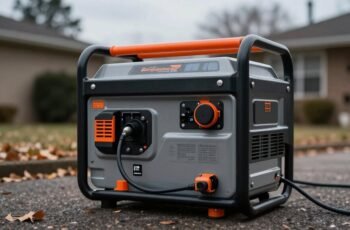
A fuel tank is the heartbeat of a portable generator, dictating how long it can sustain operations before needing a refill. Selecting the right size involves analyzing complex factors like fuel consumption rates, load demands, and mobility needs. This decision impacts not just runtime but also safety and convenience. Understanding these interconnected elements can prevent costly mistakes and ensure reliable power, making it crucial to take into account all aspects before making a purchase that truly fits your specific requirements.
Key Takeaways
- Larger fuel tanks extend runtime, reducing the need for frequent refueling during power outages or extended use.
- The tank size affects portability; bigger tanks add weight and bulk, impacting ease of transport.
- Proper tank size ensures the generator meets your operational duration needs without over- or under-sizing.
- Smaller tanks are suitable for short-term, low-demand use, while larger tanks support continuous, long-term operation.
- Choosing the right tank size balances fuel capacity, generator efficiency, and your specific power requirements.
How Fuel Tank Size Affects Generator Runtime

The size of a portable generator’s fuel tank directly determines its runtime, as it dictates how much fuel is available for continuous operation. Larger tanks contain more fuel, which translates into longer periods of power generation without refueling interruptions. The relationship between tank capacity and runtime is linear, assuming constant load and fuel consumption rates. For instance, a generator with a 3-gallon tank running at a consumption rate of 0.5 gallons per hour will operate approximately six hours continuously. Conversely, smaller tanks limit operational duration, which can impact planning during power outages or remote work. Consequently, understanding the direct correlation between tank capacity and runtime is essential for selecting a generator that meets your specific needs for duration and reliability.
Understanding Different Fuel Tank Capacities
Have you ever considered how different fuel tank capacities influence a portable generator’s performance? Variations in tank size directly impact runtime, efficiency, and operational flexibility. Smaller tanks typically result in shorter operating periods before refueling, which can limit their use in extended power outages. Conversely, larger tanks provide longer runtime but add weight and bulk, affecting portability. Understanding these capacity differences involves analyzing the balance between fuel volume, energy density, and the generator’s fuel consumption rate. Manufacturers design tanks with specific capacities to optimize performance for diverse applications, from lightweight, portable units to heavy-duty models. Recognizing these differences helps us select a generator that aligns with our power needs and logistical requirements, ensuring reliable operation without unnecessary bulk or refueling intervals.
How to Calculate Your Generator’s Refueling Needs
To accurately determine your generator’s refueling needs, we first analyze its power consumption rate, which establishes the baseline for fuel requirements. Next, we calculate the desired run time based on expected usage, ensuring sufficient operational duration. Finally, we assess the fuel tank capacity relative to these factors to identify appropriate refueling intervals and tank specifications.
Determine Power Consumption Rate
How can we accurately determine our generator’s refueling needs? The key lies in calculating the power consumption rate of connected devices. We start by listing all essential appliances and noting their wattage ratings, typically found on labels or in manuals. Next, we sum these wattages to find the total load. To refine accuracy, consider the startup surge power for devices like refrigerators or air conditioners, which temporarily draw more power. Divide the total wattage by the generator’s voltage to obtain current draw in amperes. This data allows us to estimate continuous power demands, enabling precise calculation of fuel requirements per hour. By understanding these metrics, we ensure the generator’s fuel tank capacity aligns with expected operational loads, optimizing efficiency and avoiding under- or over-sizing.
Calculate Run Time Needs
Understanding the run time of your generator is essential for effective fuel management. To calculate this, we first determine the total fuel consumption rate in gallons per hour, based on the generator’s wattage and load. Next, we identify the average operational hours needed during power outages or specific use cases. By dividing the total fuel tank capacity by the hourly fuel consumption, we obtain the estimated run time. For example, a generator consuming 0.5 gallons per hour with a 4-gallon tank can operate for approximately eight hours. This calculation allows us to plan refueling schedules accurately, ensuring continuous operation without unexpected shutdowns. Precise run time estimates are critical for optimizing fuel tank size and maintaining reliable power supply during prolonged use.
Assess Fuel Tank Capacity
Accurately evaluating your generator’s fuel tank capacity is fundamental to ensuring it meets your power needs during outages. To determine refueling requirements, we analyze the generator’s consumption rate relative to load demands. This involves understanding the fuel consumption per hour at various loads. Consider the following:
| Load Percentage | Fuel Consumption (gallons/hour) | Estimated Run Time (hours) |
|---|---|---|
| 50% | 0.5 | 4 |
| 75% | 0.75 | 3 |
| 100% | 1.0 | 2 |
Why Larger Tanks Offer More Convenience During Power Outages
Larger fuel tanks in portable generators markedly enhance convenience during power outages by extending runtime without frequent refueling interruptions. This increased capacity reduces operational downtime and minimizes the logistical challenges associated with refueling, especially in emergency scenarios. From a technical perspective, a larger tank provides a greater volume of fuel, which directly correlates with longer continuous operation, assuming consistent load demands. This means less need for manual intervention and more reliable power supply over extended periods. Additionally, larger tanks decrease the frequency of refueling stops, which can be critical when access to fuel sources is limited or safety concerns restrict frequent refills. Overall, larger tanks improve operational efficiency and reliability, making them a strategic choice for ensuring uninterrupted power during outages.
When a Small Fuel Tank Might Be Sufficient
When power demands are minimal and temporary, a smaller fuel tank can meet operational needs effectively. The reduced weight and increased portability are significant advantages in such scenarios. Analyzing usage patterns helps determine if a compact tank aligns with specific power requirements.
Shorter Power Needs
Are your power demands limited to brief, intermittent use? In such cases, a smaller fuel tank may be adequate, as the generator’s runtime per fueling cycle remains manageable. When load requirements are low and consumption rates are predictable, the necessity for extended operation diminishes. This scenario allows for a more compact design, reducing weight and cost without sacrificing essential functionality. From an analytical perspective, understanding your total expected runtime and load profile helps determine if a smaller tank suffices. By calculating the fuel consumption rate relative to your typical usage duration, you can optimize tank size to balance operational needs with portability. This approach guarantees you avoid over-specifying capacity, maintaining efficiency in both fuel management and overall generator design.
Portability Advantages
Ever considered how a smaller fuel tank can enhance portability without compromising functionality? A reduced tank size markedly decreases the generator’s overall weight and bulk, making it easier to transport and store. This benefit is especially relevant for applications requiring frequent movement, such as outdoor events or job sites. Smaller tanks also simplify design, allowing for more compact and ergonomic units that optimize space in vehicles or storage areas. Additionally, a lightweight generator can be handled with less effort, reducing the risk of injury during setup or relocation. While a smaller tank limits runtime, this trade-off favors portability in scenarios where mobility outweighs extended operation. Ultimately, selecting a generator with a smaller fuel tank provides strategic advantages for users prioritizing ease of movement and quick deployment.
The Trade-Offs: Size, Weight, and Portability
Choosing the right fuel tank size for a portable generator involves balancing several critical factors—primarily size, weight, and portability. Larger tanks extend run time but add weight and bulk, reducing mobility. Smaller tanks enhance portability but require more frequent refueling, impacting efficiency. The trade-offs can be summarized as follows:
| Tank Size | Weight Impact | Portability Impact |
|---|---|---|
| Large | Increases considerably | Reduces ease of transport |
| Medium | Moderate increase | Moderate portability |
| Small | Minimal impact | Maximizes mobility |
Optimizing these factors requires evaluating use cases: long-term power needs favor larger tanks, while frequent, lightweight use favors smaller tanks. Understanding these trade-offs aids in selecting a generator aligned with operational priorities.
How Fuel Efficiency Interplays With Tank Size
Understanding the relationship between fuel consumption rate and tank size is essential for maximizing generator performance. Higher fuel efficiency can extend runtime with smaller tanks, while less efficient models require larger tanks to meet operational needs. Analyzing this interplay helps identify the most suitable tank size for specific fuel efficiency profiles.
Fuel Consumption Rate
How does fuel efficiency influence the practical utility of a portable generator’s tank size? Fuel consumption rate directly impacts operational endurance, making it a critical factor in tank size considerations. A generator with a high fuel consumption rate requires a larger tank to sustain longer runtimes, whereas more efficient models can operate longer on smaller tanks. Understanding the consumption rate per hour under typical load conditions helps in accurate planning for emergency use or ongoing tasks. It also affects cost analysis, since higher consumption increases fuel expenses over time. Therefore, evaluating fuel consumption rate alongside tank capacity guarantees the best selection, balancing runtime needs against portability and fuel storage constraints. This precise assessment allows users to choose a generator best suited for their specific power demands and logistical considerations.
Tank Size Optimization
Fuel efficiency directly influences how we can optimize a portable generator’s tank size to meet specific operational requirements. When a generator operates with high fuel efficiency, it allows for smaller tank capacities without sacrificing runtime, reducing weight and cost. Conversely, lower efficiency necessitates larger tanks to sustain extended use, increasing portability challenges. To optimize tank size, we analyze the generator’s fuel consumption rate relative to expected load and runtime needs. Precise calculations help balance tank volume with operational duration, avoiding over- or under-sizing. This approach ensures we meet power demands efficiently while maintaining portability. Ultimately, understanding the interplay between fuel efficiency and tank capacity enables us to tailor solutions that optimize performance, cost, and logistical convenience.
Tips for Choosing the Right Fuel Tank Size for Your Needs
Selecting the appropriate fuel tank size depends on evaluating your power needs and the typical duration of generator use. To do this effectively, consider the following factors:
- Load requirements: Higher power demands consume fuel more rapidly, necessitating larger tanks for extended operation.
- Operational duration: Determine how long you need continuous power, which guides tank capacity to minimize refueling interruptions.
- Usage environment: Remote locations or emergency scenarios benefit from larger tanks to guarantee reliability without frequent refills.
Common Mistakes to Avoid When Selecting Tank Capacity
One of the most common mistakes is oversizing or undersizing the fuel tank without properly evaluating actual power demands and usage patterns. Oversizing leads to unnecessary weight, increased costs, and potential space constraints, while undersizing risks insufficient runtime during critical periods. To avoid this, it’s vital to analyze the generator’s load profile, factoring in peak and average power consumption, as well as anticipated runtime requirements. Failing to do so can result in inefficient fuel use or operational interruptions. Precise assessment ensures the selected tank capacity aligns with real-world needs, optimizing both performance and cost-effectiveness. Relying on estimations or generic recommendations without detailed analysis can compromise the generator’s reliability, making it imperative to base capacity decisions on data-driven insights rather than assumptions.
How Fuel Tank Size Impacts Safety and Maintenance
While choosing an appropriately sized fuel tank is essential for operational efficiency, it also directly influences safety and maintenance considerations. Larger tanks reduce refueling frequency, minimizing the risk of sudden power loss during critical moments, but they also pose increased hazards if leaks occur, due to the greater volume of fuel. Conversely, smaller tanks limit fuel spill consequences and simplify leak containment, but require more frequent refueling, increasing handling risks.
Key safety and maintenance factors include:
- Leak detection: Larger tanks demand more rigorous inspection routines to prevent fuel leaks.
- Ventilation needs: Increased tank size necessitates enhanced venting systems to manage pressure buildup.
- Corrosion control: Both tank sizes require appropriate materials and treatments to prevent deterioration over time, impacting safety and maintenance costs.
Frequently Asked Questions
How Does Fuel Tank Size Affect Generator Startup Time?
A larger fuel tank generally extends runtime but doesn’t notably impact startup time, which depends more on engine design and fuel delivery systems; smaller tanks may lead to quicker refueling but don’t significantly alter initial startup speed.
Are Larger Fuel Tanks More Prone to Fuel Degradation?
Larger fuel tanks are more prone to fuel degradation over time due to increased exposure and stagnation. We recommend regular fuel stabilization and storage practices to maintain fuel quality, especially for prolonged periods of infrequent generator use.
Can a Small Tank Handle High-Power Generator Models?
A small tank can handle high-power generators if it’s designed for efficient fuel consumption and rapid refueling. However, it requires frequent refills, which could interrupt operation, making larger tanks preferable for extended, uninterrupted use.
What Are the Legal Regulations Regarding Fuel Tank Sizes?
Back in the day, regulations mandated fuel tank limits to guarantee safety; today, we follow strict federal and local laws, which vary by jurisdiction, affecting generator design and capacity choices for compliance and safety considerations.
How Does Climate Influence Optimal Fuel Tank Capacity?
Climate considerably influences ideal fuel tank capacity; in colder regions, larger tanks prevent frequent refueling amid extended use, while in hotter climates, smaller tanks reduce fuel evaporation risks, ensuring efficient and safe generator operation under varying environmental conditions.
Conclusion
Choosing the right fuel tank size isn’t just about capacity; it’s about balancing runtime, mobility, and safety. While larger tanks offer extended power during outages, they can compromise portability. Conversely, smaller tanks enhance ease of transport but require more frequent refueling. By analyzing your specific needs—whether for emergency backup or lightweight use—we can optimize efficiency and safety, ensuring your generator performs reliably without unnecessary bulk or inconvenience. The right size is a strategic decision, not just a number.