When selecting a portable generator capable of supporting multiple appliances, it’s essential to evaluate key technical features such as power capacity, inverter technology, and safety mechanisms. Understanding how these elements interact influences reliability and efficiency during operation. As we examine the top options for 2023, we’ll highlight critical specifications and practical considerations that can make or break your choice—details that are crucial for ensuring consistent, safe, and effective power delivery when it matters most.
Key Takeaways
- Select generators with at least 8,000 starting watts and 6,000 running watts to handle multiple appliances simultaneously.
- Ensure the generator has multiple outlets, inverter technology, and safety features for stable, clean power.
- Prioritize models with extended runtime, large fuel tanks, and durable construction for reliable operation during prolonged use.
- Consider fuel options like gasoline, propane, or solar for sustainability and convenience based on your needs.
- Choose generators with proper load management, surge capacity, and regular maintenance features for consistent performance.
What Features Make a Portable Generator Suitable for Multiple Appliances
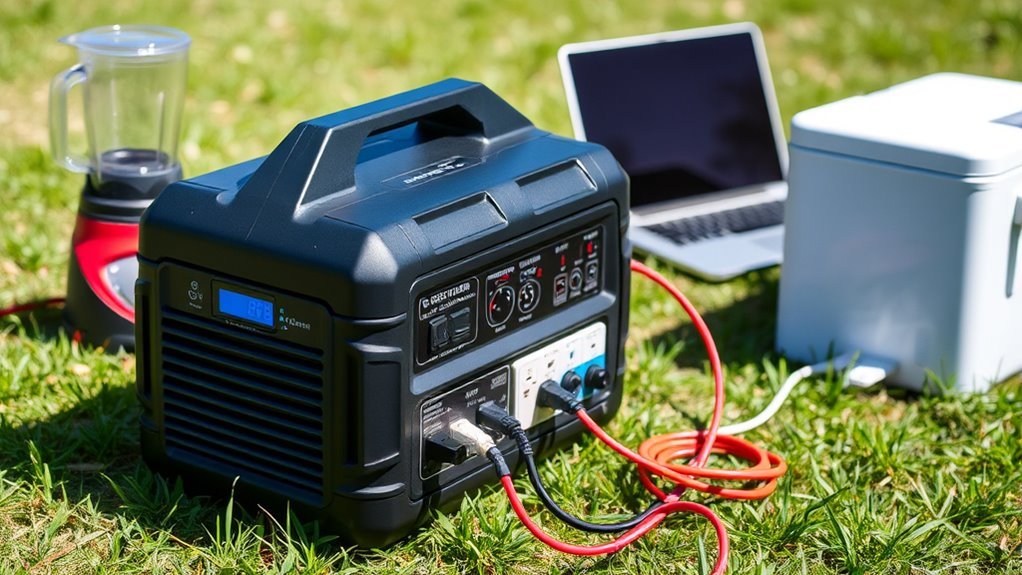
When selecting a portable generator capable of powering multiple appliances, it’s vital to focus on several key features that guarantee efficiency and safety. First, multiple outlets, including standard AC and possibly DC ports, ensure compatibility with various devices. An inverter technology is essential for stable, clean power, protecting sensitive electronics. A high surge capacity allows the generator to handle initial startup loads for larger appliances. Additionally, a robust wattage rating—both running and peak—determines the total load capacity. Safety features like automatic shutoff, overload protection, and low-oil shutdown enhance operational reliability. Finally, durable construction with proper insulation and grounding minimizes risks during use. Prioritizing these features guarantees the generator can efficiently support multiple appliances while maintaining safety and longevity.
How to Determine the Power Capacity You Need for Your Setup
To accurately determine the power capacity needed, we start by calculating the total wattage of all appliances you intend to run simultaneously. It’s crucial to account for surge power, which represents the initial startup load that exceeds the running wattage. Understanding these two factors guarantees your generator can handle your setup reliably without overloading.
Total Appliance Wattage
Determining the total appliance wattage required for your setup involves adding up the starting and running wattages of each device you plan to power. This calculation guarantees your generator provides sufficient capacity without overload. To simplify, categorize appliances by their power demands:
| Appliance | Running Wattage | Starting Wattage |
|---|---|---|
| Refrigerator | 600 | 1,200 |
| Microwave | 700 | 900 |
| Lights | 150 | 150 |
Surge Power Requirements
Evaluating surge power requirements involves understanding the initial inrush current that many appliances demand at startup. This surge can be notably higher than the device’s rated running wattage, sometimes two to three times as much. To determine your generator’s capacity, identify each appliance’s surge wattage, often listed on the label or in the manual. It’s essential to take into account the highest startup demands, especially for motors, refrigerators, or tools with motorized components. Summing these peak values ensures your generator can handle simultaneous startups without overload. Failing to contemplate surge wattage risks underestimating your power needs, leading to potential appliance damage or generator tripping. Precise calculation of both running and surge wattages guarantees reliable operation and prevents capacity shortfalls during critical power demands.
Comparing Fuel Types: Gas, Propane, and Solar for Reliable Power
When comparing fuel types for portable generators, we examine factors like availability, cost, and environmental impact to determine long-term efficiency. Gas offers widespread accessibility but tends to be more expensive and less eco-friendly, while propane provides cleaner combustion with stable pricing. Solar power, though limited by sunlight, presents a renewable option with minimal operational costs and negligible environmental footprint.
Fuel Availability and Cost
How do fuel types influence the reliability and cost-effectiveness of portable generators? Fuel availability impacts operational continuity, while cost determines overall affordability. Gasoline offers widespread availability but can be expensive and fluctuates with market conditions. Propane, stored in tanks, provides consistent pricing and longer shelf life but may be less accessible in remote areas. Solar power relies on sunlight, eliminating fuel costs altogether, but its reliability depends on weather and daylight hours.
- Gasoline’s widespread infrastructure ensures quick refueling but entails higher costs and storage concerns.
- Propane’s stable pricing supports predictable operating expenses.
- Solar eliminates ongoing fuel costs but requires investment in solar panels and batteries.
- Fuel storage safety varies, with propane tanks needing proper handling.
- Market fluctuations directly affect gasoline prices, influencing long-term expenses.
Environmental Impact and Efficiency
Considering environmental impact and efficiency, the choice of fuel type considerably influences a portable generator’s sustainability and operational performance. Gas-powered generators typically offer high energy density and quick refueling, but produce significant emissions and carbon footprint. Propane generators generate fewer pollutants, with cleaner combustion and lower greenhouse gases, yet often present slightly lower efficiency due to energy conversion losses. Solar-powered units excel in environmental friendliness, emitting no pollutants during operation; however, their efficiency depends heavily on sunlight conditions and energy storage solutions. While solar generators are sustainable in the long term, their limited power output can restrict use for high-demand appliances. Ultimately, selecting a fuel type involves balancing environmental considerations with efficiency needs, with solar leading in eco-friendliness, and gas or propane offering more reliable, consistent power for diverse applications.
Top Portable Generators for Running Multiple Appliances in 2023
As power demands increase during outages or outdoor events, selecting a portable generator capable of running multiple appliances efficiently becomes essential. To meet these needs, we focus on generators with high wattage capacity, robust surge power, and multiple outlets to support diverse devices simultaneously. Key features include inverter technology for stable power output, fuel efficiency for extended runtime, and durable build quality for reliability under demanding conditions.
- Generators with 8,000+ starting watts and 6,000+ running watts
- Multiple AC outlets (including 120V and 240V options)
- Inverter models with clean power output
- Extended runtime with larger fuel tanks
- Heavy-duty construction with reliable engine performance
Tips for Safe and Efficient Use of Your Portable Generator
Ensuring safe and efficient operation of your portable generator requires adherence to best practices that minimize risks and maximize performance. Proper setup involves placing the generator outdoors in a well-ventilated area to prevent carbon monoxide buildup. Load management is critical; distribute power evenly and avoid overloading circuits. Regularly inspect cords and connections for damage, and never bypass safety features. Use transfer switches for seamless power transfer and prevent backfeeding. Fueling should be done only when the generator is off and cooled.
| Practice | Purpose | Key Consideration |
|---|---|---|
| Ventilation | Prevent carbon monoxide poisoning | Outdoors, away from windows/doors |
| Load Management | Maximize efficiency | Avoid exceeding rated capacity |
| Inspection & Maintenance | Ensure reliability | Check cords, connections, fuel |
| Proper Fuel Handling | Prevent fires and damage | Turn off before refueling |
| Use of Transfer Switches | Safe power transfer | Prevent backfeeding |
Key Maintenance Tips to Keep Your Generator Running Smoothly
Regular maintenance is essential for keeping your portable generator operating reliably and efficiently over time. Proper upkeep guarantees peak performance, reduces downtime, and extends the unit’s lifespan. To achieve this, focus on critical tasks such as:
- Regular oil changes to prevent engine wear and ensure proper lubrication
- Checking and replacing air filters to maintain combustion efficiency
- Inspecting spark plugs for corrosion or fouling, replacing as needed
- Cleaning cooling fins and vents to prevent overheating
- Draining fuel or stabilizing it during storage to prevent gumming and varnishing
Adhering to these maintenance practices minimizes mechanical failures and preserves the generator’s power output. A systematic, technical approach guarantees consistent operation, especially when running multiple appliances under demanding conditions.
Frequently Asked Questions
How Noisy Are These Portable Generators During Operation?
These portable generators typically produce noise levels ranging from 50 to 70 decibels, comparable to a conversation or background music, which we find acceptable for most outdoor or emergency use; quieter models are available for sensitive environments.
Are There Any Environmental Impacts Associated With Different Fuel Types?
Environmental impacts vary considerably: gasoline emits higher greenhouse gases, while propane burns cleaner but still produces some emissions. We analyze fuel efficiency and emissions data, understanding that choosing eco-friendly options reduces air pollution and carbon footprint substantially.
Can Portable Generators Be Used Indoors Safely?
Portable generators should never be used indoors due to carbon monoxide risks. We analyze that proper ventilation and adherence to safety guidelines are vital when operating generators outdoors, but indoor use poses significant health and safety hazards.
What Are the Best Storage Practices for Long-Term Use?
We recommend storing generators in a dry, cool, well-ventilated area, away from direct sunlight and moisture. Regularly inspect and run them periodically to prevent fuel degradation and guarantee readiness for long-term use, optimizing performance and safety.
Do Portable Generators Come With Warranty Coverage?
Like a shield guarding your power needs, most portable generators include warranty coverage, typically ranging from one to three years, ensuring reliability and support. Always review specific manufacturer terms for complete protection and service details.
Conclusion
Choosing the right portable generator is like selecting a reliable engine for your needs—precision and purpose matter. By understanding your power requirements, fuel options, and safety practices, we can guarantee consistent, efficient performance. Regular maintenance and load management are the gears that keep everything running smoothly. Ultimately, a well-chosen generator becomes an indispensable tool, providing dependable power much like a steady heartbeat — essential and unwavering during critical moments.