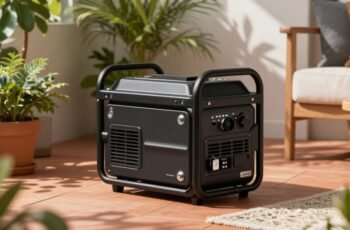
Understanding how to accurately calculate your home’s portable generator power requirements is essential for ensuring reliable operation during outages. We need to systematically identify vital appliances, determine their wattages, and account for startup surges, all while considering future needs. Proper sizing prevents overloads and extends equipment lifespan. To make informed decisions, it’s important to follow precise steps and utilize industry standards, which can be complex—yet indispensable—if you want your generator to meet your household demands effectively.
Key Takeaways
- List essential appliances and find their startup and running wattages from labels or manuals.
- Calculate total surge (startup) wattage, accounting for devices with high starting demands.
- Add a safety margin of 20-25% to accommodate future needs and prevent overloads.
- Use online calculators or manufacturer data to accurately estimate your home’s total power requirements.
- Choose a generator with capacity slightly above your total calculated wattage, including surge and safety margins.
How to Determine Your Essential Power Needs
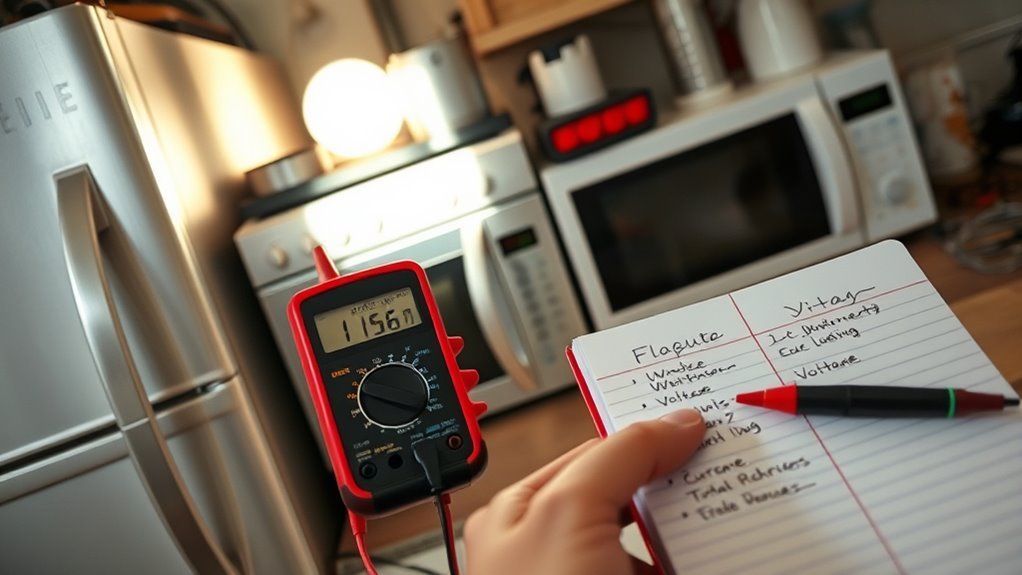
To accurately determine your essential power needs, we first need to identify the critical appliances and devices you must operate during a power outage. This involves listing each item and noting its starting and running wattage, as some devices require higher surge power at startup. Prioritize essential functions, such as refrigeration, lighting, medical equipment, and communication devices. We should also consider the simultaneous operation of multiple devices, guaranteeing the total wattage does not exceed the generator’s capacity. Precise calculation involves summing the continuous wattage of all essential appliances and accounting for surge wattage where applicable. This method ensures the selected generator provides reliable power without overload, optimizing efficiency and safety during outages.
List Your Household Appliances and Their Wattages
To accurately size your generator, we need to list all essential household appliances and record their wattages. Precise wattage values guarantee correct power calculations and prevent overloads. This step is critical for establishing a reliable power baseline for your generator selection.
Identify Essential Appliances
When determining your home’s power needs, it’s essential to compile an all-encompassing list of all critical appliances and their wattages. This list should include essential devices such as refrigerators, lighting, heating or cooling systems, communication devices, and medical equipment. For each appliance, record the manufacturer’s specifications or label wattage requirements. Prioritize appliances necessary during power outages to guarantee uninterrupted operation. Accurate identification of these devices allows for precise load calculation, ensuring the generator can support essential functions without overload. It’s important to distinguish between running wattage and starting wattage, as some appliances require more power to start. This detailed inventory forms the foundation for selecting an appropriately sized portable generator that meets your household’s essential power demands.
Determine Appliance Wattages
How can we accurately determine the power requirements of our household appliances? First, we need to identify each device’s wattage, which is typically listed on the appliance’s label or in the user manual. To proceed:
- Examine the appliance’s nameplate or specifications label for wattage or voltage and amperage, then calculate wattage if needed.
- Use a multimeter or wattmeter for precise measurement, especially for devices with variable power consumption.
- Refer to manufacturer specifications online when labels are unclear, ensuring accurate data collection.
Calculate Starting vs. Running Wattage for Devices
Understanding the difference between starting and running wattage is essential for accurate generator sizing. We need to identify the initial surge power devices require at startup and compare it to their continuous operation needs. By calculating the total wattage for each device, we can guarantee the generator can handle both the peak and steady power demands effectively.
Differentiating Starting Power Needs
Determining the difference between starting and running wattage is essential for accurately sizing a portable generator. Starting wattage refers to the initial electrical surge a device requires when powering on, often significantly higher than its continuous operating load. To visualize this:
- Imagine a refrigerator compressor, which demands a burst of power to start, approximately 3-5 times its running wattage.
- Consider an air conditioner with a compressor that requires a hefty startup surge, sometimes reaching double its typical running wattage.
- Think of a sump pump, which needs a high initial surge to overcome inertia before settling into its steady-state operation.
Recognizing these differences ensures your generator can handle the peak power demands without overload, maintaining device safety and performance.
Understanding Running Power Limits
To guarantee your portable generator can safely power your devices, it’s essential to distinguish between their running and starting wattages. Running wattage, or rated wattage, reflects the continuous power a device consumes during normal operation. It indicates the steady load the generator must sustain without risk of overload. Understanding this limit ensures the generator can handle appliances like refrigerators or lights without exceeding its capacity. Unlike starting wattage, which spikes temporarily during device startup, running wattage remains constant. Accurate knowledge of each device’s running wattage enables precise load calculations. This prevents underestimating the generator’s capacity, which could cause interruptions, or overestimating, which leads to unnecessary equipment upgrades. Properly evaluating running power limits guarantees safe, reliable operation of your portable power source.
Calculating Total Device Wattage
Have you accurately calculated the total wattage of all your devices to guarantee your generator can handle the combined load? Proper calculation involves distinguishing between starting and running wattage.
For each device, consider these steps:
- Identify the running wattage, which is the consistent power draw during normal operation.
- Determine the starting wattage, often 2-3 times higher than running wattage, necessary for motor-driven appliances.
- Sum the highest starting wattages and running wattages separately to ensure your generator can support peak and continuous loads.
For example, a refrigerator may have a running wattage of 700W and a starting wattage of 2,100W. Accurate calculations prevent overloads and ensure reliable power delivery during outages.
Consider Future Power Needs and Additional Devices
While evaluating your current power needs is essential, it’s equally important to anticipate future requirements and potential device additions. Planning for expansion ensures your generator can accommodate increased load without overstraining. Identify potential future appliances or electronics, such as additional lighting, heating systems, or smart home devices, and estimate their wattage. Incorporate these into your total load calculations to determine a buffer capacity, typically 10-20%, to account for unforeseen needs. Consider the possibility of simultaneous operation of multiple devices, which can considerably impact power requirements. By proactively including future device estimates, you ensure your generator remains reliable and efficient over time, avoiding the need for early replacement or underperformance during critical moments. This strategic approach guarantees scalability and operational flexibility.
Understand Surge Power and Its Impact on Generator Sizing
Understanding surge power is vital when sizing your generator, as many appliances draw more initial current during startup than their running wattage. Surge power, or starting wattage, can be 2 to 3 times the appliance’s rated running wattage, which impacts generator selection. To accurately account for this, consider these key points:
- Identify appliances with high startup demands, such as refrigerators, well pumps, and air conditioners.
- Calculate the combined surge wattage by summing the highest startup demands of all devices that may run simultaneously.
- Select a generator rated at least 20-25% above the total surge wattage to ensure reliable operation without overloading.
Properly accounting for surge power guarantees your generator can handle initial startup currents, preventing overloads and equipment damage.
Use Online Tools and Charts to Estimate Total Wattage
Using online tools and charts simplifies the process of estimating your home’s total wattage requirements by providing quick, accurate calculations based on appliance specifications. These resources compile detailed data, such as wattage ratings for various devices, enabling us to input specific appliances and receive an aggregate power load. Digital calculators often incorporate default values for common appliances, reducing the potential for miscalculations. Charts, typically available through manufacturer data or industry standards, serve as quick reference guides to estimate startup and running wattages. By utilizing these tools, we eliminate manual calculations and minimize errors, ensuring a precise assessment of your home’s energy demands. This approach streamlines the sizing process, allowing us to focus on selecting an appropriately rated portable generator with confidence.
Factor in Safety Margins for Reliable Power Supply
To guarantee your portable generator can reliably power your home during outages, we must incorporate safety margins into our power calculations. This assures the generator isn’t operating at maximum capacity constantly, which can reduce lifespan and reliability. Typically, we add a safety margin of 20-25% to the total estimated wattage. Visualize this as:
- Overestimating the initial load — accounting for unexpected surge demands from appliances.
- Allowing for future additions — like new devices or upgraded equipment.
- Maintaining generator health — reducing strain during peak use, preventing overloads.
Compare Generator Types and Their Power Capacities
When selecting a portable generator, it’s vital to compare the different types and their respective power capacities to guarantee you meet your home’s energy demands. Inverter generators typically provide cleaner, more stable power with capacities ranging from 1,000 to 4,000 watts, suitable for sensitive electronics. Conventional generators, with capacities between 2,000 and 15,000 watts, deliver higher power levels ideal for whole-house backup but often produce less stable output. Dual-fuel models offer versatility, operating on gasoline or propane, with similar power ranges. It’s essential to match the generator’s continuous wattage output to your essential load calculations, considering startup surges for appliances. Precise comparison of these types ensures you select a generator that efficiently supports your power needs while maintaining operational reliability.
Final Steps: Choosing the Right Portable Generator for Your Home
After determining the appropriate power capacity and generator type, the next step involves evaluating additional factors to select the best portable generator for your home. We recommend considering these critical aspects:
- Run Time and Fuel Efficiency: Assess how long the generator can operate on a single fuel tank, ensuring it meets your outage duration needs.
- Noise Level: Choose models with lower decibel ratings to minimize noise pollution during operation.
- Portability Features: Look for lightweight units with sturdy handles or wheels for easy transportation and placement.
Frequently Asked Questions
How Often Should I Maintain My Portable Generator?
We suggest maintaining your portable generator every 50-60 hours of use or at least once every three months, whichever comes first. Regular inspections, oil changes, and cleaning guarantee peak performance and longevity, preventing unexpected failures during critical times.
Can I Run All Appliances Simultaneously on My Generator?
Yes, you can run all appliances simultaneously if your generator’s wattage capacity exceeds the combined starting and running wattages of your devices. We recommend calculating total load beforehand to prevent overload and guarantee safe, efficient operation.
What Safety Precautions Are Necessary When Using a Generator?
Using a generator safely is like handling delicate machinery; we always read the manual, keep it outdoors in ventilated areas, avoid overloads, use proper grounding, and guarantee extension cords are rated correctly to prevent hazards.
How Noisy Are Different Types of Portable Generators?
Different portable generators produce varying noise levels, with inverter models typically operating between 50-60 decibels, comparable to a quiet conversation, while traditional open-frame generators can reach 70-80 decibels, akin to loud outdoor noise.
What Are the Best Storage Practices for My Generator?
Proper storage is essential; we recommend draining fuel, cleaning surfaces, and storing in a cool, dry place. Secure the generator upright, cover it with a breathable material, and perform regular maintenance checks to guarantee longevity and safety.
Conclusion
Just as engineers design bridges to withstand stress and guarantee safety, we must carefully size our generators to meet our home’s dynamic power demands. By methodically calculating wattages, considering surge requirements, and including safety margins, we ensure reliable operation akin to a well-constructed arch—strong, resilient, and ready to support unexpected loads. Precise planning today safeguards our comfort tomorrow, echoing the meticulous craftsmanship that sustains enduring structures through time.