When considering a portable generator for whole-house backup, it’s essential we accurately assess our power needs to avoid overloads or insufficient capacity. Understanding the difference between starting and running wattages, and calculating the total load of critical appliances, forms the foundation of selecting the right size. With safety and efficiency in mind, determining the appropriate generator wattage isn’t straightforward, and overlooking key factors can have significant consequences. So, what steps should we take next to guarantee reliable backup power for our homes?
Key Takeaways
- Calculate total essential appliance wattage, including surge and running demands, to determine the minimum generator size needed.
- Add a safety margin of 10-20% to accommodate future load increases and unexpected power surges.
- Ensure the generator’s rated wattage meets or exceeds your household’s critical load requirements for reliable backup.
- Consider generator type (portable vs. standby) based on capacity needs, installation complexity, and long-term household power demands.
- Choose a generator that matches your fuel preferences and supports necessary safety features like overload protection and low oil shutdown.
How Do Portable Generators Power a Whole House?
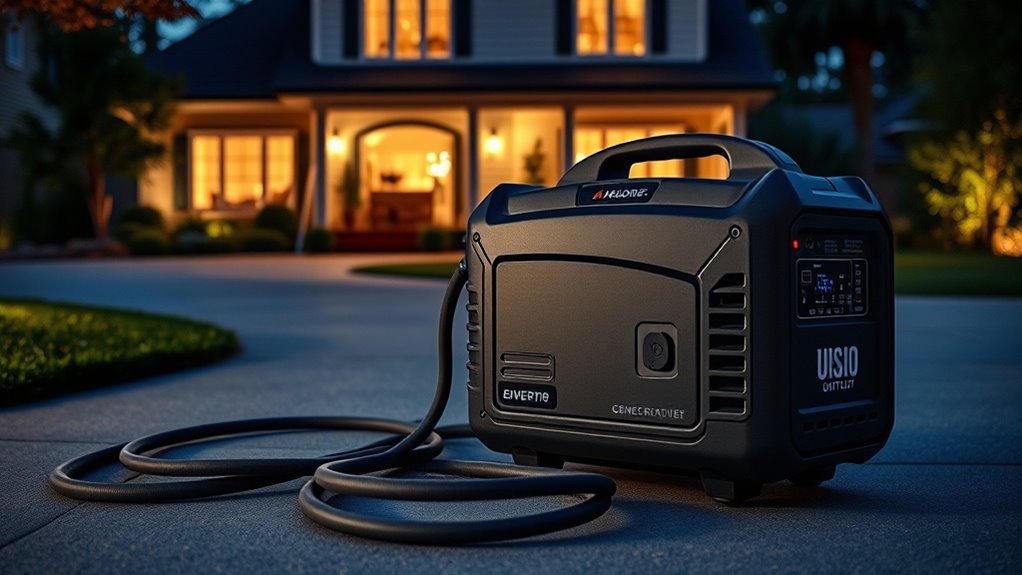
To power an entire house with a portable generator, we typically route the electricity through a transfer switch that isolates the generator from the main utility grid, ensuring safety and code compliance. The generator produces alternating current (AC) power, which needs to match household voltage and frequency standards—usually 120/240V at 60Hz. The transfer switch directs power from the generator to the home’s electrical panel, bypassing the utility line. This setup prevents backfeeding into the grid, protecting utility workers and equipment. To distribute power effectively, the generator’s rated wattage must meet or exceed the household’s critical load requirements. Proper wiring, grounding, and load management are essential to maintain system stability, safety, and compliance with electrical codes.
Determining Your Household’s Power Needs
Evaluating your household’s power needs is a fundamental step in selecting the right portable generator. Accurate assessment ensures you avoid over- or under-sizing, which can lead to inefficiency or insufficient backup. To determine your needs, consider:
Assessing your power needs ensures optimal generator size for reliable household backup during outages.
- Identify Critical Loads: List essential appliances and systems, such as refrigerators, lighting, and heating.
- Calculate Total Wattage: Sum the starting and running wattages of each device to understand peak and continuous power demands.
- Account for Future Expansion: Anticipate additional devices or appliances you might add, ensuring capacity for growth.
This methodical approach guarantees that your generator will reliably support your household during outages, providing peace of mind through precise, data-driven decision-making.
Calculating the Right Generator Size for Essential Appliances
To determine the appropriate generator size, we need to accurately assess the power requirements of essential appliances, including their startup surge demands. Understanding both continuous and peak power needs guarantees the generator can reliably support critical devices during outages. This analytical approach helps prevent undersizing, which could lead to appliance failure, or oversizing, which increases unnecessary costs.
Essential Appliance Power Needs
Determining the appropriate generator size begins with identifying the combined starting and running wattage of essential appliances. Accurate calculations guarantee reliable power delivery without overload.
Consider these important factors:
- Identify peak wattage demands of appliances like refrigerators, sump pumps, and medical devices, which often require higher starting wattage.
- Sum their continuous running wattages to determine baseline power needs.
- Factor in safety margins—adding 10-20% accommodates unexpected surges and future appliance additions.
This analytical approach minimizes the risk of overloading the generator while guaranteeing vital appliances operate seamlessly during outages. Precise wattage assessments are essential for selecting a generator that balances capacity with efficiency, ultimately safeguarding your home’s essential functions with confidence.
Surge Power Requirements
Understanding surge power requirements is crucial for selecting a generator that can handle the initial startup currents of essential appliances. Many devices, such as refrigerators, sump pumps, and HVAC systems, draw considerably higher power—often 2-3 times their running wattage—during startup. This transient spike, known as surge power or starting watts, can overload a generator incapable of meeting these initial demands. To determine the appropriate size, we analyze each appliance’s surge wattage, typically listed on labels or in manuals. Summing these surge requirements ensures the generator can accommodate simultaneous startups without overload. Failing to account for surge power risks frequent tripping or damage. Consequently, precise calculation of these transient loads is essential for reliable, safe, and efficient backup power.
Choosing the Best Generator Type for Whole-House Backup
When selecting a generator type for whole-house backup, we must compare portable and standby options to evaluate their reliability, convenience, and scalability. Fuel type options, such as gasoline, propane, or natural gas, influence operational costs and availability, while power output requirements determine the system’s capacity to meet your household’s needs. Analyzing these factors enables an informed choice that balances performance, efficiency, and long-term sustainability.
Portable vs. Standby
Choosing between portable and standby generators hinges on evaluating their operational capabilities, installation requirements, and suitability for whole-house backup. Portable generators offer flexibility, but their limited runtime and power capacity may restrict continuous operation. Standby generators provide automatic startup and consistent power, ensuring reliability during outages.
Consider these key factors:
- Reliability — Standby units activate instantly, minimizing downtime.
- Power output — Standby models typically support larger loads, essential for whole-house needs.
- Installation complexity — Portable units require manual setup, while standby systems involve professional installation, which can be more costly upfront.
Understanding these differences helps determine the most effective solution, balancing technical performance with your home’s specific power demands and long-term needs.
Fuel Type Options
What fuel type best balances efficiency, availability, and long-term cost for a whole-house backup generator? Propane, natural gas, and diesel each have distinct advantages and limitations. Propane offers cleaner emissions and stable pricing but requires storage tanks. Natural gas provides continuous supply without storage concerns but depends on infrastructure and may have variable costs. Diesel is highly efficient with high energy density, yet it involves higher maintenance and storage complexity. Consider the following:
| Fuel Type | Pros | Cons |
|---|---|---|
| Propane | Clean burning, stable cost | Requires storage tank |
| Natural Gas | Continuous supply, lower maintenance | Infrastructure dependency |
| Diesel | High efficiency, energy density | Storage, maintenance, emissions |
Power Output Needs
Evaluating the power output needs of your household is a critical step in selecting the appropriate whole-house backup generator. Accurate assessment guarantees your system can handle essential loads without overpaying for unnecessary capacity. Consider these factors:
- Total wattage of critical appliances—from refrigerators to sump pumps—this determines the minimum generator capacity needed.
- Simultaneous operation—identify which devices run concurrently to avoid overloads.
- Future expansion plans—anticipate adding appliances or upgrades, ensuring your generator can scale accordingly.
Understanding Startup vs. Running Wattage Requirements
Understanding the difference between startup and running wattage is essential when selecting a portable generator for whole-house backup. Startup wattage, or surge wattage, is the initial power surge needed to activate appliances with motors or compressors. Running wattage is the continuous power these devices consume during operation. To illustrate:
| Device | Startup Wattage | Running Wattage |
|---|---|---|
| Refrigerator | 1,200 W | 700 W |
| Microwave | 1,000 W | 1,000 W |
| Sump Pump | 2,000 W | 1,500 W |
| LED Lights (per string) | 100 W | 50 W |
Properly accounting for both wattages guarantees the generator can handle initial surges without overload while maintaining consistent power during operation.
Tips for Selecting a Safe and Efficient Generator
Choosing the right portable generator involves more than just matching wattage requirements; safety features and efficiency ratings are essential for reliable operation during outages. To guarantee peak performance, consider these key factors:
- Overload Protection – Prevents damage by shutting down during power surges, safeguarding your appliances and the generator itself.
- Low Oil Shutdown – Automates shutdown to avoid engine damage if oil levels drop, ensuring longevity and consistent operation.
- High Fuel Efficiency – Minimizes fuel consumption, reducing operational costs and extending run time during extended outages.
How to Ensure Your Portable Generator Meets Your Home’s Power Demands
To guarantee your portable generator adequately meets your home’s power demands, we must first accurately assess the total wattage required to operate essential appliances during an outage. This involves identifying each device’s starting and running wattages and summing them accordingly. Prioritization is key to avoid overloads. Below is a breakdown example:
| Appliance | Starting Watts | Running Watts |
|---|---|---|
| Refrigerator | 800 | 200 |
| Sump Pump | 1,100 | 700 |
| Lights (per circuit) | 200 | 200 |
| Furnace Fan | 1,200 | 800 |
| Microwave | 1,000 | 1,000 |
Frequently Asked Questions
How Long Can a Portable Generator Run Continuously?
We typically find portable generators can run continuously from 8 to 24 hours, depending on their fuel capacity, load, and efficiency. Proper maintenance and fuel management help maximize runtime during extended outages effectively.
What Maintenance Is Required for a Portable Generator?
We perform regular oil changes, inspect and replace filters, check spark plugs, clean cooling vents, and monitor fuel levels. Scheduled maintenance guarantees peak performance, reliability, and longevity, minimizing unexpected failures during critical power outages.
Can a Portable Generator Be Used Indoors Safely?
We advise against indoor use of portable generators due to carbon monoxide risks, poor ventilation, and safety hazards. Instead, we recommend outdoor installation, proper exhaust setup, and adherence to safety protocols to guarantee safe operation.
How Loud Are Portable Generators During Operation?
Portable generators typically operate between 50 to 80 decibels, comparable to a vacuum cleaner or conversation. We analyze their noise levels based on engine size and housing, recognizing that quieter models often involve advanced muffling technology.
Are There Any Legal Restrictions on Portable Generator Use?
We find that legal restrictions on portable generator use vary widely, often focusing on noise levels, emissions, and safety codes, so we recommend thoroughly checking local regulations to guarantee compliance and avoid potential penalties or safety issues.
Conclusion
In conclusion, selecting the right portable generator is like fitting a puzzle piece—precision ensures all critical appliances operate smoothly during outages. By accurately calculating your power needs and choosing a generator within the 5,000 to 10,000-watt range, we can prevent overloads and safeguard your home. Thoughtful sizing transforms uncertainty into reliability, turning a potential storm into a manageable challenge. Properly matched, your generator becomes the steady heartbeat of your home’s emergency power system.